 0
0
 0
0
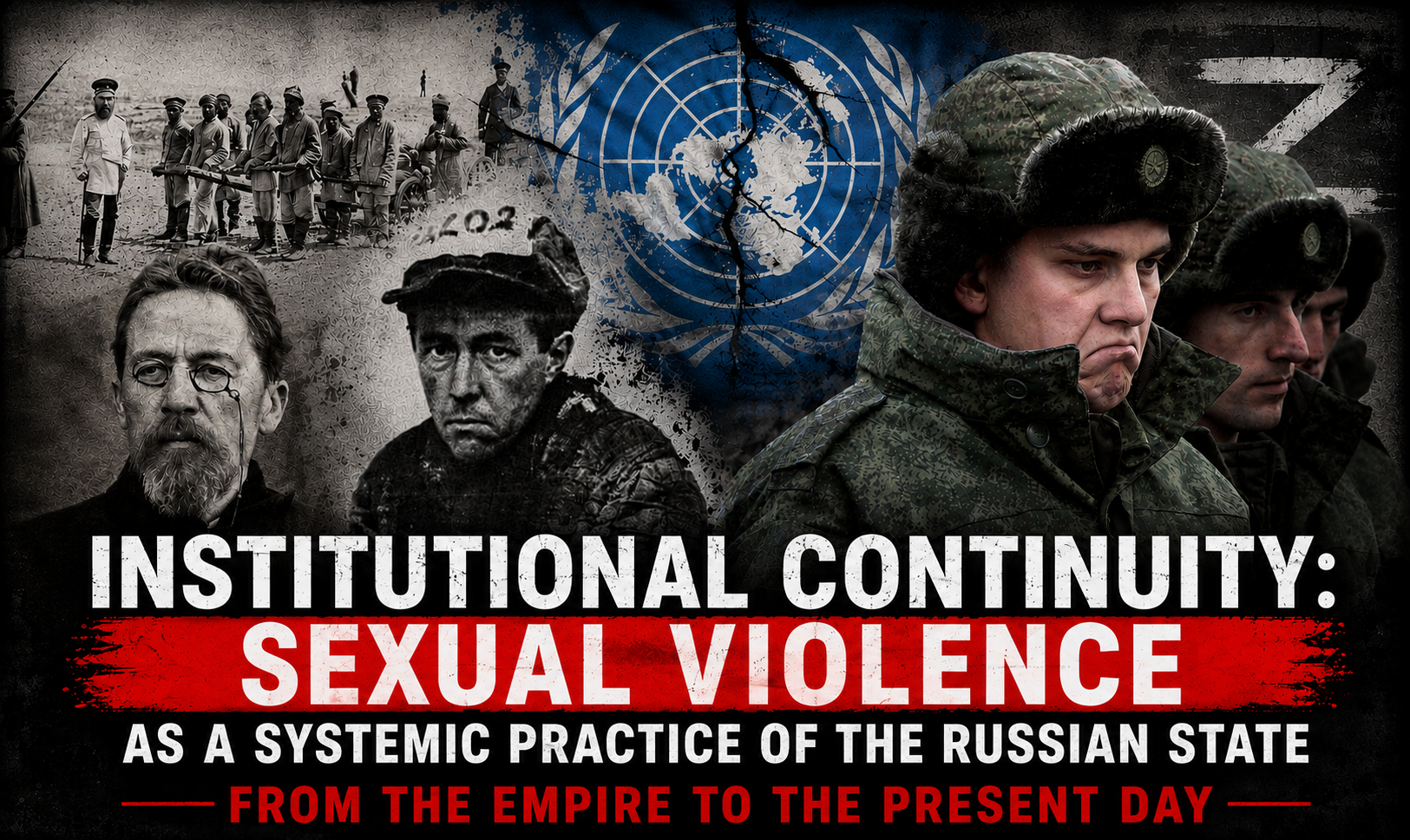
On 29 May 2026, the Secretary-General of the United Nations released his annual report on conflict-related sexual violence. For the first time, the annex listed Russia’s armed forces and security agencies — for the systematic use of sexual violence against prisoners of war and civilians detained during the war against Ukraine.
The 35-page report covers 77 state and non-state actors across 21 countries. The UN Special Representative on Sexual Violence in Conflict documented 9,788 cases in 2025 — a figure she described as reflecting “a far broader pattern of violations that remain largely invisible and undocumented.” With regard to Russia and territories under its control, 310 verified cases of sexual violence against prisoners of war and detained civilians were recorded: rape, gang rape, torture by electric shock and beatings to the genitals, and forced nudity. Russia denied UN investigators access to places of detention.
Moscow’s reaction was telling. Russia’s Permanent Representative to the UN, Vasily Nebenzya, declared that his country considered the data “groundless lies” and instead promised to prepare its own report — on Ukraine’s alleged “misconduct” toward Russian prisoners. This mirror rhetoric is itself a revealing marker: rather than rebutting specific facts, a counter-accusation is offered. Such a response confirms the thesis we develop below: in Russia, sexual violence as a practice is not perceived as something requiring substantive denial — because it is part of the normative background noise of the system.
SAKHALIN ISLAND: CHEKHOV AS WITNESS
To understand why the 2026 UN report describes not an anomaly but a continuum, it is worth turning to literature — not as artistic fiction, but as a primary source. Anton Chekhov wrote “Sakhalin Island” in 1895, following his own journey to the penal colony island. This is not a novel. It is an investigative reportage with elements of statistics and administrative analysis, written by a man with medical training and a sociological perspective.
Chekhov describes a system in which female convicts were distributed among settlers “like working livestock and household property” — literally alongside cattle in the same administrative petition: “we request that horned cattle be furnished for milk production… and women for the arrangement of domestic affairs.” He records that newly arrived women were taken to the barracks and inspected “like merchandise,” with the question of “who takes whom” settled on the very first day. The practice was not spontaneous — it was refined, ritualised, reproducible.
Particularly significant is Chekhov’s account of women asking their prospective cohabitants — “will you hurt me?” — and receiving an evasive reply about “a samovar and a cow.” The question is asked, but the system provides no answer. Violence is not denied — it is written into the price of the transaction. The administration recorded this as “joint household formation” — euphemisms that legitimised coerced cohabitation through the notarial language of orders.
What makes Chekhov particularly valuable as a witness is his refusal of sentimentality. He does not invent horrors. He registers standard practice. It is precisely in this “ordinariness” that the key to understanding the problem lies. Sexual violence and forced prostitution were not deviations from the norm of late nineteenth-century Sakhalin — they were the norm, formalised in departmental orders, articles of the “Statute on Exiles,” and instructions from the island’s commandant.
THE GULAG ARCHIPELAGO: SOLZHENITSYN AND THE CONTINUITY OF THE SYSTEM
More than half a century after Chekhov, Alexander Solzhenitsyn in “The Gulag Archipelago” documented the same system — but now in its Soviet rather than its tsarist form. The chapter “Women in the Camp” is a documentary account of how the punitive apparatus reproduced the Sakhalin experience on an industrial scale.
The ritual of the initial “distribution” of women remained unchanged across seventy years: new arrivals were led naked along a narrow corridor between privileged prisoners — “and then among the trustees it was decided who takes whom.” On their first night, women faced not an explanation of the camp regime but recruitment through “fried potatoes” and a room with a hot plate. He who offered had power. She who was offered had only the choice between capitulation and starvation.
Solzhenitsyn records the systemic logic: a woman “saves her life” by becoming a sexual object of the administration. This transaction is described with cold realism — without moral condemnation of the trustees, for they are products of the same system that also produces the victims. The crucial point: this concerns not the excesses or abuses of individual guards — it concerns a reproducible institutional mechanism that functioned from the Solovetsky Islands of the 1920s through the camp system of the 1950s. Only the language of formalisation differs — not the substance of the practice.
Solzhenitsyn’s key contribution is to show that the Soviet state did not “inherit” isolated practices from the tsarist system — it inherited an entire institutional code. A system that views an imprisoned woman as a “necessary object for the satisfaction of natural needs” (Chekhov, in the words of Sakhalin’s commandant) or as a means of “saving one’s life” at the cost of one’s body (Solzhenitsyn) is one and the same system, dressed in different uniforms.
CAUSATION: NORMALISATION AS STATE PRACTICE
Between Chekhov in 1895, Solzhenitsyn in the 1950s, and the UN report of 2026 there are not three distinct phenomena, but one prolonged one. This continuity has specific mechanisms of reproduction.
First, institutional legitimisation. From the “Statute on Exiles” to NKVD camp orders to modern filtration camps — each successive form of the Russian state produced a departmental apparatus that normalised sexual violence through bureaucratic language. Not “rape,” but “joint household formation.” Not “sexual torture,” but an “educational measure.” This language is not merely a mask — it is a mechanism of normalisation for those who carry out the acts.
Second, the absence of accountability as a systemic feature. Throughout the entire period documented by Chekhov and Solzhenitsyn, not one commandant who turned a women’s barracks into a brothel, not one trustee who distributed women as property, was ever held accountable for sexual violence. Impunity is not a consequence of the system’s imperfections: impunity is part of the system. It is precisely impunity that ensures the reproduction of the practice.
Third, social normalisation and tacit complicity. Particularly important is the aspect on which Chekhov insisted: neighbours, observing smoke rising from a new samovar, spoke “with envy” that “such-and-such already has himself a woman.” Social approval — not coerced, but voluntary — is one of the mechanisms by which the system reproduces itself. Not when the state commands — but when the neighbour envies. This is normalisation: a practice that requires no explanation or defence because it is perceived as the natural order of things.
It is precisely this third mechanism — social normalisation — that explains why Nebenzya’s reaction in 2026 is what it is. He does not rebut specific facts. He redirects attention. Because at a deep cultural level there is nothing to rebut: the practice is the norm, and there is no need to conceal it — even from oneself.
CONCLUSIONS: WHAT “SYSTEMIC PRACTICE” MEANS
Russia’s inclusion in the UN’s “blacklist” in 2026 is an important but fundamentally insufficient step. It records the symptom without examining the disease. Guterres’s report describes 310 documented cases — but those cases are the visible apex of a system whose root structure reaches back to the Sakhalin barracks of the nineteenth century.
Anton Chekhov and Alexander Solzhenitsyn — despite all the differences between them — documented one and the same thing: a state system in which sexual violence is not a malfunction, but a function. A function of control, humiliation, subjugation. A function that reproduces itself through institutional language, the impunity of perpetrators, and social approval.
Any research, any measure addressing Russia’s sexual crimes in Ukraine, must treat these not merely as an aggregate of violent acts, but as a manifestation of a deeply rooted civilisational matrix, formed over the past five hundred years. To ignore this context is to render every report a description of symptoms without a diagnosis.
Chekhov wrote of Sakhalin: “it seems to me that if these unfortunate women did not exist, the island would have had no meaning whatsoever.” The system indeed required these women — but not for the purposes it declared. Rather, to reproduce the hierarchy of power through their bodies. This logic is unchanged — from Sakhalin in 1895 to the filtration camps of 2022–2026. Only the forms have changed. The substance has remained.


