 0
0
 0
0
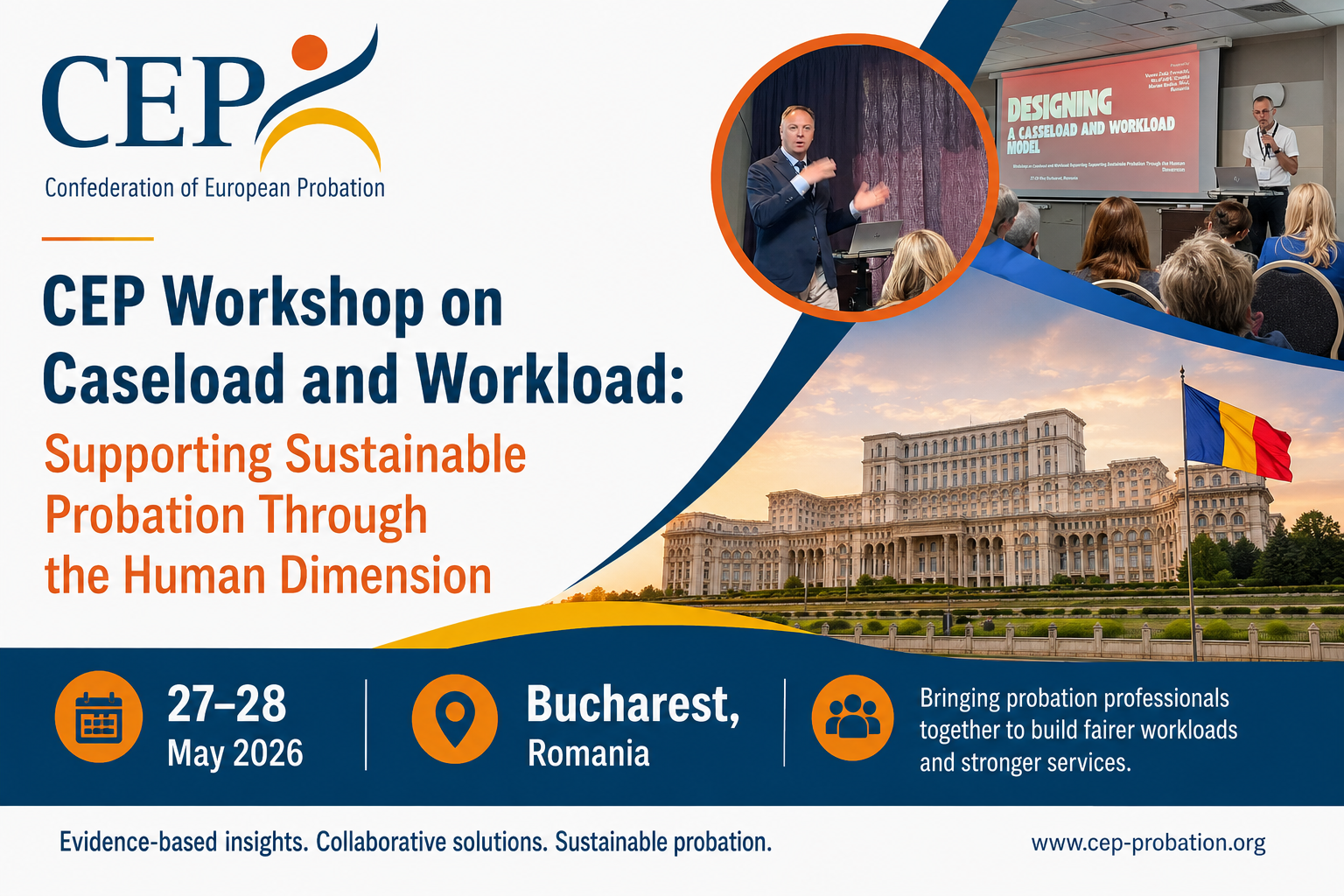
The Confederation of European Probation (CEP) convened a two-day expert workshop in Bucharest on 27–28 May 2026, dedicated to one of the most persistent structural challenges in European probation systems: the management of caseload and workload. Сo-funded by the European Union, the event brought together probation practitioners, senior administrators, and researchers from across Europe — and, notably, from as far as South Korea — under the chairmanship of CEP Secretary General Jana Špero Kamenjarin. The workshop marked the public culmination of the work of CEP’s newest Expert Group on Caseload and Workload, and presented to the broader probation community the group’s newly developed Guidelines on Caseload and Workload.
OPENING AND FRAMING
The event was formally opened by Diana Mustățea, Deputy Director General for Probation at Romania’s National Probation Directorate (Ministry of Justice), whose remarks set a clear strategic tone. Noting that Romania’s caseloads currently far exceed European averages, she underscored that the issue is “not just technical — it is strategic and deeply human.” She invoked Rule 29 of the European Probation Rules, which provides that probation staff must be “sufficiently numerous” to supervise, guide, and assist individuals effectively and humanely. Diana Mustățea identified three pillars of sustainable probation: evidence-based practice, investment in people, and institutional adaptability. CEP Secretary General Jana Špero Kamenjarin reinforced this framing, tracing the Expert Group’s origins to an earlier CEP audit that had found many high-level managers were still measuring workload as a simple count of files rather than as a weighted, qualitative measure of professional demand.
RESEARCH PERSPECTIVES
The first substantive session was delivered by Prof. Christian Ghanem (Technical University of Nuremberg), who provided a comparative research overview of caseload and workload across European jurisdictions. Prof. Ghanem drew attention to the significant variation in caseload norms across Europe — figures ranging from twenty-five to sixty or more cases per officer depending on supervision intensity and risk level — and cautioned against any single transnational benchmark. He raised what he termed the “paradox” of caseload reduction: that lower numbers do not automatically translate into better outcomes unless evidence-based practice is integrated. His data suggested that only when caseloads fall below approximately fifty-four cases and evidence-based methods are applied does recidivism reduction of around thirty percent become achievable. Prof. Ghanem also addressed the emerging impact of digital tools and AI on administrative workload, highlighting both efficiencies and risks, including the documented use of unauthorised AI tools for drafting court reports in the United Kingdom.
The morning continued with a presentation by Marian Badea and Liliana Lupsica (National Probation Directorate, Romania) together with Prof. Ioan Durnescu (University of Bucharest), exploring the human dimension of caseload within Romanian and international practice. Their contribution situated Romania’s challenges within a broader comparative context, including reference to the 2021 UK study by His Majesty’s Inspectorate of Probation, which linked high caseloads to deteriorating staff wellbeing, case quality, and recidivism outcomes. They also introduced Romania’s ongoing work to measure effective workload empirically and develop allocation standards, as well as its deployment of an e-Court File application to reduce administrative burden.
INTRODUCING THE GUIDELINES: DESIGN AND MEASUREMENT
The post-coffee session was dedicated to the formal introduction of the CEP Guidelines on Caseload and Workload, presented in two thematic components.
Vesna Zelic Ferencic (Ministry of Justice, Croatia) and Marian Badea addressed the conceptual and methodological foundations of designing a caseload and workload model, stressing that any model must distinguish sharply between the raw number of cases assigned to an officer (caseload) and the total professional demand those cases generate (workload). Croatia indicated plans to pilot the guidelines’ roadmap within the framework of the forthcoming Norwegian Financial Mechanism Programme.
Aleksandra Kerna (State Probation Service of Latvia) then presented Latvia’s workload measurement and monitoring system — widely regarded as one of the most mature such systems in Europe — as an operational exemplar embedded within the guidelines. Aleksandra Kerna traced the system’s evolution from Excel-based calculations introduced in 2008 through to its full integration into Latvia’s probation client case management system in 2020, where workload coefficients are now calculated automatically without manual input from division managers. The core formula assigns time values to each case based on function type, client risk and need level, case stage, and special categories (juveniles, violent offenders, sexual offenders), expressed as a coefficient where 1.0 represents a full workload. A senior specialist working exclusively with high-risk clients and preparing parole reports might carry twenty-four cases to reach that coefficient, while a colleague without such specialisation may carry eighty-one. The system also balances workload across Latvia’s territorial divisions, directing vacancies and supervisory support toward the most burdened units — a transparency mechanism Kerna acknowledged generates complex staff reactions, combining appreciation with anxiety about staffing implications.
ORGANISATIONAL JUSTICE, BURNOUT, AND THE “GLASS BOX”
The afternoon panel on organisational dimensions of workload proved among the most theoretically rich of the programme. Prof. Ioan Durnescu and his colleague Liliana Lupsica presented a framework drawing on organisational justice theory — distributive, procedural, and interactional justice — to argue that the subjective experience of workload is profoundly shaped not merely by caseload numbers but by how allocation decisions are made and communicated. Durnescu introduced the metaphor of the “black box” versus the “glass box”: the former characterised by opaque managerial allocation, unknown rationale, and staff complaints read as insubordination; the latter defined by visible criteria, weighted models, staff input, and individual conversations about case assignment. Prof. Ioan Durnescu estimated that organisational justice indicators can account for up to twenty-two percent of job stress variation, and cited US research demonstrating that procedurally just environments produce lower fear of victimisation and stronger commitment to reform.
Durnescu’s colleague Dr. Liliana Lupsica presented findings from a 2025 joint study conducted with Professors Charlie Brooker (Royal Holloway University) and Karen Tolk (University of Chester) on burnout in probation services. The study approached burnout not as individual deficit but as systemic vulnerability with measurable costs for organisational effectiveness and probation’s public mission. The research proposed a multi-level organisational care framework — operating at primary, secondary, and tertiary prevention levels — and the team is currently developing a standardised self-assessment scale to allow organisations to benchmark and track their own staff care practices over time. One practitioner participant in the discussion noted managing 146 cases personally, identifying externalisation of counselling programmes and increased staffing as the two most immediate remedies available; Prof. Ioan Durnescu, in turn, emphasised that greater allocation transparency — with criteria developed jointly with teams — could be implemented the very next day.
PRACTICE EXAMPLES: FLANDERS, SWEDEN, ENGLAND AND WALES
The afternoon panel moderated by Joachim Tein presented three national case studies. Ben van Heesch (Probation Agency, Flanders-Belgium) outlined the Flemish model; Ida Ulveryd (Swedish Prison and Probation Service) addressed Sweden’s strategies for managing excessive workload; and Ian Barrow (HMPPS, England and Wales) discussed England and Wales’s approach. A roundtable chaired by Tein, “A Day in the Life of a Probation Staff Member,” featured practitioner voices from France (Marie-Sophie Biggio), Romania (Stere Giaca), and Latvia (Sintija Stivriņa).
DAY TWO AND OUTCOMES
The second day (28 May) shifted to applied work, with practice laboratories organised around the guidelines themselves. Participants worked through the guidelines’ roadmap in structured groups. The morning closed with an “Idea Wall” session — What is Next? Sustainable Probation Practice — before closing remarks by Špero Kamenjarin and Mustățea.
SIGNIFICANCE
The Bucharest workshop represents a milestone in CEP’s effort to move the European probation field beyond intuitive or politically convenient caseload numbers toward empirically grounded, justice-sensitive workload management. The guidelines introduced here — informed by national models from Latvia, Croatia, Romania, Flanders, Sweden, and England and Wales — provide a flexible methodological framework adaptable to the diversity of European legal and organisational contexts. The consistent thread running through all contributions was a recognition that workload is ultimately a system problem, not an individual one: its solution lies in transparent institutional architecture, evidence-based allocation, and genuine organisational care for practitioners who stand at the intersection of public safety and human rehabilitation.
The workshop was organised by CEP’s Expert Group on Caseload and Workload and co-funded by the European Union.