 0
0
 0
0
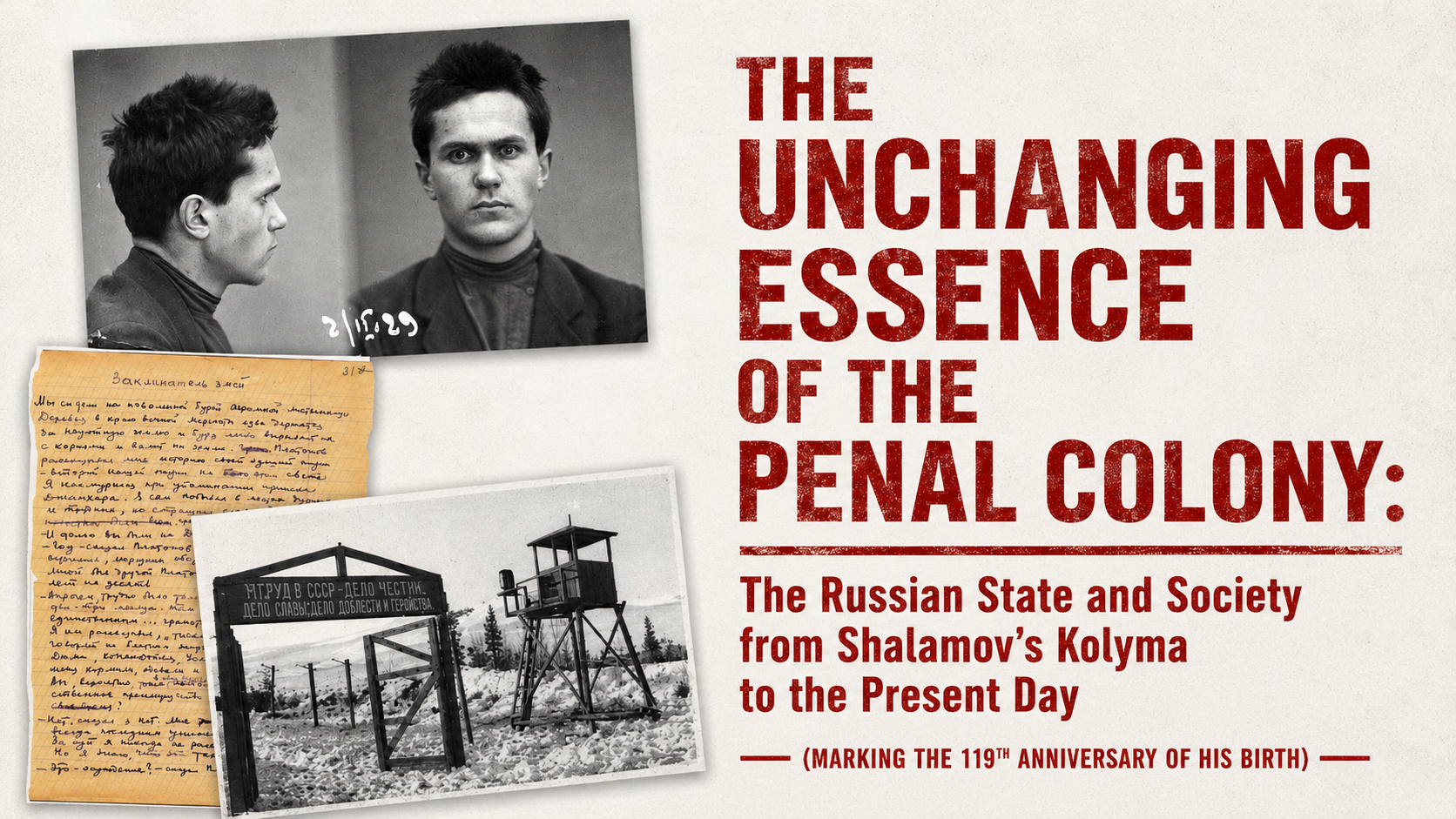
On June 18, 1907, Varlam Shalamov was born – a man fated to spend almost twenty years inside the machine that ground up the lives and destinies of millions, and to come out of it not as a broken witness but as a dispassionate clerk of the record. We remember him not as a writer in the ordinary sense – he himself insisted that the “Kolyma Tales” are not literature, that they are a new prose, a prose-document in which there is no room for invention, for catharsis, or for consolation. They are testimony. And it is precisely for this reason that one should return to them every time the temptation arises to believe that the machine has stopped.
THE OFFICE OF THE MACHINE
The machine begins not with barbed wire but with the office. Shalamov’s most terrifying document is not a description of death but a routine work report in which a living human being and a dead mechanism become grammatically indistinguishable:
“In accordance with your instruction to provide an explanation regarding the six-hour stoppage of the No. 4 brigade of convicts that occurred on 12 November of this year at the ‘Golden Key’ sector of the mine entrusted to you, I report: The air temperature in the morning was over fifty degrees below zero. Our thermometer was broken by the warder on duty, of which I reported to you. It was nonetheless possible to gauge the temperature, since spit froze in mid-air. The brigade was led out on time, but it could not set to work because the injector of the boiler that serves our sector and thaws the frozen ground refused outright to work… I have already written, everywhere I possibly could, that I can no longer work with such an injector. For five days now it has been working monstrously, and yet the fulfilment of the whole sector’s plan depends on it. We cannot manage it, while the chief engineer pays no heed and only demands cubic metres. Head of the ‘Golden Key’ sector, mining engineer L. Kudinov.
Across the report, in a clear hand, is written: 1) For refusal to work over the course of five days, which caused a disruption of production and stoppages at the sector, convict Injector is to be placed under arrest for three days without being sent out to work, and lodged in the enhanced-regime company. The case is to be handed to the investigative authorities to bring convict Injector to lawful account. 2) To chief engineer Gorev I point out the absence of discipline in production. I propose to replace convict Injector with a civilian hire. Head of the mine, Alexander Korolyov.”
The resolution, written across the page in a clear hand, does not notice the substitution – because for the machine there is none. The name of the mechanism, the injector, is read by the warder as a convict’s surname: “convict Injector is to be arrested… The case to be handed to the investigative authorities.” And this is not a clerk’s slip. It is the essence of a system for which a human being and a part were interchangeable units of the production plan, where a faulty injector and an exhausted body alike were that on which “the fulfilment of the whole sector’s plan depended”, while the chief engineer “only demanded cubic metres”. The machine did not distinguish the living from the lifeless, because both were for it merely a resource that could be arrested, replaced, written off.
THE ARITHMETIC OF HUNGER
And then the doors would open – and the arithmetic would begin, in which the price of a human life is measured in grams:
“The huge double doors swung open, and into the transit barrack came the man doling out the food… Two thousand eyes watched him from every side: from below – from under the bunks – head-on, from the side, and from above – from the height of the four-tier bunks, up which those who still had strength climbed by a little ladder. Today was a herring day… The herring was issued in the morning – half a fish every other day. What calculations of proteins and calories had been made here, no one knew, and no one took any interest in such scholastics… The process of devouring the food went on as long as the gills were sucked clean and the head was eaten away… A man who carelessly cuts the herring into portions does not always understand (or has simply forgotten) that ten grams more or less… may lead to drama, to bloody drama, perhaps. Of tears there is nothing even to say. Tears are frequent, they are understood by all, and no one laughs at those who weep.”
Here there is neither executioner nor blood – there are only ten grams that “could lead to drama, to bloody drama.” The machine attains perfection at the moment it no longer needs a warder with a club: an inattentive hand doling out the food is enough, half a herring every other day is enough, to bring two thousand eyes beneath the four-tier bunks down to the level of mere survival. The human being is not killed – he is reduced to gills, to a fish-head, to the struggle for a scrap. And no one laughs anymore at those who weep: tears have become as much a given as those fish-tails.
THE MURDER OF COLOUR
The machine destroys not only the body. It methodically destroys the very capacity for colour, for a future, for childhood:
“The notebook was small, but the boy had managed to draw in it all the seasons of his home town. Bright earth, a uniform green, as in the canvases of the early Matisse, and a blue, blue sky, fresh, clean and clear… The combination of colours in the school notebook was a truthful depiction of the sky of the Far North, whose colours are extraordinarily pure and clear and have no half-tones. ‘Better to look for a newspaper to roll a smoke.’ – He tore the notebook from my hands, crumpled it and threw it onto the heap of rubbish. The notebook began to film over with frost.”
DREAMS
It remained for the machine to take away the last thing – dreams. But even in sleep hunger does not let go:
“I fell asleep, and in my ragged, hungry sleep I saw that tin of Shestakov’s condensed milk – a terrifying tin with a cloud-blue label. Enormous, blue as the night sky, the tin had been pierced in a thousand places, and the milk seeped out and flowed in a broad stream of the Milky Way. And easily I reached up to the sky with my hands and ate the thick, sweet, starry milk.”
A terrifying tin of condensed milk, blue “as the night sky,” pierced in a thousand places, flowing as the Milky Way – and even this, the sweetest of visions, is only hunger that has taken on the form of the cosmos. The machine has colonised even the space of dreaming.
THE TWO LAWS OF THE MACHINE
From Kolyma come two laws that are by no means metaphors. In the camp they were formulas of survival; today they describe no longer the camp but an entire society. The first: “You die today, and I – tomorrow”. This is not the cynicism of a few scoundrels – it is the anthropology of a system from which moral choice has been removed along with the ration. One can survive only at another’s expense. The machine does not oblige one to hate – it merely places a person in conditions under which another’s death becomes your chance.
The second: “Aren’t you personally being raped? Then shut your mouth”. This is the law of complicity through silence – the cheapest and most reliable means by which the machine recruits millions. As long as the violence has not touched you personally, you are not a witness but a part of the silence on which everything holds. Silence here is not neutral – it is a brick in the wall.
THE MACHINE THAT DID NOT STOP
More than forty years have passed since Shalamov’s death – and the worst that can be said of present-day Russia is that it drew nothing from his testimony. Not a single lesson. “Kolyma Tales” did not become a warning for Russian society; they became, at best, an exotic curiosity and, at worst, an instruction manual. For both laws of the machine have gone nowhere – they have turned into the very mode of existence of a society that has still not emerged from the condition of collective victim and finds in that condition an exceedingly convenient alibi.
“We ourselves are victims of the system”, says this society, refusing to notice that it is itself the system; that the carceral state reproduces itself not only through coercion from above but also through consent from below – through the consensus of its subjects no less than through coercion of them. And here it is important to name the threshold plainly, for it is precisely on this seam that an attentive opponent will stumble. In the camp there truly was no choice: both laws were formulas of survival under conditions of extremity, and Shalamov records them precisely as non-moralisable – to judge a starving body for living at another’s expense would be to understand nothing. The scandal of contemporary Russian society lies elsewhere: it reproduces the camp code outside the conditions of extremity – there, where the ration suffices, where another’s death is not the condition of one’s own survival, where there is a choice. Hence the reproach is not for the code as such, but for the voluntary internalisation of an involuntary code: for the appropriation, as one’s own ethics, of what was merely the mechanics of survival of the doomed. To grant Russian society the status of collective victim is not only analytically false but also practically harmful: it lifts responsibility for colonial aggression and allows the painful question of its own agency to be avoided. Russian power is the flesh and blood of the Russian people, rooted in a five-hundred-year tradition of imperial thinking, in which the culture of the camp – from Siberian penal servitude to the GULAG – long ago ceased to be an external coercion and became an internal code – not imposed by extremity but chosen in its absence.
WHY WE REMEMBER
And yet we return to Shalamov not in order to recognise the machine once again – but in order not to become a part of it. His prose offers no consolation, because consolation would be a lie; it offers something else – immunity against the temptation to call the executioner a victim, against the arithmetic in which ten grams decide a fate, against the silence that passes itself off as neutrality. One hundred and nineteen years ago a man was born who refused to die together with his memory – and wrote it all down in a clear hand, across the report, so that no one could say “we did not know.”
The huge double doors have swung open. Behind them no longer stands the man with the tray of herring – behind them stand we ourselves, with the choice of which his characters were deprived. And the only thing we owe Shalamov on the day of his birth is not to look away.


