 1
1
 0
0
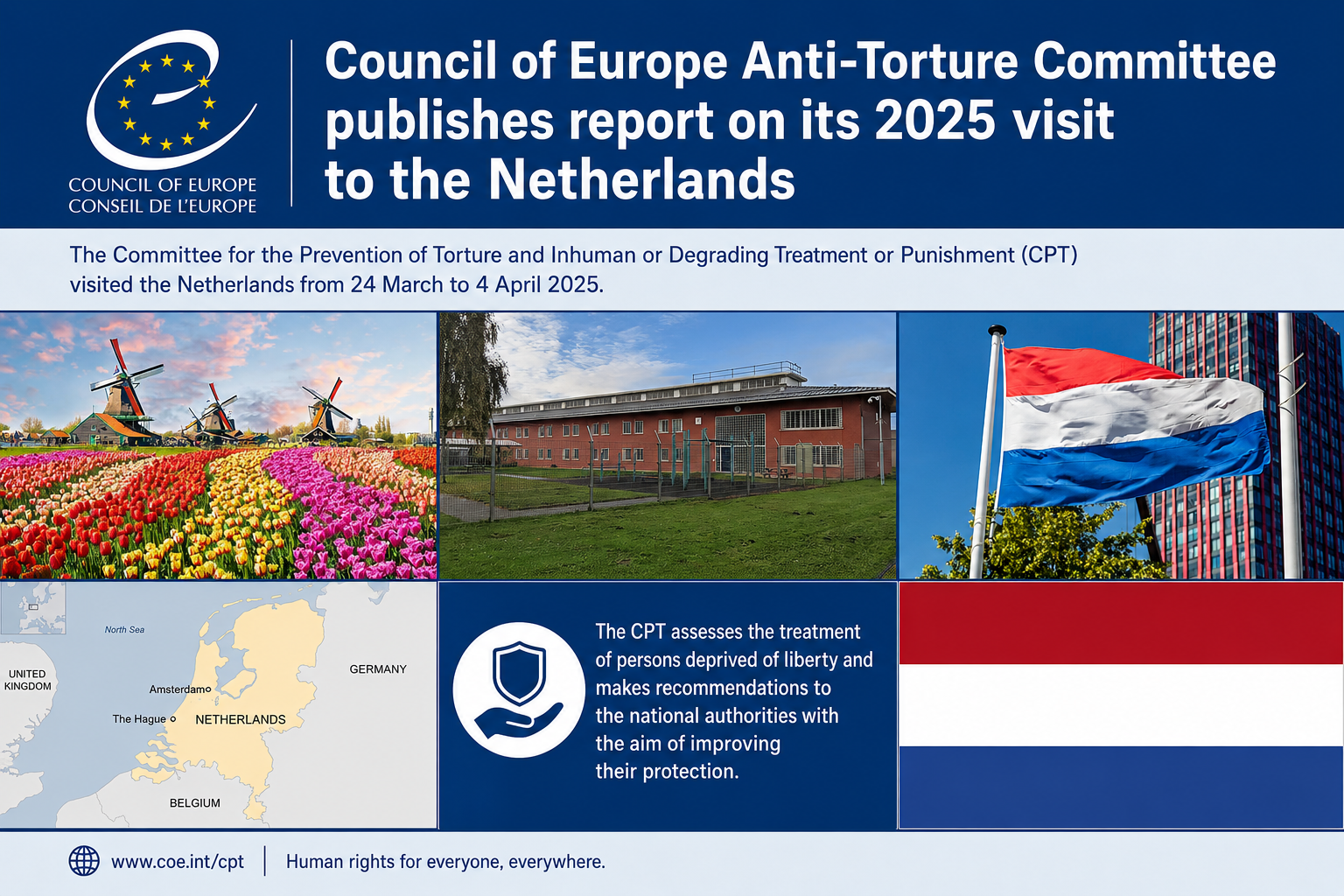
The European Committee for the Prevention of Torture (CPT) has released the report on its October 2025 visit to the Netherlands, which focused on the treatment of foreign nationals deprived of their liberty. The delegation examined two administrative immigration detention facilities – the Schiphol and Rotterdam Detention Centres – and one penal establishment, Ter Apel Prison, all of which hold foreign nationals without legal status.
A central theme of the report is the long-stalled reform of the legal framework for immigration detention. Since 2007 the CPT has urged that facilities for territorial detention be taken out of the scope of the Penitentiary Principles Act, and the Dutch authorities themselves share this view. Yet the “Return and Detention of Foreign Nationals” Bill (Wet terugkeer en vreemdelingenbewaring), first introduced in Parliament back in 2014 to establish a single legal basis for administrative immigration detention, had still not been adopted at the time of the report.
The Committee is sharply critical of two features of the current draft. The regime envisaged for border detention could prove more restrictive than the one already in force, and the draft not only retains solitary confinement as a disciplinary sanction in territorial detention but extends it to border detention – running counter to the Dutch prison service’s own efforts to curtail solitary confinement because of its proven harm.
The report also notes that the overall use of immigration detention is falling: around 4,400 foreign nationals were detained under immigration law in 2024, down from 7,812 in 2010 – a reduction of roughly 44% over fourteen years. At the same time, the authorities’ multi-year priority of reducing “nuisance” caused by certain asylum seekers, through accelerated processing and a focus on return, has reshaped the detained population. At Rotterdam DC the CPT found a concentration of people with complex physical and mental health needs and substance-use disorders whom the facility could not adequately care for, fuelling inter-detainee violence and frequent interventions by the Emergency Response Team.
At Ter Apel Prison, which mainly holds sentenced foreign nationals awaiting removal, the Committee praised the activities, education and work on offer, but again found a high proportion of prisoners with mental-health and addiction problems whose needs went unmet. It judged the prison’s Extra Care Unit unfit for purpose – too large, sharing premises with a regular unit, and lacking suitably qualified staff.
Finally, the CPT addressed the Netherlands’ well-established complaints system, which now buckles under rising caseloads, with months often passing between a complaint and its resolution. The Committee called on the authorities to reinforce its effectiveness, confidentiality and independence, and to adapt procedures to the realities of short-term immigration detention so that the right of complaint remains a genuine remedy.
The Dutch authorities have responded, setting out the measures taken in answer to the Committee’s recommendations.
📄 Report (EN): https://rm.coe.int/48802c3a25
📄 Executive summary and observations (EN): https://rm.coe.int/48802c3a24
📄 Government response (EN): https://rm.coe.int/48802c3a27
🔗 Source: www.coe.int


