 1
1
 0
0
Contemporary migration crises – whether controlled, provoked, or spontaneously unfolding – arguably provide the most illustrative empirical material for studying the erosion of the absolute prohibition of ill-treatment. Whereas ill-treatment was previously analyzed predominantly as a product of the penitentiary system or criminal justice structures, migration policy increasingly demonstrates the transplantation of that very same logic of social control onto the police, migration service, and border guard institutions – that is, onto structures that formally do not belong to the penitentiary system but perform a functionally analogous role with respect to migrants: the role of an instrument for containing, displacing, and disciplining the body of the “stranger.” In Zygmunt Bauman’s terminology, this distinction is precisely captured by the opposition between “tourists,” whose mobility is encouraged and serviced, and “vagabonds,” whose mobility is subject to maximal restraint and control; it is migrants, stateless persons, refugees, and exiles who are the first to fall into the category of “vagabonds” (Bauman, 2004; Bankovskaya, 2008). The central thesis is that, in the contemporary world, ill-treatment of migrants is not an accidental excess on the part of individual actors but a collateral, yet entirely predictable, product of a broader system of social control, one built under the banner of a “high social mission” to protect the population, while in reality serving to shield political elites from the electoral risks associated with uncontrolled migration.
THE LETTER OF THE NINE STATES AND INSTITUTIONAL PRESSURE ON THE EUROPEAN COURT OF HUMAN RIGHTS
On 22 May 2025, at the initiative of Denmark and Italy, nine Council of Europe member states (Austria, Belgium, Czechia, Denmark, Estonia, Italy, Latvia, Lithuania, and Poland) published a joint letter calling for a “new and open-minded conversation” about how the ECtHR interprets the Convention, focusing above all on the Court’s case law in the migration sphere (Governments of Denmark et al., 2025). In the preamble to the letter, its signatories declared their commitment to the rule of law and the protection of human rights, while at the same time asserting that the Court “has in some cases extended the scope of the Convention too far compared with the original intentions behind it,” thereby shifting the balance between individual rights and the ability of democratically elected governments to make decisions in the interests of their own populations.
Formally, the letter had no legal force and was not directed against any specific migrant; in substance, however, it was directed less against migrants than against the ECtHR itself – it was a political manifesto asserting the democratic legitimacy of elected governments and their freedom of action, which, in the signatories’ view, was constrained by the Court’s interpretations. The Secretary General of the Council of Europe, Alain Berset, in his response of 24 May 2025, emphasized that the ECtHR is not an external body but the judicial arm of the Council of Europe, established by the member states themselves and bound by the Convention, which all 46 states freely signed and ratified, and warned that the Court “must not be turned into a weapon – neither against governments, nor by governments themselves” (the Court must not be weaponized – neither against governments, nor by them) (Berset, 2025).
This “letter of the nine” launched a process that, over the following year, acquired institutionalized form: on 10 December 2025, on World Human Rights Day, an informal ministerial conference took place in Strasbourg, culminating in a joint communiqué from what had by then become 27 Council of Europe states (including the United Kingdom), and on 15 May 2026 the Committee of Ministers adopted the so-called Chișinău Declaration, devoted to the ECtHR’s case law in the migration sphere. The Declaration formally affirms that migrants remain protected by the Convention, while at the same time directly acknowledging the phenomenon of “the instrumentalization of migration.” The instrumentalization of migration is understood as situations in which migratory flows, including irregular border crossings, are deliberately facilitated, encouraged, or used by another hostile or rival state – or by another actor, in some cases through the use of force – for the purpose of exerting pressure on another state and on European democracies, destabilizing or undermining them. This can be regarded as a relatively new contemporary phenomenon, arising in a specific geopolitical and security context, one that poses particular challenges for territorial integrity and national security and also risks undermining support for, and the integrity of, the Convention system. In fact, the concept is new only in a qualified sense; in the academic literature, this phenomenon is described through the concept of “the instrumentalization of migration” – the strategic engineering of migration flows, which the American researcher Kelly Greenhill divides into several types: coercive instrumentalization (aimed at extracting political concessions from another state), instrumentalization for the purpose of expropriation (displacing certain population groups in order to seize territory), and economically motivated instrumentalization (Garcés Mascareñas, 2021).
The Declaration calls for “new approaches” to respond to the challenges associated with mass, irregular arrivals, including the examination of applications for international protection in third countries and the establishment of return hubs outside the territories of destination states.
It is characteristic that, in the text accompanying earlier drafts of the Declaration, the minimum threshold of severity of ill-treatment required to find a violation of Article 3 of the Convention is explicitly described as relative and dependent “on all the circumstances of the case,” and it is proposed that this threshold be applied in such a way as to avoid “unnecessary restrictions” on decisions to expel or extradite foreign nationals.
The Committee of Ministers expressed concern that, in cases where a person cannot be extradited to face prosecution or serve a criminal sentence for a serious offence, this may lead to impunity, allowing the person to escape justice in the country where the offence was committed simply because they left that country. All possible measures should therefore be taken to avoid this, in accordance with the Convention’s obligations. This is a very distant, yet important, example of the veiled legitimization of a very gradual lowering of the threshold of ill-treatment specifically with respect to migrants: a prohibition that is absolute by its very nature is turned into a relative one through the procedural rhetoric of “balance” and “context.”
What is very interesting is that the Declaration emphasizes that the ECtHR has rarely found a violation of Article 3 of the Convention in cases of removal or extradition to a state with a long democratic tradition and respect for human rights, since the Convention does not require contracting states to impose their standards on other states, and that domestic courts should therefore apply the Court’s case law concerning contracting states with caution when assessing Article 3 risks in states that are not parties to the Convention, having regard to detention conditions or access to socio-economic support.
It seems appropriate to recall Zygmunt Bauman’s view that bureaucratic selection mechanisms, similar to “return hubs,” are an institutionalized variant of the old division of global space into “tourists” and “vagabonds”: global economic and political elites are given the “green light” for free movement, while migrants, asylum seekers, and persons with “suspect” immigration status are systematically given the “red light,” which materializes precisely in facilities located outside the territory of the destination state (Bauman, 2004). By legitimizing such facilities at the highest interstate level, the Chișinău Declaration transforms this distinction from a de facto practice into a recognized element of public order.
THE CEUTA CASE (JULY–AUGUST 2026) AS A PARADIGM OF THE INSTRUMENTALIZATION OF MIGRATION
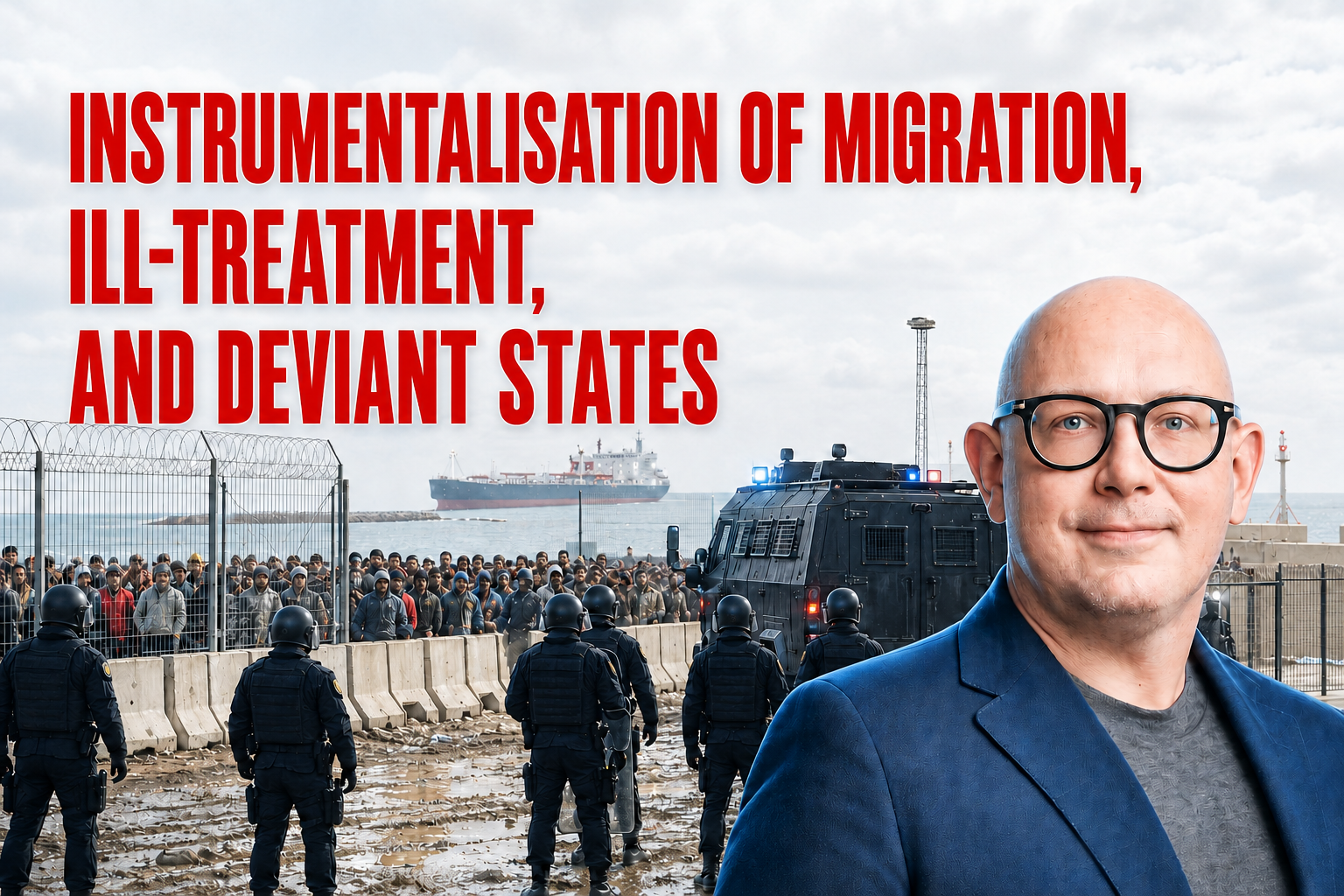
If the “letter of the nine” illustrates the institutional, diplomatic dimension of the gradual, subtle, and almost invisible erosion of the absolute prohibition, then the crisis that unfolded in late July 2026 around the Spanish exclave of Ceuta on the North African coast provides an extraordinarily vivid, though perhaps overly radical, example for the overall picture of this process.
During 30–31 July 2026, between 49,000 and 73,000 people crossed the border between Morocco and Ceuta (a city with a population of around 85,000) in an irregular manner, most of them Moroccan nationals, among whom, according to some estimates, were up to a thousand unaccompanied minors (France 24, 2026a). The immediate trigger for the mass influx was a wave of disinformation on social media that misrepresented a ruling of Spain’s Supreme Court of 8 July 2026, which restricted the practice of the “hot return” (devoluciones en caliente) of persons intercepted at sea, as supposedly an opening of the border. The consequences proved tragic: more than 80 people died, either by drowning or being crushed in the crush of the crowd; most of those who arrived voluntarily returned to Morocco over the following days or were sent back through border crossing points, but several thousand people, including children, remained on the Ceuta coastline as of mid-August 2026, without shelter, water, or medical assistance (France 24, 2026b).
It has not been definitively established whether the July 2026 movements were deliberately organized by the Moroccan side; nevertheless, according to certain accounts, the arrival of migrants at the Moroccan border had a somewhat organized and, at the same time, guaranteed (that is, effectively tolerated by the border guard) character, which gives grounds for speaking of the destabilization of the regional situation as a probable objective – which, in turn, points to the pertinence of the Chișinău Declaration’s concern with the instrumentalization of migratory movements.
It is telling that, just a few weeks after the peak phase of migration pressure, the Moroccan side – instead of de-escalating or cooperating constructively with Spain in resolving the humanitarian crisis – resorted to reviving and sharpening its territorial claims to Ceuta and Melilla: Morocco’s Minister of Justice, Abdellatif Ouahbi, publicly asserted “historical and geographical” rights over both enclaves and proposed establishing a bilateral dialogue mechanism, the ultimate goal of which would be their integration into Morocco (Thykjaer, 2026). The Spanish side categorically rejected these claims, emphasizing the sovereign status of Ceuta and Melilla as part of the territory of the European Union (Thykjaer, 2026).
Such a sequence of events – first a sharp and orchestrated build-up of migration pressure, then, synchronously with it, the assertion of political demands not directly related to migration issues as such – is a typical pattern of conduct customarily described as the instrumentalization of migration. This strengthens, rather than weakens, the argument in favor of the applicability of the Chișinău Declaration to the Moroccan–Spanish case, since the temporal coincidence of the humanitarian crisis and the territorial claims is in itself a significant indirect indication of deliberate instrumentalization, even in the absence of direct evidence of centralized planning of the movements themselves (Thykjaer, 2026, August 22).
The 2026 crisis in Ceuta was already the second episode of this kind over the past five years: in May 2021, after Spain admitted the leader of the Polisario Front, Brahim Ghali, for COVID-19 treatment, Morocco relaxed its border controls, as a result of which around 10,000 people arrived in Ceuta – an episode that international relations experts unambiguously characterized as the use of migration to exert political pressure on Madrid.
It is telling that the crisis is unfolding against the backdrop of a broader geopolitical context: the Moroccan side has historically claimed sovereignty over Ceuta and Melilla, and some commentators have drawn parallels with the Moroccan Green March of 1975 and with Belarus’s instrumentalization of migration against Poland in 2021. At the same time, Spanish officials and part of the international media put forward alternative hypotheses – ranging from economic hardship and the frustration of Moroccan youth (unemployment among 15–24-year-olds reached 37.2% in 2025) to a geopolitical “settling of scores” linked to Spain’s refusal to provide the Rota and Morón air bases for US and Israeli operations in connection with the Iran–Israel conflict, and to Madrid’s diplomatic rupture with Tel Aviv (Regragui, 2026). What matters here is not the definitive establishment of the Moroccan side’s motives, but the very structure of the Spanish state’s and the European community’s response, which consistently reproduces the logic described earlier in relation to the “deviant state”: a state confronted with a threat (whether real or instrumentalized) consistently expands the boundaries of permissible ill-treatment, legitimizing this by the need to protect “our own” from “outsiders.”
FROM “HOT RETURNS” TO RUBBER BULLETS: THE BANALITY OF VIOLENCE AND THE SOCIETAL DEMAND FOR IT
The most troubling aspect of the Ceuta crisis was not so much the sheer scale of the border crossing as the public reaction to it – a reaction that revealed the existence, within the host society, of a pronounced demand for ill-treatment of migrants. Footage of police officers firing rubber bullets at migrants, and of individual local residents resorting to vigilante violence and setting dogs on the newly arrived, could shock no less than footage of the mass crossing itself. This duality – simultaneous outrage at the brutality shown toward migrants and a silent, or even open, approval of a “heavy hand” in response – is empirical confirmation of the thesis that ill-treatment in the migration context is not an excess on the part of individual actors, devoid of societal support. On the contrary, it is produced by the very societal demand for the restoration of control, and this demand is used by the state (and above all by its political elites) as a legitimizing resource for expanding the discretion of law enforcement structures.
This observation regarding the societal demand for harshness stands in direct conceptual connection with Zygmunt Bauman’s thesis on the construction of the “punitive city” (punitive city) as a spatial reflection of a new social stratification: “The elites have themselves chosen isolation. The elites pay for isolation willingly and generously. The rest of the population is forcibly ‘cut off’ and compelled to pay a high cultural, psychological, and political price for their isolation. Those who are unable to make separate existence a matter of free choice and to pay the cost of their own security become victims of the modern-day equivalent of the ‘enclosures’ of the late Middle Ages and early Modern period” (Bauman, 2004, p. 36). From this perspective, the local residents of Ceuta who set dogs on the newly arrived, and the police officers who fired rubber bullets, are not an anomaly but a manifestation of that very same logic of communal self-defense which, unlike the global elites, lacks the resources for voluntary, privileged isolation from the stranger and therefore resorts to violent isolation instead. It is telling that, in Bauman’s view, it is precisely the avoidance of contact with the “other,” rather than solidarity, that has become the leading survival strategy in the contemporary megacity: “The question of whether or not you like your neighbor is no longer relevant. Keep your distance from your neighbors, and you will not face this dilemma or the need to choose: you simply will not be presented with the opportunity to choose between love and hatred” (Bauman, 2004, pp. 72–73). It is precisely this preventive renunciation of moral choice in favor of isolation that structurally enables the tacit societal legitimation of violence against migrants described above.
Herein lies the fundamental difference from classic cases of torture in penitentiary institutions: whereas ill-treatment in pre-trial detention facilities or correctional colonies is traditionally concealed from society and only rarely becomes public knowledge, violence against migrants at the border increasingly takes place publicly, is broadcast live, and receives tacit, and at times openly expressed, societal legitimation. Political elites, for their part, prefer to “turn a blind eye” to such ill-treatment, characterizing it as an unfortunate yet understandable by-product of the fight against irregular migration rather than as a systemic problem requiring investigation and the prosecution of those responsible.
The Spanish government, for instance, in its official narrative of the events in Ceuta, consistently reduced the causes of the crisis to disinformation campaigns and human smuggling networks, avoiding any acknowledgment – even indirect – of the responsibility of the neighboring state or of its own structural vulnerabilities at the southern border, while Prime Minister Pedro Sánchez simultaneously and publicly characterized these events as a “violation of Spain’s territorial integrity” (Marí-Klose & Molina, 2026). This contradiction between the rhetoric of “attack” and the practice of “disinformation” is telling: it allows the state simultaneously to dramatize the threat in order to justify harsher measures, while downplaying its responsibility for the consequences of those measures for the bodies of specific individuals.
LEGAL ASSESSMENT: IS THERE A DUTY TO CONTROL BORDERS, AND DOES ARTICLE 3 OF THE CONVENTION ADMIT OF EXCEPTIONS
From a legal standpoint, the Ceuta crisis has provided additional and new grounds for discussion of how genuinely absolute the principle of the absolute prohibition of torture is, and whether it admits of exceptions in the context of instrumentalized migration. International law doctrine is increasingly debating whether states bear a positive obligation to control their own borders – a question that has acquired particular urgency in connection with the case of Lithuania v. Belarus, currently pending before the International Court of Justice, and with a number of cases awaiting examination by the ECtHR (Pérez-González, 2026; International Court of Justice, n.d.).
The right of a state to control the entry and stay of foreign nationals on its territory is traditionally regarded as a sovereign right that is not disputed either by the ECtHR or by international law in general; however, the characterization of this right as a legal obligation – with its own specific legal basis and content – is far more contentious. One possible source of such an obligation is considered to be states’ obligations to counter the smuggling of migrants under the Protocol against the Smuggling of Migrants by Land, Sea and Air, supplementing the United Nations Convention against Transnational Organized Crime; however, Morocco is not a party to this Protocol, and the obligations arising from the 2018 Global Compact for Safe, Orderly and Regular Migration are political rather than legally binding in character.
Of fundamental importance for the purposes of this study is a different conclusion reached by contemporary doctrine: even if it is proven that a neighboring state deliberately facilitated or encouraged irregular movements for the purpose of exerting pressure on the destination state, this does not in itself alter the scope of the individual obligations that the destination state owes to persons within its jurisdiction. The wrongful conduct of one state does not in itself create a legal basis for weakening the obligations that another state independently owes to specific individuals. This concerns above all the principle of non-refoulement and the best interests of the child with respect to unaccompanied minors.
An analogous conclusion was formulated even earlier by the Court of Justice of the European Union in the case of M.A. (C-72/22 PPU) (Court of Justice of the European Union, 2022), delivered against the backdrop of Belarus’s instrumentalization of migration against Lithuania: neither an extraordinary mass influx nor the irregular status of entry can, in itself, justify a refusal to grant access to the asylum procedure or the detention of an applicant solely on the ground of irregular entry.
Nor can the ECtHR’s judgment in N.D. and N.T. v. Spain [GC] (ECtHR, 2020), frequently invoked by proponents of expanding states’ discretion in the migration sphere, be regarded as an exception to this rule: that case concerned the specific factual circumstances of the immediate collective return of persons who had attempted to artificially exploit the sheer scale of a fence-storming incident in order to avoid an individual procedure, and it does not establish a general exception to the absolute character of Article 3 of the Convention or to the principle of non-refoulement.
Indeed, N.D. and N.T. v. Spain [GC] (applications nos. 8675/15 and 8697/15, Grand Chamber judgment of 13 February 2020) concerns the so-called “hot returns” of migrants at the border of the Spanish enclave of Melilla: the applicants, having scaled the border fence with Morocco as part of a group of 75–80 people, were immediately handed back to the Moroccan authorities without any individual procedure. Although the Court found that a collective expulsion had taken place without an individual examination of the applicants’ cases, no violation of Article 4 of Protocol No. 4 to the Convention was found. The Grand Chamber based this on the doctrine of the applicants’ own conduct, pointing to the absence of “cogent reasons” for their failure to use the legal channels of entry available to them (the Beni Enzar border crossing point, or applications for asylum or a visa at consular offices). This judgment significantly narrowed the standards of protection against collective expulsion in situations of mass, spontaneous border crossing and has been criticized in the doctrine for shifting the burden onto the victims of expulsion.
The legally correct response to the wrongful conduct of a state responsible for the instrumentalization of migration lies within the sphere of the law of international state responsibility – retorsions, countermeasures within the limits permitted by international law, and diplomatic and political instruments – rather than within the sphere of removing the guarantees that protect specific individuals from refoulement. It is precisely this substitution – the attempt to justify a weakening of individual guarantees by reference to the international wrongfulness of a third state’s conduct – that constitutes the “temptation” to which, in the view of a substantial part of the doctrine, the initiators of both the “letter of the nine” and the Chișinău Declaration have succumbed. It is telling that these two processes – diplomatic pressure on the ECtHR and the actual crisis at the border – form a single discursive continuum: the former legitimizes the lowering of the Article 3 threshold “in advance,” at the level of principles, while the latter does so after the fact, at the level of the concrete law-enforcement and factual practice of states.
MIGRATION-RELATED STATE DEVIANCE: DOES THE CHIȘINĂU PROCESS FIT THE “DEVIANT STATE” MODEL
The concept of the “deviant state” has previously been used by the author to denote a type of state conduct in which officially declared commitment to absolute human rights standards is systematically combined with institutional connivance at their violation, where the latter is deemed instrumentally useful for achieving a declared “higher” goal – whether combating crime or restoring control over borders. The Chișinău process of 2025–2026 gives grounds for asking whether it is no longer merely an individual state, but the entire Council of Europe system as such, that is turning “deviant.” Unlike the classic case of a deviant state that violates standards “silently,” concealing ill-treatment from international oversight, what is at issue here is an open, institutionalized attempt to normatively legitimize a lowering of the threshold of protection – not through a violation of the Convention, but through its simultaneous “reinterpretation” by individual contracting states. This is a qualitatively new level of erosion: whereas traditional deviance in state conduct in the penitentiary sphere presupposes a conflict between state practice and the standard it has itself recognized, the Chișinău Declaration seeks to eliminate the conflict itself by changing – or at least blurring – the standard, while retaining the rhetoric of commitment to human rights.
It is telling that the process of adopting the Declaration was accompanied by a steady expansion of the circle of initiating states: from the nine signatories of May 2025 to the twenty-seven participants in the December communiqué, and eventually to consensual approval by all forty-six Council of Europe member states in May 2026. This expansion is in itself a telling indicator of just how effectively the mechanism of normalization operates: what critics not without reason characterized in May 2025 as an attempt to subordinate an independent judicial body to political expediency had, a year later, become the consensus position of practically the whole of Europe.
Human rights organizations, including the PICUM network, which represents the interests of undocumented migrants in Europe, have characterized the final Declaration as a direct attack on the Convention and on the authority of the Court (Nielsen, 2026, May 15). At the same time, the official position of the Committee of Ministers insists that what is at issue is not a revision of standards but merely a “clarification” of the fundamental principles of the Convention system in the context of migration. This terminological game – “clarification” instead of “revision” – is a typical device for legitimizing a lowering of protection standards: it allows states to formally avoid accusations of violating their Convention obligations while, in fact, changing the practical consequences of applying Article 3 of the Convention for specific, most vulnerable categories of persons.
Moreover, this concern was also echoed at the level of UN special procedures: independent human rights experts, including the Special Rapporteur on the human rights of migrants, emphasized that the Chișinău Declaration effectively entrenches the priority of coercive migration control over states’ human rights obligations, expanding practices of detention and return of migrants, diminishing guarantees of due process, and opening the way to the extraterritorial processing of asylum applications and the creation of so-called “return hubs” in third countries whose safety for migrants has not been established. In the experts’ view, these approaches create a real risk that contracting states, under cover of declaratory rhetoric about “clarification,” are in fact leading to the normalization of human rights violations, including cases of death, torture, ill-treatment, enforced disappearance, or the persecution of migrants – which directly contradicts the absolute character of the prohibition of torture enshrined in Article 3 of the Convention, a prohibition that admits of no derogation or exception even in the context of managing migration processes (UN Office of the High Commissioner for Human Rights, 2026, June 9).
In this sense, the migration policy of contemporary European states appears not merely as yet another example of ill-treatment but as a laboratory in which mechanisms for legitimizing cruelty are being tested – mechanisms that may later be transferred, or more precisely, returned, to the “classic” spheres of application of Article 3 of the Convention, including the penitentiary system and law enforcement activity in general. This potential retransmission of violence into “classic” spheres is taking place against the backdrop of what Zygmunt Bauman described as the symbolic collapse of the very idea of the prison as an instrument of correction: “today the question of ‘rehabilitation’ is not so much debatable as it is simply irrelevant,” and what matters most for contemporary penitentiary practitioners is no longer a declaration of ‘rehabilitative intentions’ but the very fact of isolation: “What prisoners do in their individual cells concerns no one. What matters is that they are simply there” (Bauman, 2004, pp. 156–159).
This thesis describes with equal precision the function of contemporary migrant detention centers, where the discourse is no longer one of “correction” or “integration,” but simply of the physical isolation of unwanted persons as such. The logic of “exceptional circumstances,” which justifies a weakening of guarantees with respect to migrants as a group supposedly situated outside the ordinary legal order, is structurally identical to the logic historically employed by states to justify the torture of persons suspected of terrorism or particularly serious crimes – a logic that the Court, in its earlier case law, has consistently rejected, affirming that Article 3 of the Convention admits of no exceptions regardless of the victim’s conduct or the nature of the threat facing the state. It is precisely for this reason that the consistent preservation of this principle unchanged with respect to migrants carries significance that extends far beyond migration issues as such: it is a test of the viability of the entire architecture of absolute human rights in Europe.
CONCLUSIONS
The analysis of material relating to the 2026 migration crisis in Ceuta and the institutional pressure exerted by nine, and subsequently twenty-seven, Council of Europe member states on the European Court of Human Rights confirms the central thesis of this study: ill-treatment of migrants is not an accidental excess but a systemic, structurally conditioned, and at the same time entirely predictable by-product of the expansion of mechanisms of social control beyond the traditional penitentiary system into the structures of the police and border control. The artificial nature of a significant portion of this ill-treatment manifests itself in at least three interrelated dimensions:
first, in the veiled lowering of the legal threshold of acts prohibited under Article 3 of the Convention through diplomatic and political rhetoric of “balance” and “new approaches”;
second, in the practical legitimization of violence against migrants by law enforcement structures and even by individual segments of the population, where political elites knowingly “turn a blind eye” to such violence, characterizing it as a collateral, yet justified, consequence of the “high social mission” of protecting the population;
third, in the very structure of the societal demand that transforms collective anxiety about irregular migration into tacit approval of cruelty.
The principle of the absolute prohibition of torture and inhuman or degrading treatment remains absolute de jure; yet the Ceuta case, like the year of diplomatic siege of the ECtHR that preceded it, convincingly demonstrates that, de facto, this principle, under the pressure of migration issues, is undergoing the most systemic and concerted erosion in the entire history of the application of Article 3 of the Convention.
REFERENCES
Bankovskaya, S. (2008). Chuzhaki i granitsy: K ponyatiyu sotsial’noy marginal’nosti [Strangers and boundaries: Toward the concept of social marginality]. In A. Filippov (Ed.), Sotsiologicheskaya teoriya: istoriya, sovremennost’, perspektivy [Sociological theory: History, modernity, prospects] (pp. 389–396). Saint Petersburg.
Bauman, Z. (2004). Globalizatsiya: Posledstviya dlya cheloveka i obshchestva [Globalization: The human consequences] (M. L. Korobochkina, Trans.). Ves Mir Publishing House. (Original work published 1998)
Berset, A. (2025, May 24). Alain Berset on the joint letter challenging the European Court of Human Rights. Council of Europe. https://www.coe.int/en/web/portal/-/alain-berset-on-the-joint-letter-challenging-the-european-court-of-human-rights
Court of Justice of the European Union. (2022). M.A. v. Valstybės sienos apsaugos tarnyba, Case C-72/22 PPU, ECLI:EU:C:2022:505.
European Court of Human Rights. (2020). N.D. and N.T. v. Spain [GC], Application nos. 8675/15 and 8697/15.
France 24. (2026a, August 18). In Ceuta, migrants stranded at Europe’s gates await their fate. https://www.france24.com/en/europe/20260818-ceuta-migrants-stranded-europes-gates-await-their-fate
France 24. (2026b, August 19). ‘We won’t go back’: Young Moroccan migrants in Ceuta refuse to abandon their European dream. https://www.france24.com/en/europe/20260819-we-won-t-go-back-young-moroccan-migrants-ceuta-refuse-abandon-european-dream
Garcés Mascareñas, B. (2021, May). Ceuta: The weaponisation of migration (Opinion CIDOB 669). Barcelona Centre for International Affairs. https://www.cidob.org/en/publications/ceuta-weaponisation-migration
International Court of Justice. (n.d.). Alleged smuggling of migrants (Lithuania v. Belarus). https://www.icj-cij.org/case/200
Governments of Denmark, Italy, Austria, Belgium, Czechia, Estonia, Latvia, Lithuania, and Poland. (2025, May 22). Open letter on the interpretation of the European Convention on Human Rights [Letter]. Presidenza del Consiglio dei Ministri. https://www.governo.it/sites/governo.it/files/Lettera_aperta_22052025.pdf
Marí-Klose, P., & Molina, I. (2026, August 7). In the Ceuta crisis, both Spain and the EU need to do better. Internationale Politik Quarterly. https://ip-quarterly.com/en/ceuta-crisis-both-spain-and-eu-need-do-better
Nielsen, M. L. (2026, May 15). European countries urge rethink of human rights on migration. Euractiv. www.euractiv.com/news/european-countries-urge-rethink-of-human-rights-on-migration/
Pérez-González, C. (2026, August 18). Must states control their borders? The Ceuta crisis and international law. EJIL: Talk! – Blog of the European Journal of International Law. https://www.ejiltalk.org/must-states-control-their-borders-the-ceuta-crisis-and-international-law/
Regragui, O. (2026, August 7). Beyond the border: Four hypotheses on the migration crisis in Ceuta. Geopolitical Monitor. https://www.geopoliticalmonitor.com/beyond-the-border-four-hypotheses-on-the-migration-crisis-in-ceuta
Thykjaer, C. (2026, August 22). Amid the Ceuta crisis, Morocco has raised territorial claims against Spain. Euronews. https://ru.euronews.com/my-europe/2026/08/22/spain-rejects-morocco-ceuta-melilla
United Nations Office of the High Commissioner for Human Rights. (2026, June 9). Chișinău Declaration risks weakening protections for migrants, undermines absolute prohibition of torture: UN experts. OHCHR. www.ohchr.org/en/press-releases/2026/06/chisinau-declaration-risks-weakening-protections-migrants-undermines


