 0
0
 0
0
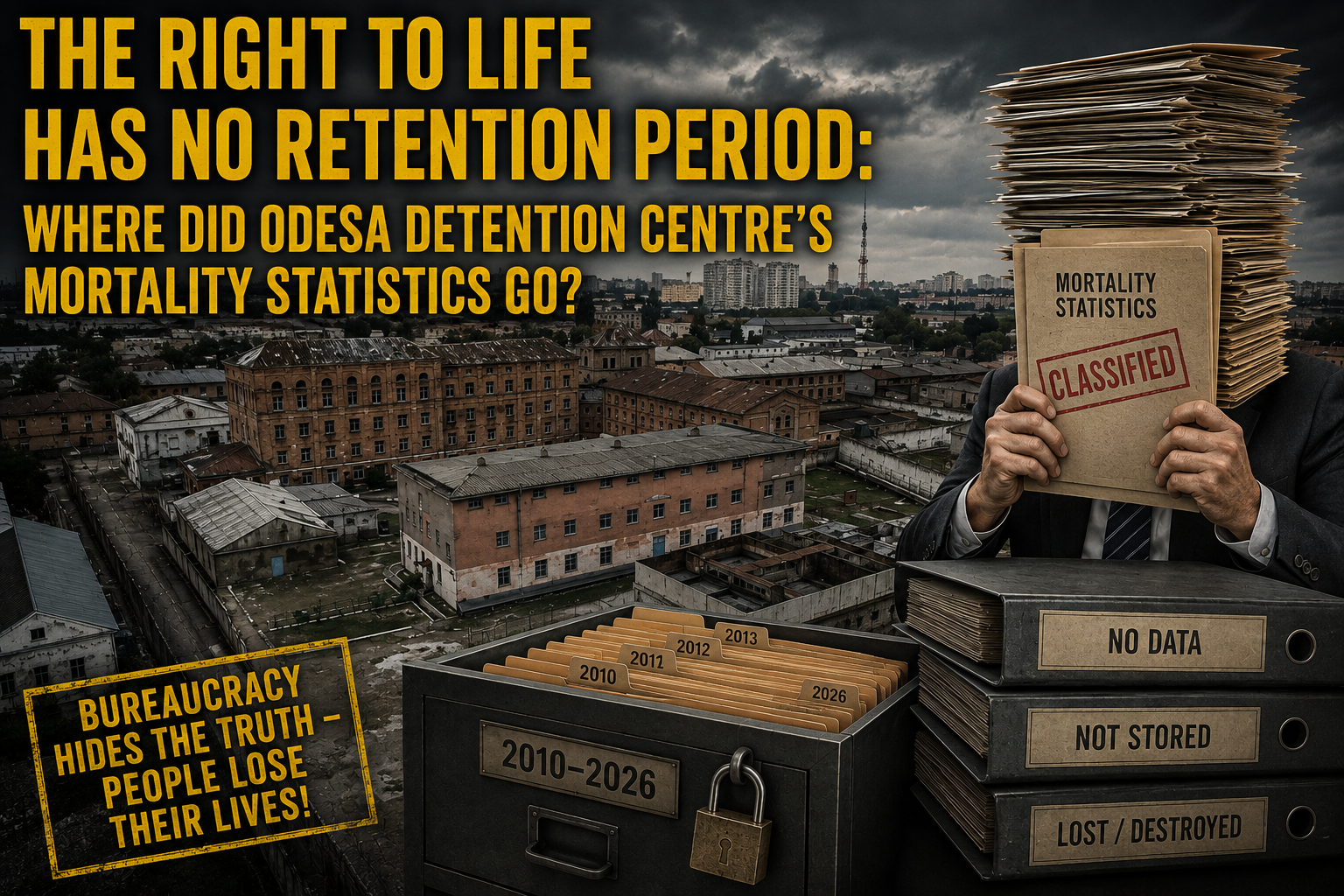
How many people have died in the Odesa Pre-Trial Detention Centre over the past decade and a half? How many of them took their own lives? How many inflicted injuries on themselves, unable to endure the conditions of detention? These are not abstract figures for statistical digests. They are a direct measure of the state’s ability to protect the life of a person whom it has itself deprived of liberty and for whom it bears full responsibility under Article 2 of the Convention for the Protection of Human Rights and Fundamental Freedoms. And it is precisely this simple, lawful, and entirely public question that, throughout August 2026, the state system was unable – or unwilling – to answer honestly.
I sent a request for public information to the Odesa Pre-Trial Detention Centre, the South-Central Interregional Department for the Execution of Criminal Punishments of the Ministry of Justice (hereinafter – the Department), the Department for the Execution of Criminal Punishments, and the Ministry of Justice, requesting statistics on deaths, suicides, and self-inflicted injuries at the Institution for 2010–2020.
On 13 August 2026 the Institution replied by letter No. 5/20-32-26/9/11: the number of deaths was disclosed only for 2023–2026, while for 2010–2022 it stated that the retention period for monthly reports is three years, and that the data therefore allegedly “cannot be provided.” Yet in that very same letter, literally on the next line, the Institution readily provided suicide and self-harm figures for 2021–2026 – that is, for a period which, counting from 2021, had likewise long exceeded the three-year retention period. This produces a strange arithmetic: the expiry of the retention period somehow blocks access to some figures while posing no obstacle whatsoever to providing others. This is already the first crack in the official version of events.
On 18 August 2026 the Department, having forwarded part of the request to the appropriate recipient, unexpectedly raised the stakes in its letter No. 9/6274/26/Я-613: the reason given for the absence of information for 2010–2020 was no longer the expiry of the retention period, but the “destruction of documents” pursuant to a specific act on the withdrawal and destruction of documents dated 25.02.2026, No. 1. A date, a number, a legal fact had appeared.
On 20 August 2026 the very same Institution to which this act allegedly relates directly, in letter No. 5/17-61-26/62, categorically stated that it had never claimed, and does not claim, that the records were completely and irreversibly destroyed; that no document confirming the fact, date, or manner of destruction of these specific records had been found; and that, in general, it had no “documented grounds” on which to name the date, legal basis, or particulars of any destruction act.
Thus, within the space of a single week, I received two mutually exclusive official positions from two bodies within one and the same penal execution system. The higher authority in the system asserts the fact of document destruction, citing a specific act. The subordinate institution to which that act directly relates denies any awareness of it whatsoever. Either one of the two state bodies is not telling the truth – or, no less alarming, neither of them actually knows what happened to the mortality archive of the region’s largest pre-trial detention centre.
It must be clearly understood: the expiry of the statutory retention period for a document and the physical destruction of information are, legally and factually, two different things. First, the state relies on the first argument – supposedly, the period has expired, and the data are “unavailable.” When that argument fails to withstand scrutiny (since the information could have been retained in electronic form, in other departments, or in the consolidated reporting of the central office), a second argument suddenly appears – the destruction act. And when this argument, too, begins to be checked on the merits – by requesting a copy of the act, the composition of the commission, the actual date of destruction, confirmation that no electronic or back-up copies remained – it turns out that the Institution itself can say nothing specific about any such act.
This is not a bureaucratic error. It is a classic behavioural pattern in which each link of the system successively advances a new argument only once the previous one stops working, while responsibility for the final outcome is diffused among several bodies in such a way that none of them can be held personally accountable. The Institution can say: “we merely carry out what the Department instructs.” The Department can say: “we merely consolidate what the Institution has provided.” And the mortality statistics for eleven years – 2010–2020 – remain unknown.
The Odesa Pre-Trial Detention Centre is not an ordinary institution among hundreds of similar ones. Over the years of independence it has acquired a grim reputation as a place where cases of ill-treatment, torture, and inadequate conditions of detention have been systematically recorded – as attested both by applicants’ own cases before the European Court of Human Rights concerning this Institution and by numerous findings of national and international monitoring bodies. When an institution with such a reputation suddenly cannot – or will not – provide transparent statistics on deaths, suicides, and self-harm covering more than a decade of its operation, this does not inspire confidence; rather, it gives rise to entirely reasonable suspicion as to precisely what is being concealed behind references to “retention periods” and “destruction acts.”
Mortality statistics in places of deprivation of liberty are not an internal departmental accounting matter. They are one of the few objective instruments by which society, human rights organisations, and international bodies such as the European Committee for the Prevention of Torture can assess whether the state is fulfilling its positive obligation under Article 2 of the Convention – the obligation to protect the lives of persons who are under its full control. Concealing, blurring, or selectively disclosing such statistics is, in substance, an attempt to render impossible any external oversight of what takes place behind the walls of the pre-trial detention centre.
If the state has indeed destroyed the documents, society has the right to know: when, on what grounds, who made that decision, and whether the existence of electronic copies was verified before destruction. If the documents have not been destroyed but are simply “inconvenient” to disclose, that too should be stated plainly. But what is happening now – where one body cites a specific destruction act while the other effectively denies that very same act – is the worst of all possible scenarios: it gives society neither the truth about destruction nor the data themselves.
A demand has been sent in response to each of these letters for a final, consistent, and unambiguous answer: whether the information has been completely and irreversibly destroyed – in both paper and electronic form, including back-up copies; who exactly made the decision to destroy it; who was on the commission; and whether the existence of electronic copies was verified before destruction. A separate, certified copy of the act itself, dated 25.02.2026, No. 1, is being demanded.
The question remains open. And for as long as the Odesa Pre-Trial Detention Centre and the South-Central Interregional Department for the Execution of Criminal Punishments continue shifting responsibility onto one another instead of giving a direct and verified answer, society has every right to conclude that behind this contradiction lies not merely careless record-keeping, but an unwillingness to acknowledge the scale of the problem of death and violence at an institution that has long been associated with torture and ill-treatment.
The right to life has no retention period.


