 3
3
 0
0
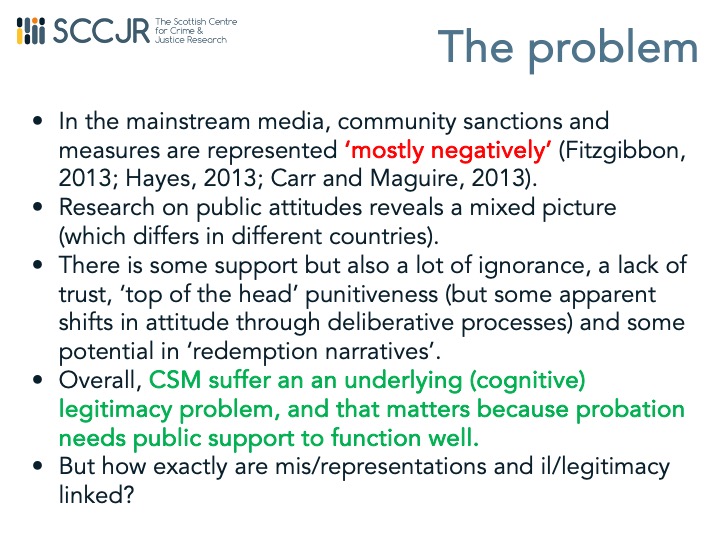
Overall, community sanctions and measures suffer an underlying legitimacy problem. Unlike the Crown, probation has never become a taken for granted part of the criminal justice system. And its legitimacy has remained in question. And that matters because probation needs other support in order to function well.
But to dig a little bit deeper into the problem, we have to ask another question. How are media misrepresentations and the evidence of probation connected? What is the relationship between these two things? Now, before I answer that question, I wanted to indulge myself by going back to some earlier work.
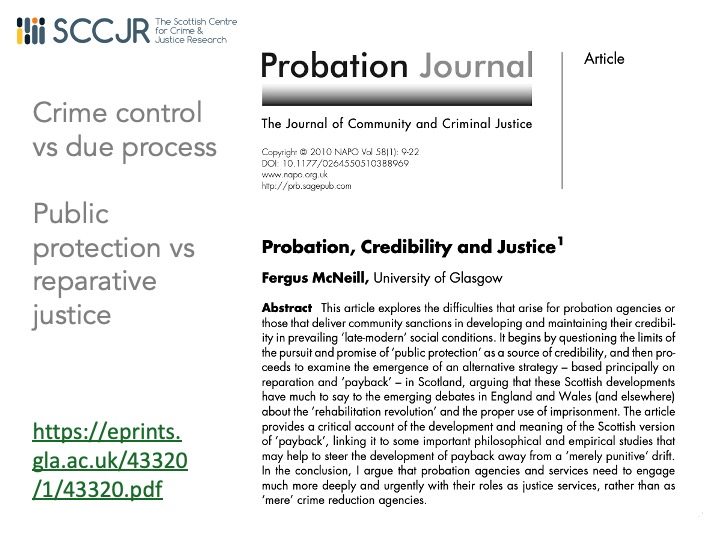
And in the paper that was subsequently published, I tried to point out that in many jurisdictions, particularly in the United Kingdom, probation had become too centrally preoccupied with advancing its case, with making its pitch for public support on the grounds that it could offer crime control, that it could offer public protection, that it could keep people safe. All of those promises stand on one side of a core dichotomy that exists in every criminal legal system. In these systems, we have to balance the desire to control crime with the necessity of due process and respect for human rights.
And justice requires more than crime control. The mere controlling of crime in and of itself does not deliver justice. Reducing recidivism will never be a satisfactory outcome measure for a justice system. If we wanted to, we could execute everybody who ever commits a crime, and we would have zero recidivism. We would also have zero respect for human rights and no defensible due process. So, we have to balance these things.
And when we’re trying to advance a case for probation, we have to attempt to grant control, but we must also think about justice. What is the justice that we are seeking to deliver? And in this paper, and as I so believe, the forms of justice that probation can offer are criminal. They seek to repair the relationships that are damaged by crime.
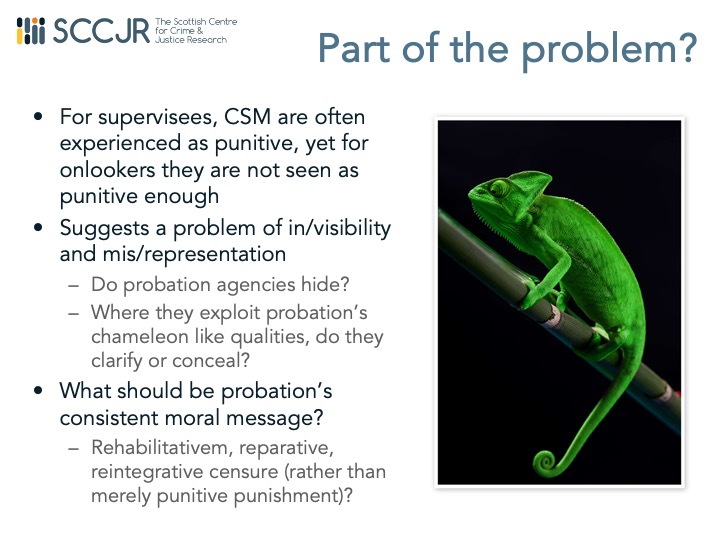
That’s what I think is and should be central to our message. But our message has become confused. The picture here is of a chameleon.
As you know, chameleons have a special capacity when they feel threatened that they can change colour so that they fit into every environment and become invisible. And we’ve talked about the invisibility of probation many times over the last couple of weeks. And I think some of the problem is a problem of our own being.
Probation has promised to do too many different things, to search too many different contexts and environments, to appeal to too many different sentiments, to respond to too many different political pressures. And the problem with being so adaptable in the search for survival is invisibility and distrust. For supervisees, when we ask people about their experience of supervision, many of them will tell us that it is abusive.
Not because their supervisors are mean. Inevitably, it involves the invasion of their privacy and the restriction of their liberty. So there is suffering in probation.
Yet, for the ordinary person, for the public, typically, as we’ll see in a moment, probation is seen as being not abusive at all, or not abusive enough. So we have a problem of invisibility. Perhaps a problem that is partly… And I think the way out is to ask ourselves the question, what should be probation’s consistent moral message? What is a harm? And there I would place reparation, rehabilitation and reintegration, alongside this important work which I’m about to speak about, words, sorry, this important work I’m about to speak about, censure, which I’ll explain next.
That’s not the sight I was expecting. Doesn’t matter. Let me just explain censure now.
So in English, when we use the word censure, we mean to express severe or extreme disapproval of a certain action. And when we’re responding to crime, we have to express censure in order to communicate clearly that the behaviour is unacceptable and that it has done significant damage to the relationship on which our mutual well-being and our collective flourishing depends. If, as an agency or an organisation or a sanction, probation doesn’t seem to adequately censure or prevent, it will never satisfy the inevitable and legitimate public appetite for wrongdoing to be censured.
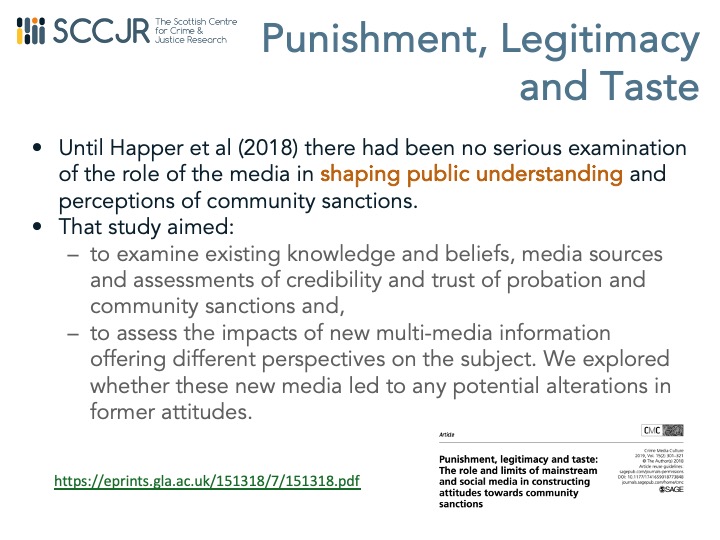
So censure has to be part of what we do, but that doesn’t mean that we have to prioritise being punitive and problematic to the interests of the world. So let me tell you first about this interesting piece of research that I was involved with a few years ago where I collaborated with a world-leading team of media researchers at Basel University, called the Basel Media Group. Catherine Harper is the lead author on this paper.
It’s the director of that group. And we realised in talking together that there had really been no serious examination of the role of the media in shaping public understanding and perceptions of community sanctions. We knew what they were saying, but we didn’t really understand what effect representations were producing.
So we set up a small study, a pilot study, to examine what people believe about probation, what media sources say, and how people use those media sources to develop their attitudes and beliefs and perceptions about probation. And to do that we created a multimedia environment with many different stories about probation, and we put people in that environment and talked to them about what messages they could await from it. Here’s the method.
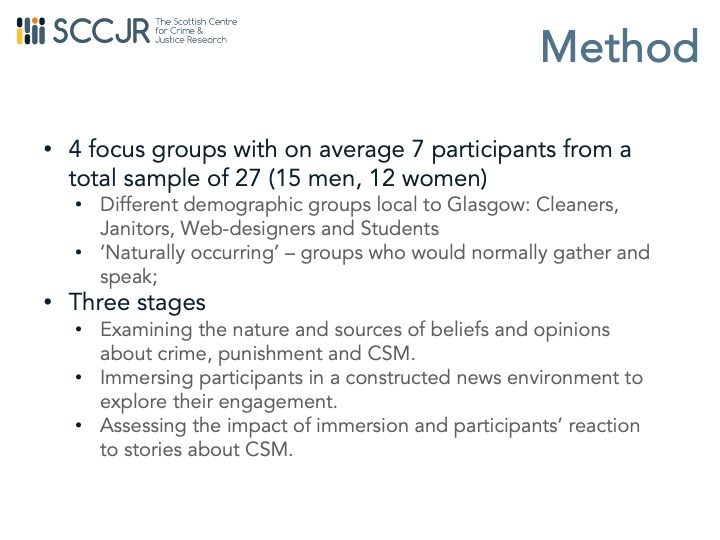
We had four focus groups, each of about seven people, a total number of just 27 people, 15 men and 12 women. And they belonged to two different demographic groups, all local to the Basel area. We had manual workers, working class people, blue collar workers, cleaners and janitors, but we also had web designers and students, so educated middle class people in different groups.
And we tried to make the groups naturally comparable so that people were among their peers as they discussed the media sources. And we had three stages. We asked them about the nature and sources of their beliefs and opinions about filing punishment for probation.
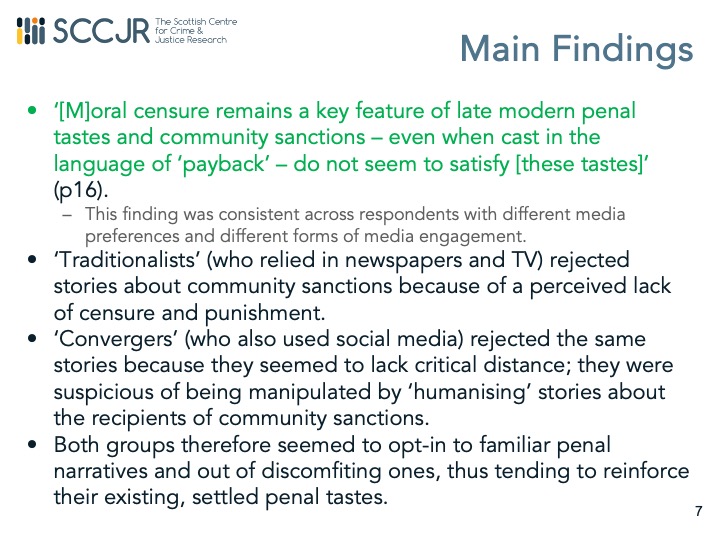
We immersed them in this new environment we had created. And then we assessed the impact of the immersion on their reactions. What did we discover? We discovered that moral censure is a key feature of late modern phenomic taste.
Let me explain the terminology here. So, for sociologists, late modernity is the period from the 1970s onwards when societies are facing big changes. Globalisation is part of that, so is an increasing preoccupation with risk, a decline in the provision of collective welfare, greater individualisation, greater competition, atomisation is a word which is sometimes used to describe the fragmentation and rupture within societies as the old systems of belief that held people together, attribute and decay in the late modern period.
So in this kind of feverish, febrile, complicated social context, lots of things are going on in the criminal justice system and in the way of society which affects people’s taste. And I’m using the word here in the same way that we would talk about our musical taste, talk about the things that we like to eat. So what tastes govern our appetites? And when it comes to punishment, we have appetites.
And tastes, we prefer certain things over other things. And our tastes are the product of the societies in which we are, in which we are as human beings. And what we find here is that censure, an old-fashioned idea, but one which has survived and still has significant purchase in the context of late modernity, and when it comes to community sanctions, even if you re-describe these sanctions in the language of payback, which was a fashionable thing to do in the UK a few years ago, we’re still not satisfied.
The censure is insufficient. And that finding that community sanctions don’t deliver adequate censure, was common across the different groups. It didn’t matter what your level of education was, or what your job was, or which social group you were a partner with.
Across different disciplines, with different kinds of media engagement, the finding was consistent. There’s a problem with censure, or a lack of censure. But there’s a difference in the reasoning behind the problem.
For the traditionalists, who were the working-class people, who still relied mainly on newspapers and television for their information about community sanctions, they rejected community sanctions straightforwardly because of a perceived lack of censure, and a perceived lack of function. Just not talking about all the bad guys. That was a simple message for the traditionalists.
The converters were the more educated people who were also using social media to keep their attitudes. And they rejected the same stories for a different reason. They said these stories lacked critical distance and were suspicious that we’re being manipulated by these stories of trying to humanise people involved in probation.
We know what we’re trying to do when it’s over with these human stories. So, we’re not sure. Both groups ended up opting into familiar penal narratives, and out of unsettling new narratives, and that reinforced their settled taste for punishment.
So, this is a depressing story. And it’s worth saying it’s a small story, and we can’t be sure whether it would generalise even in Scotland, far less so than the range of countries represented in this room. But I think the central message about the importance of censure, and about this trust in media reporting, is that we need to hold on to those messages and think about them.
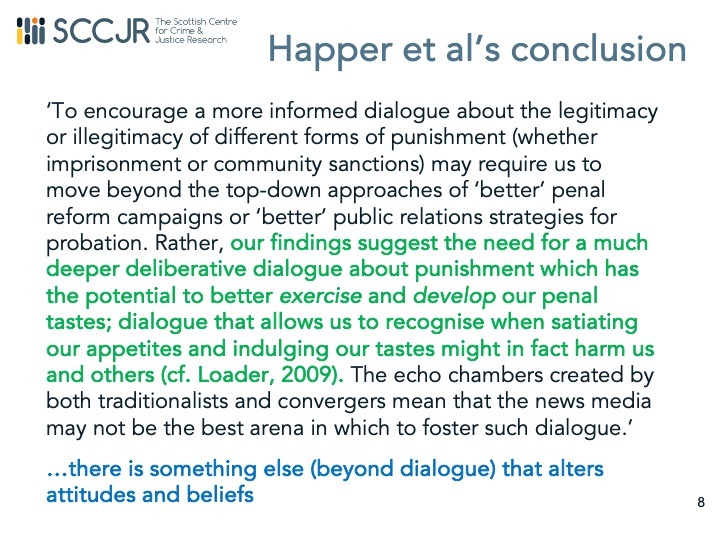
So, that part of it I’ll conclude. I’m just going to take out the central quote in green here. Our findings suggest that for a much deeper, deliberative dialogue about punishment, which has the potential to better exercise and develop our tastes, and help us to recognise when satiating our appetites, and indulging our tastes, might do us harm.
In many of our societies, we have developed tastes for punishment that are backwards. Actually, actively harmful. We rely on the doubt, which produces re-offending.
That’s the simple truth. We think of the present as a magic box that solves things, but all the present does, which is a crucial thing, is to defer our problem. Unless you’re going to keep people in prison forever, the problem of re-integration, and of addressing re-offending remains.
But yet, we’re addicted to the magic box. It temporarily pushes away the problem and allows us to satisfy ourselves with the feeling that people who cause us harm are suffering. That’s an unhealthy taste.
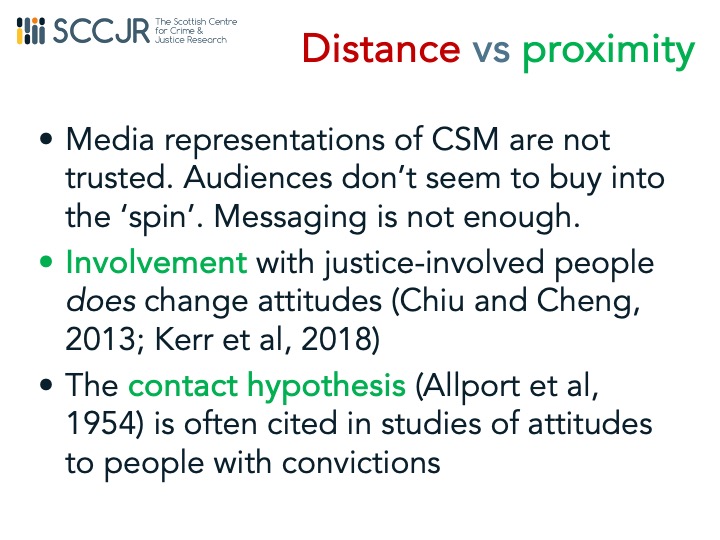
And if we want it to change, we can’t do it through clever public relations exercises, or the transmission of messages that people will. So, the only alternative is engagement, in a deliberative dialogue, which takes that taste seriously, and works with it initially on its own terms. In thinking about how then to develop a dialogue, one of the things that we have to do is narrow the distance between the so-called punitive public and the people involved with probation.
And I mean by that both the service users, and people working in the system. Audiences don’t seem to buy into the spin. Messaging will not be enough.
So, I think we need to create opportunities for involvement. And we have a lot of research from several different countries, which suggests that involvement does change attitudes. When we actually spend time with prisons, for example, in prisons, we think differently about prisons.
When we spend time with people on probation, we think differently about probation. When we spend time in Turkey, we think differently about Turkey. When we spend time in Norway, sometimes we start to question whether our beliefs about everything being perfect are right.
So, contact, the contact hypothesis in public attitude research suggests that one of the most powerful ways of changing attitudes is through contact, through involvement, and through engagement. I want to talk to you briefly about one way of engineering engagement. Engineering is exactly the wrong word to use here when I’m talking about arts and culture.
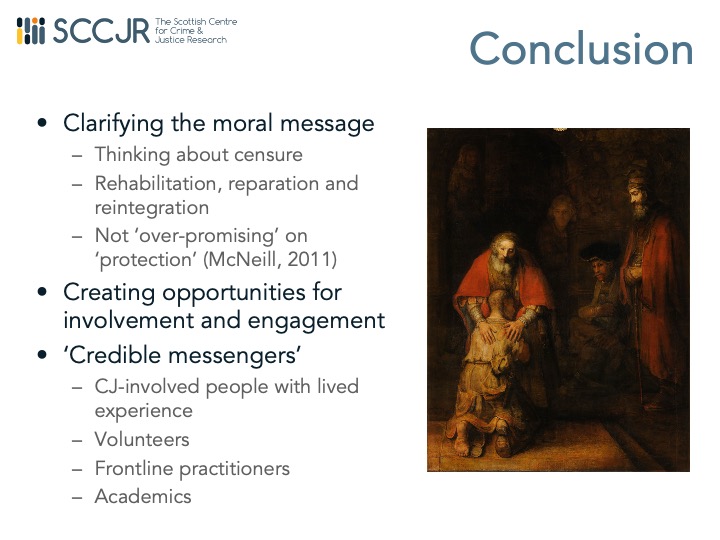
What kind of justice do we promise? I think it’s perfectly reasonable and necessary for probation agencies to deliver censure to communicate clear and unambiguous moral messages about wrongdoing. That there are many reasons why people offend which are rooted in social inequalities and injustices that they experienced before they were involved in offending. So that’s complicated but it doesn’t mean that we can’t express censure for criminal wrongdoing.
However, our response is not to meet that harm with further harm, not to indulge in purely punitive impulse to repay harm for harm but rather to find means of rehabilitation, reparation and reintegration. And crucially here, I think we must not overpromise on crime control or public protection. I think this is a major mistake by probation services in the UK around the turn of the century.
I understand why probation leaders felt that with declining support for a welfare risk approach they had to find another way to persuade their political masters to support their agencies but the strategy of defining yourself as a public protection agency makes probation a hostage to fortune. You could be an outstanding and world-leading service in terms of delivering the most effective possible public protection. You only need one case to go wrong for that reputation to be destroyed.
So, we must not overpromise on protection. We should try to create opportunities for involvement and engagement and that might mean thinking about the role of volunteers in our probation systems, thinking about how they involve civil society organisations in a variety of different ways but it also means we have to think a little bit more carefully about credible messengers. This is a phrase that I borrow from work on initiatives to try to reduce participation in gang violence and in that work it’s been discovered that if the people who are working with the young people who are vulnerable to or already embarked on gang involvement, if the people communicating the message have credibility then the potential Who are credible messengers? In that context the answer is people with lived experience of gangs.
And I think in our context the public might trust probationers’ accounts of probation more than they would trust probation managers’ accounts of probation. Why? Because probation managers have a vested interest in seeing the probation. Therefore, they have an in-built credibility problem in the public sphere.
People are sophisticated consumers of messages that we give them so we need to think more carefully about who a trusted messenger about probation might be. Criminal officers involve people, volunteers, frontline practitioners I think are more likely to be trusted by the public because they have the credibility of day-to-day defenders on which they can draw to get examples and illustrations that make the work seem real and valuable to their audiences. And academics may have a part to play but I wouldn’t overstate it because one of the sad things about big modernity is that we have less faith in so-called experts than we used to have in the middle of the 20th century.
So, I can’t solve the problem for you, but I can work with you to think about what a message is and who should be messaging it.



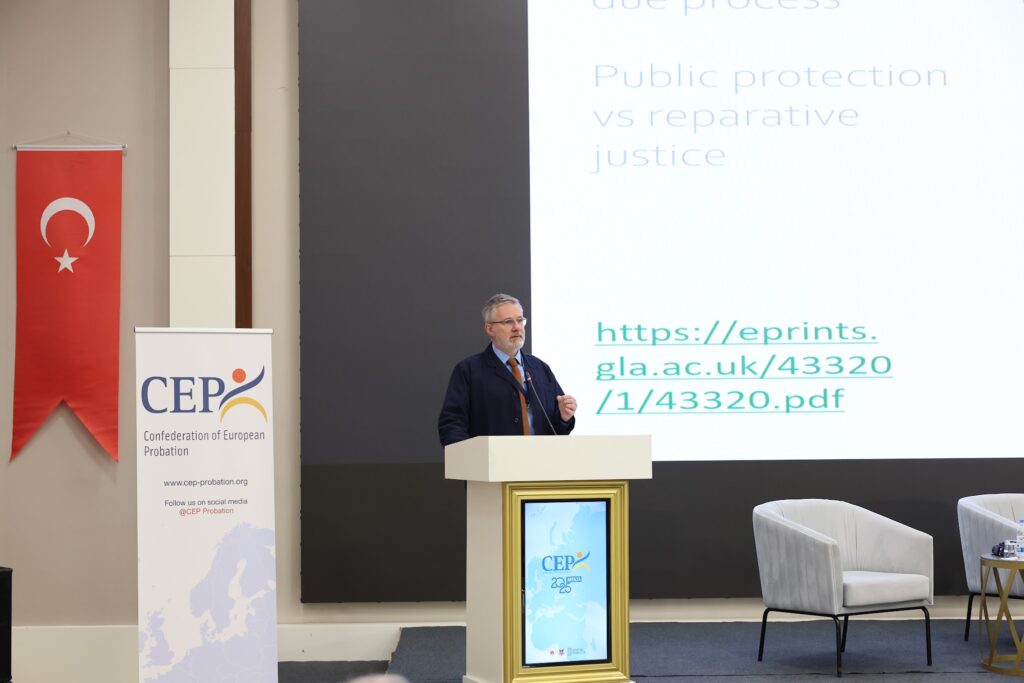
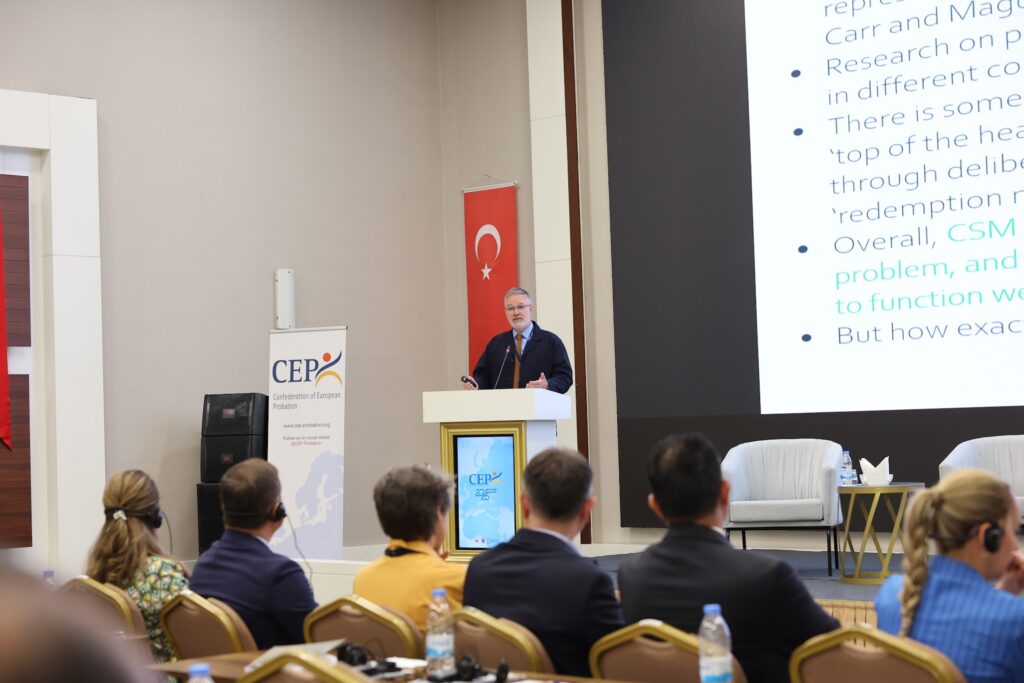


The abstracts of Professor Fergus McNeill’s speech were prepared by Dmytro Yagunov. The owner of the website is responsible for the completeness of Professor Fergus McNeill’s speech.