 0
0
 0
0
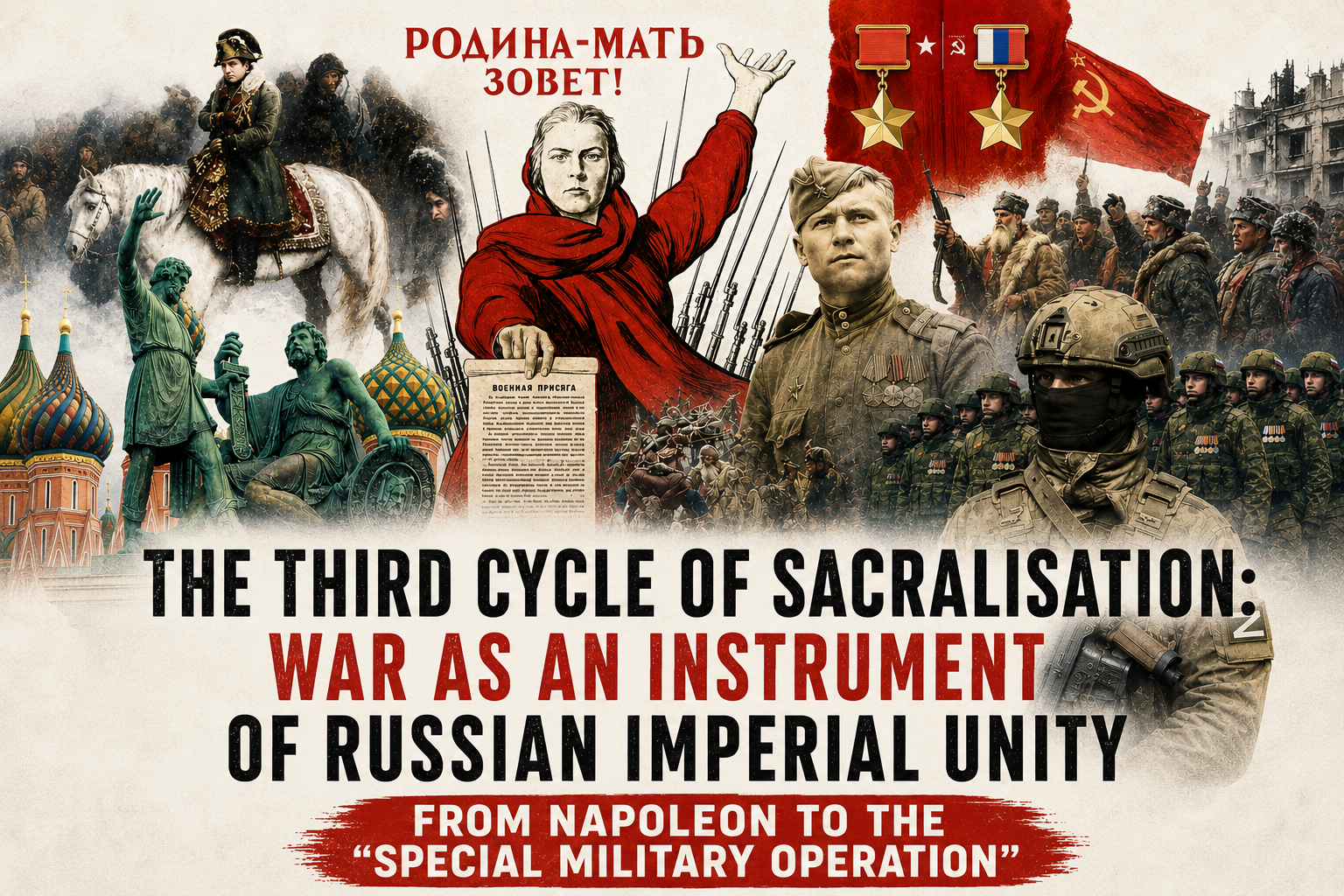
In 1912, the Russian Empire was in a state of absolute agitation and feverish excitement. The cause of this excitement was the centenary of the so-called victory over Napoleon – an event that had served for a full century as the cornerstone of official state ideology, the principal source of legitimacy for the tsarist regime, and the primary instrument for maintaining the unity of a variegated, multi-national, internally contradictory empire.
Was that victory real? Was it as unambiguous as official propaganda depicted? Can one speak at all of an “exclusively Russian” victory in that great struggle of nations? These are questions for historians – complex and multifaceted ones. But for understanding the mechanisms by which the Russian state functions – both in the nineteenth century and today – what matters far more than the factual substance of those events is the manner in which they were retransmitted, reinterpreted, and deployed by power.
In 1912, the tsarist Okhranka and gendarmerie, ordinary agents and officials of the security services, received an unusual assignment: they traveled across every corner of the vast Russian Empire – through the ramshackle villages of central Russia, through the remote backwaters of Siberia, through the provincial towns of the Little Russian borderlands – searching for elders, elderly people who had either witnessed Napoleon’s invasion themselves or had at least heard of it from their parents. Such witnesses were brought to Moscow and Saint Petersburg, put on public display, and taken to ceremonial events. Living human memory was to become the living flesh of the official narrative.
This was, of course, not the invention of any particular official or some passing whim of the imperial court. Behind it lay a deep systemic logic. The existence of the Russian Empire – a state built on the colonial subjugation of dozens of peoples and ethnic groups, on violence, on the suppression of any aspiration toward self-determination – urgently required the continuous heroisation and sacralisation of supreme power. A myth was needed that would transform subjects into participants in a single great mission. And nothing served this purpose better than the image of military triumph achieved through sacrifice and suffering.
Traditionally – and this is well known to scholars of the phenomenon of Russian imperialism – power resorted to so-called “injections of sacred sacrifice”: the carefully cultivated conviction that “our people” had made immeasurable sacrifice in order to defeat an external enemy, and that this sacrifice therefore consecrates the power that led them, the state itself, and all subsequent generations living “in the shadow” of that sacrifice. The cult of victory over Napoleon fulfilled precisely this function: it transformed a brutal and chaotic military conflict into an epic in which the central hero was “the Russian people” – a collective, abstract, but highly convenient image for manipulation.
THE FIRST SACRALISATION CYCLE AND ITS DESTRUCTION
Yet already by 1912, a glaring internal contradiction had revealed itself between the demands of propaganda and the requirements of real geopolitics. The celebration of the centennial of the victory over Napoleon was politically entirely inopportune and awkward in the context of the formation of the Entente — the strategic alliance in which France was to become Russia’s key partner on the eve of the already palpable great pan-European war. How could one simultaneously hold grand public celebrations in honor of the victory over the French and sign alliance treaties with that same France?
This was precisely one of the most acute examples of how instruments of ideological unity, constructed around the image of an external enemy, inevitably become hostages to current diplomatic needs. One cannot forever hate those whom one needs today as an ally. The celebrations therefore proceeded, but far more restrained than originally envisioned. Russia was compelled gradually to “release” the instrument of unity that had served it for a century.
Before the victory over Napoleon, other sacralisation constructs had existed: the victory over the Polish interventionists at the beginning of the seventeenth century, the legend of Ivan Susanin, numerous military triumphs over Sweden, Turkey, and Persia – all of these served the same purposes: to bind the heterogeneous body of the empire through the cult of sacrifice and victory, through the memory of an external threat that had been “together” overcome. But none of these victories possessed the same sweeping, all-encompassing consolidating potential as the defeat of Napoleon. For understanding subsequent centuries, this is of fundamental importance.
The First World War destroyed everything. It destroyed not only the Romanov dynasty and the old social structure, but the very foundations of the sacralisation toolkit upon which the ideological architecture of the empire rested. Soviet power succeeded it, with its large-scale but considerably more primitive ideological constructs: class struggle, world revolution, the building of communism. These abstractions inspired part of society, but they did not provide the deep, almost archetypal unity that was given by the sacred memory of collectively endured wartime suffering and collectively achieved victory.
Was it not for this reason that Soviet power, in the interwar and early postwar periods, searched so desperately for its own sacred equivalent? The Revolution, the Civil War, various “minor” military operations — Afghanistan had not yet come, but there were Mongolia, Spain, Khalkhin Gol, the Finnish campaign — all of these attempted to fulfill the same function. But none of these conflicts, by their scale and symbolic weight, could replace the “Napoleonic narrative” of the nineteenth century. The instrument did not work.
THE SECOND CYCLE: THE “GREAT PATRIOTIC WAR” AS A NEW MYTH
And then came 1941. After Stalin remarkably recovered from the initial shock – caused not only by the suddenness of the attack but also by his own grandiose miscalculations in army-building and his destruction of the command corps – Soviet propaganda faced a task of colossal proportions: to explain to people what they were dying for, and to convince them that it was worth dying for.
It was then that a new, second great sacralisation instrument was born — the “Great Patriotic War.” It is essential to note the semantics: not the Second World War, which encompassed all theaters of military operations from the Pacific to the Atlantic, but specifically “Patriotic” – that is, the defense of one’s native land, corresponding to the very same archetypal schema as the campaign of 1812. The name itself is a construct: it inscribed the new conflict into an already-prepared cultural matrix, activating the same deep layers of mass consciousness.
Soviet, and subsequently post-Soviet, and today’s Putinist Russia obtained a truly “magical instrument.” Innumerable sacrifices – real, genuine sacrifices of millions of people – became the foundation of a new sacred narrative. Every regime requiring legitimacy appeals to them. They justify everything: from the suppression of the Hungarian uprising of 1956 to the invasion of Afghanistan, from “counter-terrorist operations” in Chechnya to the annexation of Crimea. The logic is simple and terrifying in its simplicity: “Our grandfathers defeated fascism, and therefore what we are doing today is also a struggle against fascism.”
This second cycle of sacralisation served Russia for almost exactly one hundred years — just as the “Napoleonic” narrative had done. From the Victory of 1945 until the end of the twentieth and beginning of the twenty-first centuries, it remained the core of official state ideology, its semantic and emotional center. But time passes. Veterans of the Second World War are dying. The living connection with that generation is fading into the past. And the regime is beginning to sense that the instrument is gradually wearing out.
THE THIRD CYCLE: THE INVASION OF UKRAINE AND A NEW SACRALISATION
The beginning of Russia’s full-scale invasion of Ukraine in February 2022 marked, according to our conception, the launch of a third, new centennial sacralisation cycle. This fact must be grasped in all its tragic gravity. What is at stake is not simply another aggressive war by an authoritarian regime. What is at stake is the launch of a deep, long-term mechanism of ideological transformation – a mechanism whose consequences will be felt across several coming generations.
Already at the May 9 parades in Moscow and other major Russian cities, something revealing and symbolically significant is occurring: alongside the veterans of the Second World War – or, more precisely, alongside those presented as such veterans, since virtually no real veterans of that war remain – veterans of the so-called “special military operation” are now appearing. The vacuum, the ideological emptiness that was inevitably forming with the deaths of the living participants of the Second World War, is already being filled with new “heroes.” The state is carefully, methodically, but relentlessly effecting this symbolic “transfer.”
This care is not accidental. The regime understands perfectly the danger: veterans of the “SMO,” unlike veterans of the Second World War, are alive, young, organised, armed with real combat experience and real psychological trauma. They cannot simply be symbolised – they are themselves active political actors. And it is precisely for this reason that the current government so carefully constructs for them special structures, organisations, so-called “communities,” veterans’ clubs – parallel social institutions meant to provide these people with a sense of special election, of special status in the hierarchy of the new Russia.
It is here that one of the most serious threats lies — not only for Ukraine but for all of Europe. The third sacralisation instrument has already been launched. It is already functioning. And regardless of whether Putin is replaced by some “democratic” successor, regardless of which party comes to power in Russia – this sacralisation will not disappear. Ideological constructs that feed on blood and suffering are extraordinarily tenacious.
THE HUMAN DIMENSION: MILLIONS OF CASUALTIES AS THE FOUNDATION OF HATRED
In speaking of sacralisation, we must not forget its human dimension. Today, in the public sphere – in Ukraine and in Europe alike – the colossal losses of Russia in this war are being actively discussed. Hundreds of thousands killed and wounded are spoken of. Comparisons are drawn with the bloodiest battles of the Second World War. Figures, analyses, and statistics are cited.
But there is another, no less important dimension to these losses, about which far less is said. Each killed Russian soldier is not merely a statistical unit. He is someone’s son, someone’s father, someone’s husband. Behind him stand women – mothers, wives, sisters, children – who today grieve in Russia, who will raise their children and grandchildren in the atmosphere of this grief, in the shadow of this loss. And this atmosphere — regardless of any political changes — will inevitably shape an alienation from Ukraine, a hatred of all things Ukrainian, a conviction that Ukraine means death, that Ukraine is the enemy.
Of course, Mala Tokmachka and other symbols of the indomitability of the Ukrainian armed forces are symbols of genuine heroism and courage. But behind each such symbol stands the reverse side as well: the replenishment of the army of hatred taking place on the other side of the front. Not because Ukraine is doing anything unlawful – it is defending itself. But the consequences of this defense will have a long-term psychological and social projection in the very heart of enemy society.
Regardless of what ruling party holds power in Russia, who becomes the next president after Putin, or what name the regime receives – “liberal,” “democratic,” “federative,” or any other – Russian society, formed by grief and grievance, will either continue to openly hate everything Ukrainian, or accumulate that hatred in latent form, ready to flare up at the first opportunity. For this real scenario – Ukrainian society and the Ukrainian state, the European Union, and individual European states — must be prepared today.
“FUTURE RUSSIAN SS TROOPS”: NEW COMBAT FORMATIONS AND THE THREAT OF REVANCHISM
One of the most alarming aspects of the current situation is the gradual formation in Russia of specific veterans’ structures that recall — and this analogy is not an exaggeration — the processes that took place in Germany after the First World War. At that time, the Freikorps and veterans’ associations eventually gave rise to the SS and SA – the force that buried the Weimar Republic.
Today in Russia, these new combat formations – so-called “communities” of SMO veterans, various patriotic organisations, private “Cossack” formations – are gradually being integrated into the social fabric. They are being given special status, privileges, access to state resources. They are acquiring the right to violence, consecrated by the state and sacralised by the official narrative. Not so long ago, Mussolini’s “Blackshirts” began in just the same way – as veterans’ organisations of men who had passed through the First World War and found no place in peacetime society.
From this perspective, the current state of affairs provides no grounds whatsoever for asserting real peace even after the conclusion of the active phase of hostilities. A ceasefire, the signing of some agreement, the withdrawal of troops – all of this may stop the immediate killing. But the social, psychological, and ideological processes already set in motion in Russia will not halt together with the military ones. And in this lies the principal tragedy of the present moment.
TÜBINGEN AS AN EXAMPLE: DENAZIFICATION THAT WORKED
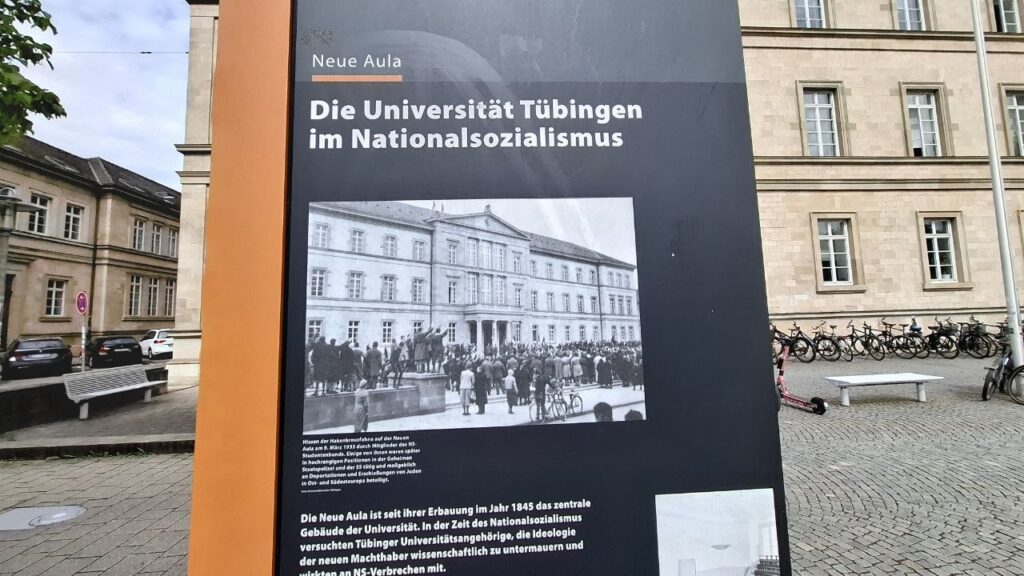
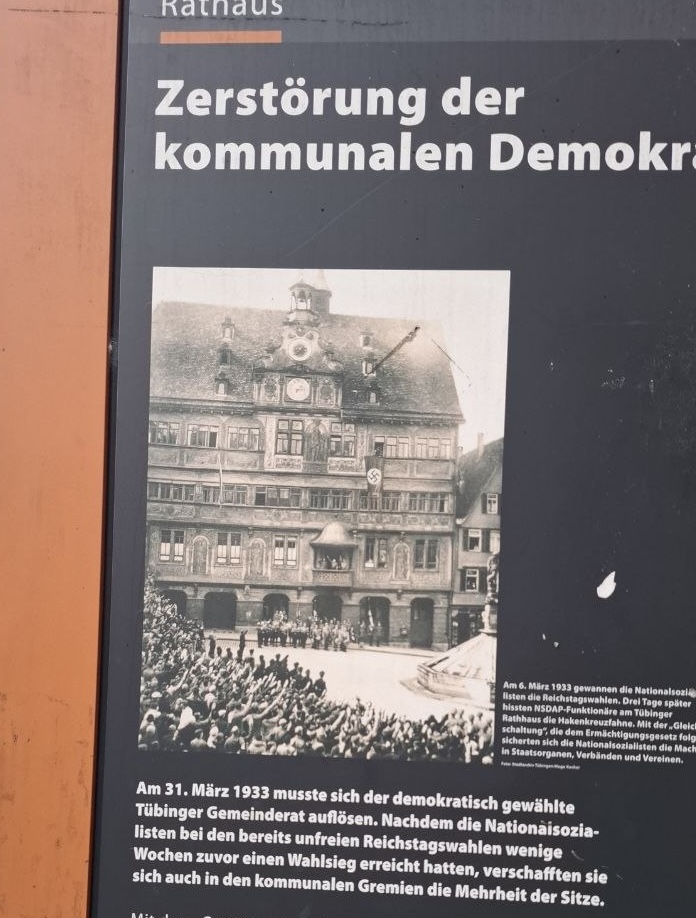
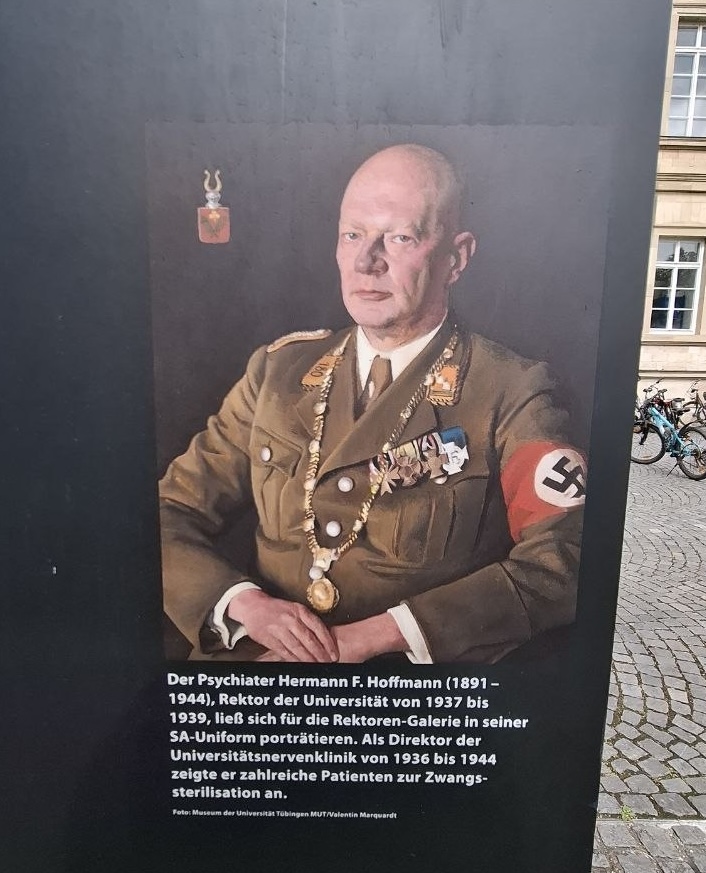
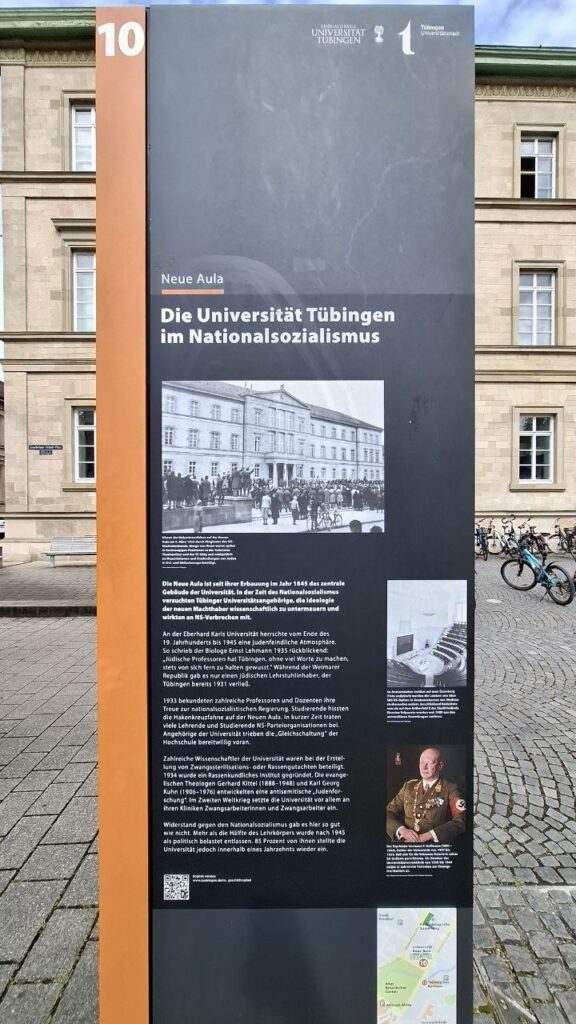
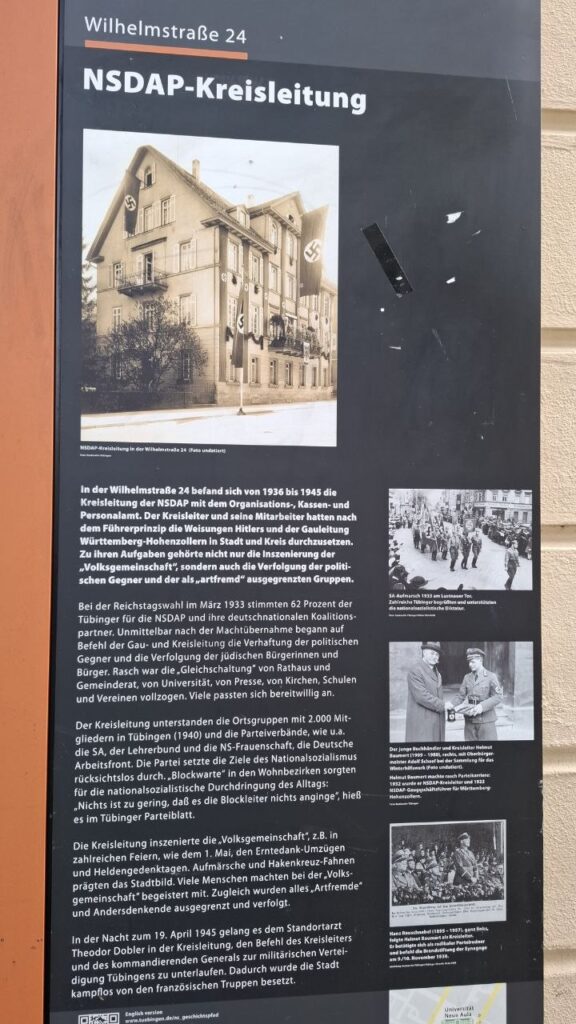
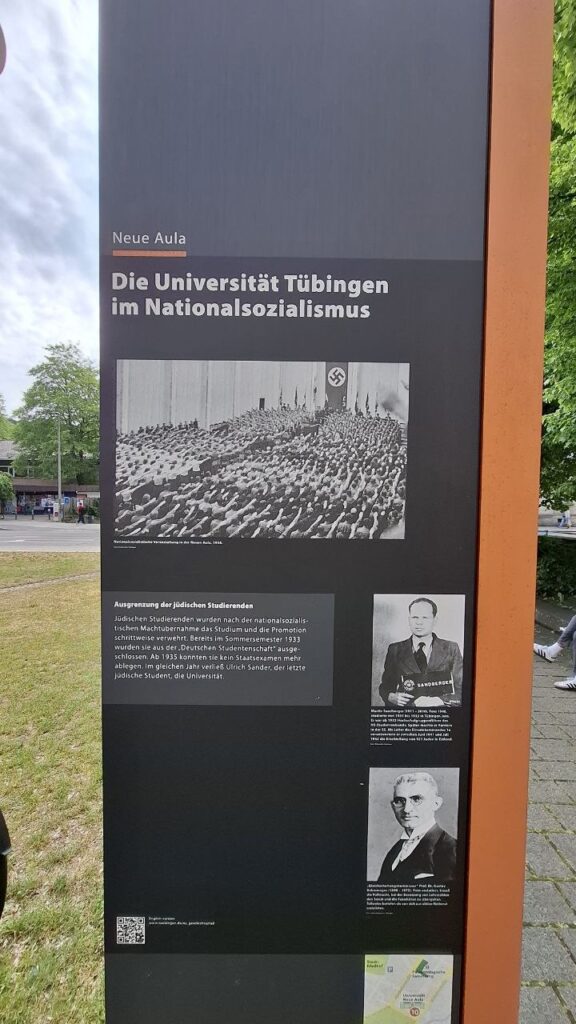
Allow me to cite a concrete example from my own city of Tübingen. Throughout this university city – one of the oldest and most prestigious university centers in Germany – there are information stands and display cases dedicated to the city during the Nazi era. They are not hidden away in museum storerooms or concealed in archives. They stand in the open air, on public streets, next to cafes and shops.
Near the main building of the university stands a column on which are depicted – and this is extraordinarily telling – university professors and scholars giving the Nazi salute. Those depicted are not marginals, not criminals, not uneducated lumpen elements. Those depicted are people with academic degrees, in ceremonial academic robes, with all the insignia of academic dignity. And among them stands the rector of the university in full ceremonial dress and with Nazi insignia — insignia that are not painted over or effaced, but on the contrary displayed clearly and unambiguously.
Why? So that they remember. So that every student, every passerby, every tourist can see: this is what happens to a society that gives these demons free rein. This is where the combination of academic authority, state propaganda, and the cult of the leader leads. The people of Tübingen remember – and these are not mere words. This is the result of decades of systematic, thoughtful, consistent denazification carried out by the Federal Republic of Germany under the pressure and participation of the Allies.
But the key phrase here is “under the pressure and participation of the Allies.” The denazification of Germany occurred because Germany suffered a total and unambiguous defeat, because occupation administrations arrived on its territory, because its society passed through the Nuremberg trials, through lustrations, through enforced re-education. Nothing of the kind with respect to Russia — even in the most optimistic scenario of regime change — will occur. There will be no external denazifying authority over Russia. And without external compulsion, no regime voluntarily demolishes its own ideological foundations.
CONCLUSIONS: WHAT THE THIRD CYCLE MEANS FOR THE FUTURE
In summary, it must be stated: as a result of this war, as a result of the launch of the third sacralisation instrument of Russian aggressive expansion – regardless of when and on what terms it ends, along which borders the “ceasefire line” will be drawn – the next several generations of Russian citizens will grow up in the wake of this new sacred narrative. They will receive it with their mothers’ milk, through school textbooks, through state television, through official ceremonies.
This narrative will inevitably contain the image of Ukraine as an enemy – moreover, an enemy that has inflicted immeasurable suffering upon “our people.” The fact that this war was initiated by Russia itself, that Ukraine is the victim of aggression rather than its instigator – within the framework of this narrative, that fact will carry no significance whatsoever. Just as in 1912, in the official Moscow narrative, the question of who brought Napoleon to Moscow and why was not discussed.
For Ukraine and for Europe, this means one thing: it is necessary to think not only about the present day and not only about the terms of a future peace settlement. It is necessary to think about the strategic architecture of security for decades ahead. It is necessary to construct such institutional, legal, economic, and military deterrence mechanisms as will be effective not only against the present Putin, but against his successors as well – both those who will come immediately after him and those who will appear a generation hence.
We cannot afford to indulge in the illusion that “after Putin everything will change.” A great deal may change. But the deep structure of social consciousness, shaped by the blood and suffering of hundreds of thousands of families, is formed over decades. This is the principal tragedy – and the central challenge – confronting Ukraine and Europe at the present day.


