 0
0
 0
0
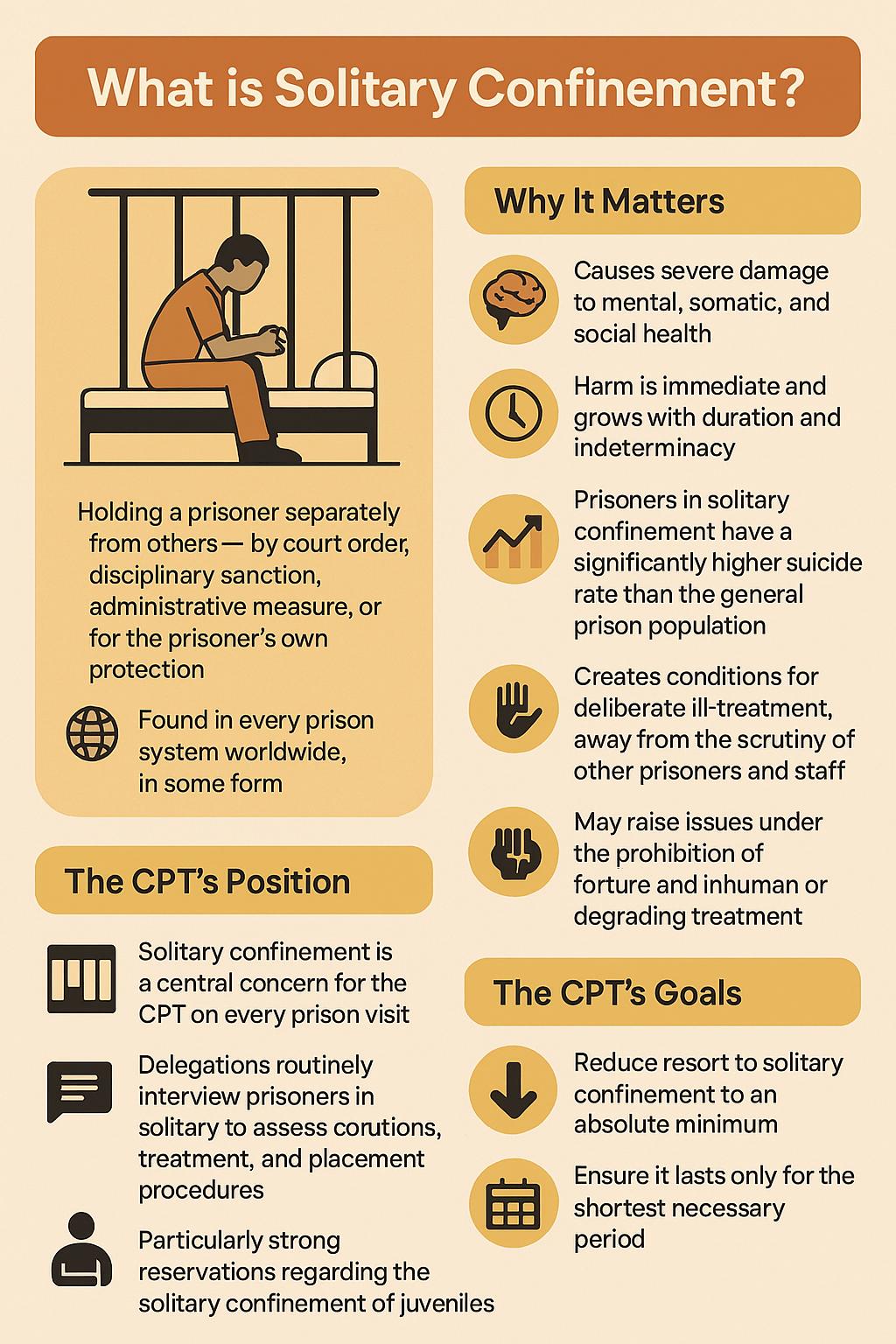
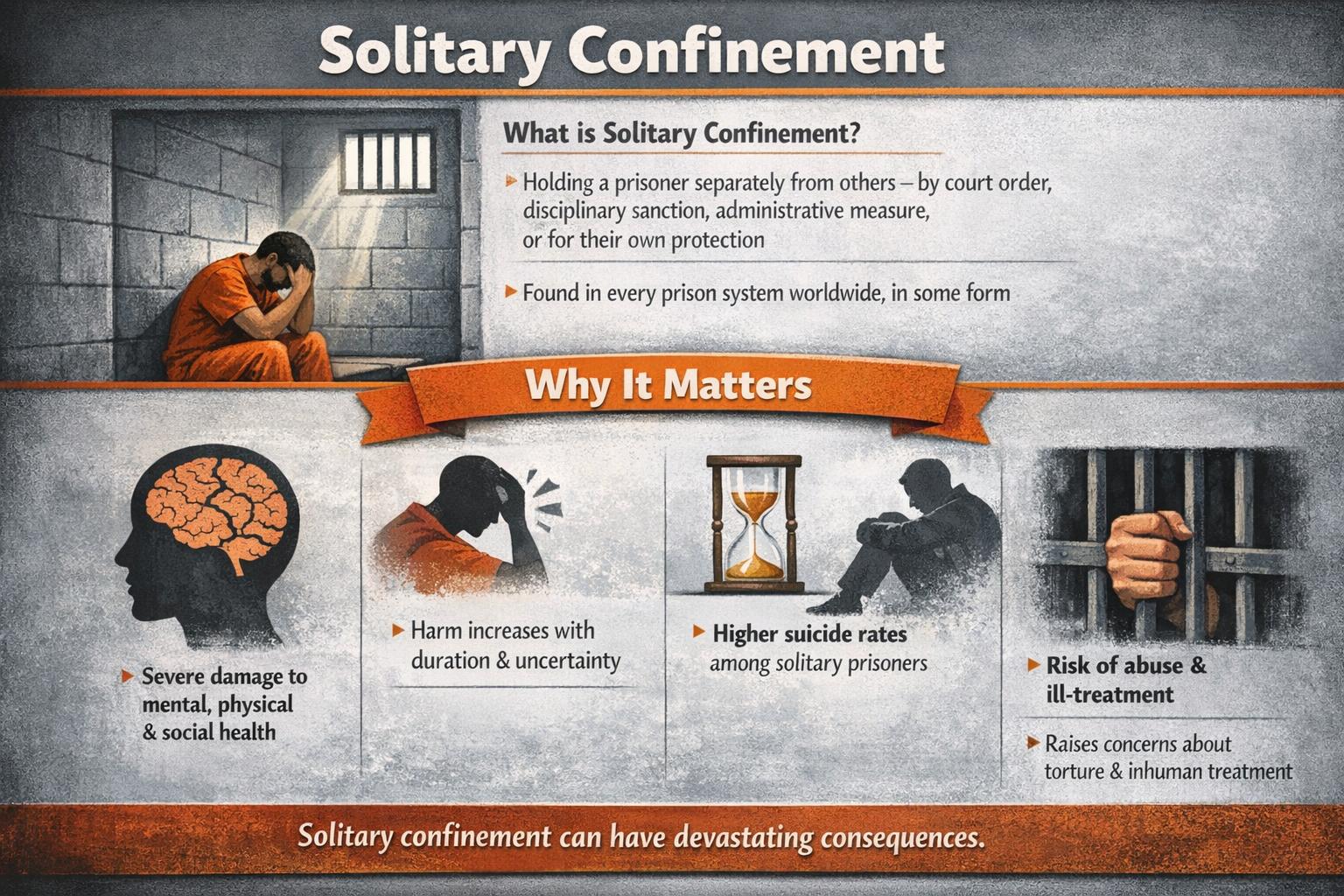
What is Solitary Confinement?
- Holding a prisoner separately from others — by court order, disciplinary sanction, administrative measure, or for the prisoner’s own protection
- Found in every prison system worldwide, in some form
Why It Matters
- Causes severe damage to mental, somatic, and social health
- Harm is immediate and grows with duration and indeterminacy
- Prisoners in solitary confinement have a significantly higher suicide rate than the general prison population
- Creates conditions for deliberate ill-treatment, away from the scrutiny of other prisoners and staff
- May raise issues under the prohibition of torture and inhuman or degrading treatment
The CPT’s Position
- Solitary confinement is a central concern for the CPT on every prison visit
- Delegations routinely interview prisoners in solitary to assess conditions, treatment, and placement procedures
- Particularly strong reservations regarding the solitary confinement of juveniles
The CPT’s Goals
- Reduce resort to solitary confinement to an absolute minimum
- Ensure it lasts only for the shortest necessary period
- Make each solitary regime as positive as possible
- Guarantee full accountability through transparent procedures
Solitary confinement of prisoners is found, in some shape or form, in every prison system. The CPT has always paid particular attention to prisoners undergoing solitary confinement, because it can have an extremely damaging effect on the mental, somatic and social health of those concerned.
This damaging effect can be immediate and increases the longer the measure lasts and the more indeterminate it is. The most significant indicator of the damage which solitary confinement can inflict is the considerably higher rate of suicide among prisoners subjected to it than that among the general prison population. Clearly, therefore, solitary confinement on its own potentially raises issues in relation to the prohibition of torture and inhuman or degrading treatment or punishment. In addition, it can create an opportunity for deliberate ill-treatment of prisoners, away from the attention of other prisoners and staff. Accordingly, it is central to the concerns of the CPT and, on each visit, delegations make a point of interviewing prisoners in solitary confinement in order to examine their conditions of detention and treatment and to check the procedures for deciding on such placements and reviewing them. In this section of its General Report, the CPT sets out the criteria it uses when assessing solitary confinement. The Committee believes that if these criteria are followed, it should be possible to reduce resort to solitary confinement to an absolute minimum, to ensure that when it is used it is for the shortest necessary period of time, to make each of the solitary confinement regimes as positive as possible, and to guarantee that procedures are in place to render the use of this measure fully accountable.
The CPT understands the term “solitary confinement” as meaning whenever a prisoner is ordered to be held separately from other prisoners, for example, as a result of a court decision, as a disciplinary sanction imposed within the prison system, as a preventative administrative measure or for the protection of the prisoner concerned. A prisoner subject to such a measure will usually be held on his/her own; however, in some States he/she may be accommodated together with one or two other prisoners, and this section applies equally to such situations.
As regards more specifically the solitary confinement of juveniles, a practice concerning which the CPT has particularly strong reservations, reference should also be made to the comments made by the Committee in its 18th General Report.
This section does not apply to the isolation of prisoners for medical reasons, as the grounds for such a measure are of a fundamentally different nature.