 0
0
 0
0
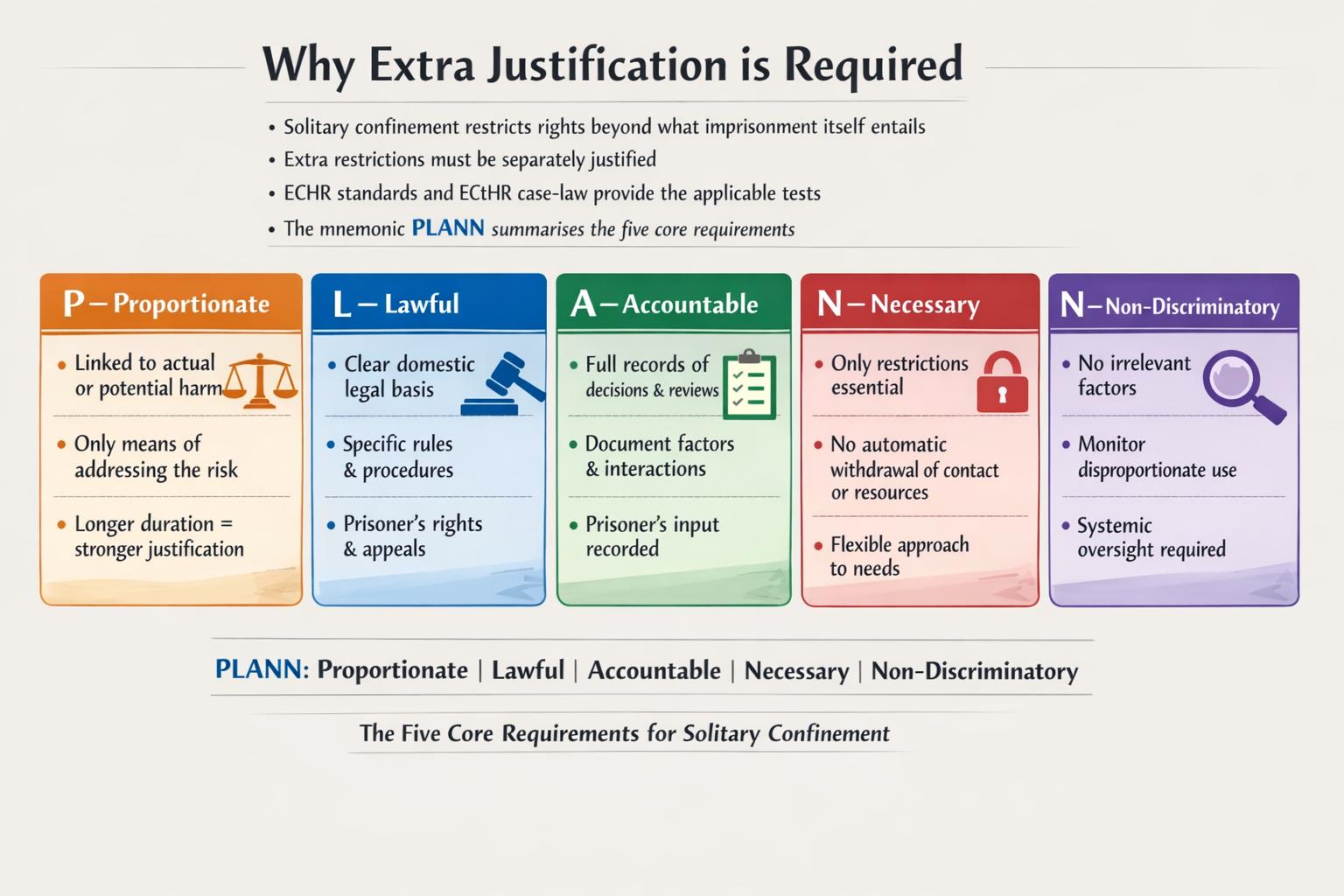
Why Extra Justification is Required
- Solitary confinement restricts rights beyond what imprisonment itself entails
- Extra restrictions must be separately justified
- ECHR standards and ECtHR case-law provide the applicable tests
- The mnemonic PLANN summarises the five core requirements
P — Proportionate
- Restriction must be linked to actual or potential harm caused or faced by the prisoner
- Solitary confinement is a serious restriction → the harm justifying it must be equally serious
- Must be the only means capable of addressing the risk
- Longer duration = stronger justification required + greater effort to ensure effectiveness
- Most jurisdictions limit it to the most serious disciplinary offences — this principle applies universally
L — Lawful
- Every permitted form must have a clear domestic legal basis
- The law must be communicated in a comprehensible form to those subject to it
- Law must specify: 1) precise circumstances for imposition; 2) authorised decision-makers; 3) procedures to be followed; 4) prisoner’s right to make representations; 5) obligation to give fullest possible reasons (with limited security exceptions); 6) frequency and procedure for reviews; 7) procedures for appeal
- Each type of solitary confinement regime must be clearly differentiated in law
A — Accountable
- Full records must be kept of all decisions and all reviews
- Records must document: factors considered, information relied upon, prisoner’s input (or refusal)
- All staff interactions during solitary confinement must be recorded, including: 1) attempts to engage with the prisoner; 2) the prisoner’s responses
N — Necessary
- Only restrictions necessary for safe, orderly confinement and the requirements of justice are permissible
- No automatic withdrawal of: 1) visits, telephone calls, correspondence; 2) access to resources normally available (e.g. reading materials)
- Regime must be flexible enough to relax any restriction not individually necessary
N — Non-discriminatory
- Only relevant factors may be considered; irrelevant factors must be excluded
- Authorities must actively monitor use of solitary confinement to detect: 1) disproportionate use against individuals or groups; 2) use without objective and reasonable justification
- Systemic oversight is required, not merely case-by-case review
Solitary confinement further restricts the already highly limited rights of people deprived of their liberty. The extra restrictions involved are not inherent in the fact of imprisonment and thus have to be separately justified. In order to test whether any particular imposition of the measure is justified, it is appropriate to apply the traditional tests enshrined in the provisions of the European Convention on Human Rights and developed by the case-law of the European Court of Human Rights. The simple mnemonic PLANN summarises these tests.
Proportionate: any further restriction of a prisoner’s rights must be linked to the actual or potential harm the prisoner has caused or will cause by his or her actions (or the potential harm to which he/she is exposed) in the prison setting. Given that solitary confinement is a serious restriction of a prisoner’s rights which involves inherent risks to the prisoner, the level of actual or potential harm must be at least equally serious and uniquely capable of being addressed by this means. This is reflected, for example, in most countries having solitary confinement as a sanction only for the most serious disciplinary offences, but the principle must be respected in all uses of the measure. The longer the measure is continued, the stronger must be the reason for it and the more must be done to ensure that it achieves its purpose.
Lawful: provision must be made in domestic law for each kind of solitary confinement which is permitted in a country, and this provision must be reasonable. It must be communicated in a comprehensible form to everyone who may be subject to it. The law should specify the precise circumstances in which each form of solitary confinement can be imposed, the persons who may impose it, the procedures to be followed by those persons, the right of the prisoner affected to make representations as part of the procedure, the requirement to give the prisoner the fullest possible reasons for the decision (it being understood that there might in certain cases be reasonable justification for withholding specific details on security-related grounds or in order to protect the interests of third parties), the frequency and procedure of reviews of the decision and the procedures for appealing against the decision. The regime for each type of solitary confinement should be established by law, with each of the regimes clearly differentiated from each other.
Accountable: full records should be maintained of all decisions to impose solitary confinement and of all reviews of the decisions. These records should evidence all the factors which have been taken into account and the information on which they were based. There should also be a record of the prisoner’s input or refusal to contribute to the decision-making process. Further, full records should be kept of all interactions with staff while the prisoner is in solitary confinement, including attempts by staff to engage with the prisoner and the prisoner’s response.
Necessary: the rule that only restrictions necessary for the safe and orderly confinement of the prisoner and the requirements of justice are permitted applies equally to prisoners undergoing solitary confinement. Accordingly, during solitary confinement there should, for example, be no automatic withdrawal of rights to visits, telephone calls and correspondence or of access to resources normally available to prisoners (such as reading materials). Equally, the regime should be flexible enough to permit relaxation of any restriction which is not necessary in individual cases.
Non-discriminatory: not only must all relevant matters be taken into account in deciding to impose solitary confinement, but care must also be taken to ensure that irrelevant matters are not taken into account. Authorities should monitor the use of all forms of solitary confinement to ensure that they are not used disproportionately, without an objective and reasonable justification, against a particular prisoner or particular groups of prisoners.