 2
2
 0
0
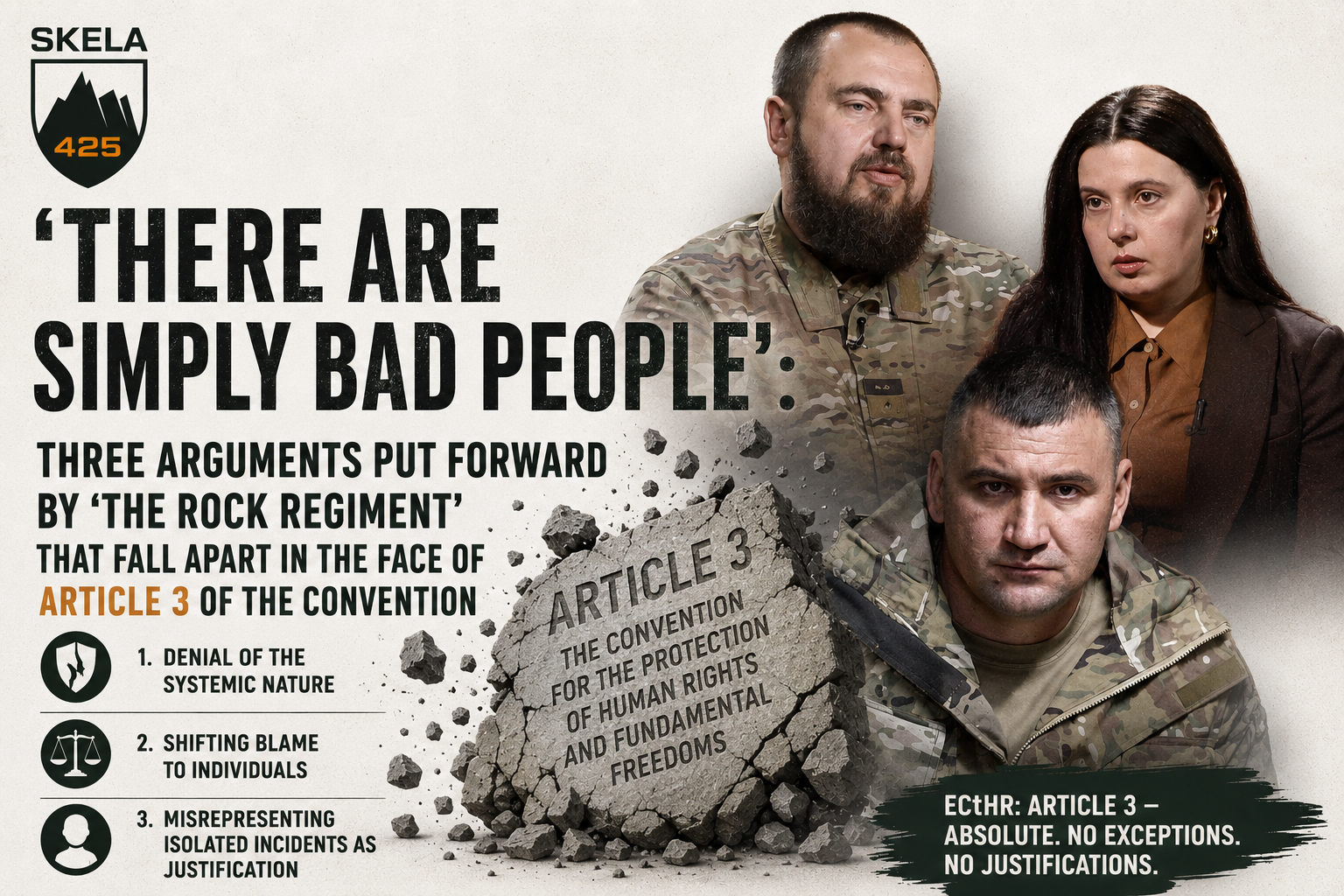
Radio Svoboda (Radio Liberty), in its programme “Svoboda Live”, released a conversation with Andrii Surai, head of the civil-military cooperation group of the 425th Separate Assault Regiment “Skelia”, under the title “‘Skelia’ from the inside: we ask a representative of the regiment about the deaths of soldiers, beatings and torture”. The context of this conversation is as follows. Large-scale inspections are under way in one of the largest assault regiments of the Armed Forces of Ukraine, and the regiment’s commander, Yurii Harkavyi, has been suspended from command. The reason is the testimony of servicemen who passed through “Skelia” and now report beatings and abuse in the regiment. In addition, relatives of deceased recruits claim that the men were not provided with timely medical assistance, while those who were on opioid substitution therapy were denied it and were beaten if methadone was found on them. Journalists of the outlet “Babel” have recorded 25 non-combat deaths over the past six months; most of the deceased men had not spent even a month in the regiment, and pneumonia is predominantly indicated as the official cause of these deaths. The relatives of the recruits mostly disagree with the official diagnoses and believe that their loved ones were abused before their deaths.
This public discussion deserves a separate legal commentary. Not because of the emotions, but because of the arguments voiced in it. These arguments are so typical, so recognisable and so legally flawed that they are worth examining calmly, consistently and with references to the case-law of the European Court of Human Rights. First — the direct speech of the participants in the conversation, then — my analysis.
Presenter: “As of now, we have a statement by the Military Ombudswoman Olha Reshetylova, who, for example, said that as far back as a year ago she was in “Skelia” and documented the testimony of people who likewise spoke about torture on the polygraph at that time.”
Representative of “Skelia”: “Stop, stop, stop. Torture or beating?”
Presenter: “Do you draw some great distinction? Beating, torture?”
Representative of “Skelia”: “Look, a beating is when someone got beaten. It could be… Excuse me, suppose I start settling scores with someone in the street, and one of us beats the other. Is that torture or a beating?”
Presenter: “As I understand it, this is not simply about settling scores.”
Representative of “Skelia”: “No, for me torture is when someone has tied a person up and derives some kind of pleasure from it.”
Presenter: “And wrapping people in tape — as the outlet “Babel” wrote… That people are wrapped in tape, and that too, as I understand it…”
Representative of “Skelia”: “Again, we run entirely into “Babel”, which took this from the testimony of one, single…”
Presenter: “Since we have already started raising this topic of deaths or beatings: for example, Katia Lykhohliad, whom we mentioned, literally a few days ago published a photo of a man — a volunteer, wounded after combat, young, idealistic, not drug-dependent — who was beaten in “Skelia” as a preventive measure. I think you have seen that photograph.”
Representative of “Skelia”: “That is bad. It must be investigated, and the person who beat him like that must bear responsibility for it.”
Presenter: “Have you seen this story?”
Representative of “Skelia”: “I am seeing it now.”
Presenter: “It has been up for three days already, you can take a look.”
Representative of “Skelia”: “You understand, I do not deal with this constantly… It is bad, it is unworthy to treat servicemen like that, and it must be investigated.”
Presenter: “And why are people beaten in “Skelia” like that as a preventive measure?”
Representative of “Skelia”: “Why do people beat people at all? Why? Because there are some bad people who believe that if they are stronger, they are automatically right.”
Three arguments were voiced in this dialogue.
The first argument: a beating is not torture, because one can also get into a fight in the street.
The second argument: torture is when someone has tied a person up and derives pleasure from it.
The third argument: people beat people because there are some bad people.
Each of these three arguments is a classic technique of neutralisation, and each of them falls apart at the very first juxtaposition with Convention standards.
Let us begin with the fundamentals. The object and purpose of the Convention as an instrument for the protection of individual human beings require that its provisions be interpreted and applied so as to make its safeguards practical and effective (Marguš v. Croatia [GC], § 127). This means, among other things, that no terminological games — “beating or torture?” — can remove the facts of ill-treatment from the scope of Article 3 of the Convention.
Article 3 of the Convention enshrines one of the fundamental values of democratic society. It prohibits in categorical terms — without any exceptions — torture, inhuman or degrading treatment and punishment, irrespective of the circumstances or the victim’s conduct (97 members of the Gldani Congregation of Jehovah’s Witnesses and 4 Others v. Georgia, § 95; A. and Others v. the United Kingdom [GC], § 126; A.V. v. Ukraine, § 47; Aleksakhin v. Ukraine, § 49; Aliev v. Ukraine, § 129; Bekos and Koutropoulos v. Greece, § 45; Buglov v. Ukraine, § 68; Chember v. Russia, § 48; Cobzaru v. Romania, § 60). The prohibition is absolute. It knows no exceptions — not for war, not for “combat cohesion training”, not for “prevention”, and not for “educational work with personnel”.
Now to the first argument — about the street fight. The analogy with settling scores in the street is legally untenable for one simple reason: it removes the main element from the picture — the context of authority, subordination and control. A serviceman on the premises of a military unit is not a participant in a symmetrical conflict between two private individuals in the street. He is within a hierarchical structure, under the authority of commanders, without any real possibility of avoiding contact with those who use violence against him, and without the possibility of simply walking away. That is precisely why the European Court regards servicemen — just like detainees and prisoners — as persons under the control of the State, and the State as bearing full responsibility for their treatment.
The Court’s case-law concerning the armed forces is elaborated in detail. Thus, compulsory military service often involves an element of suffering, as do measures depriving a person of liberty (Chember v. Russia, § 49). Many acts that would constitute inhuman or degrading treatment in respect of prisoners may not reach the threshold of ill-treatment when they occur in the armed forces, provided that they serve the specific mission of the armed forces, for example as part of combat training (Chember v. Russia, § 49). However, the State is under an obligation to ensure that a citizen performs military service in conditions compatible with respect for his human dignity, that the procedures and methods of military training do not subject him to pain and suffering of an intensity exceeding the unavoidable level of hardship inherent in military training, and that, given the practical demands of such service, his health and well-being are adequately secured, in particular by providing him with the medical assistance he requires (Chember v. Russia, § 50).
Moreover, the State is under an obligation to put in place rules determining the level of danger to life or health that may arise not only from the very nature of military activities but also from the human factor that comes into play when the State conscripts ordinary citizens into military service. Such rules must require the adoption of practical measures aimed at the effective protection of servicemen against the dangers inherent in military life, and appropriate procedures for identifying the shortcomings and errors liable to be committed in that regard by those in charge at different levels (Chember v. Russia, § 50). In other words, the “human factor” — including “bad people” — is not an excuse for the State, but a direct subject of its positive obligations. The State is obliged to foresee that in hierarchical militarised structures violence is a foreseeable risk, and it is obliged to have a system that identifies and neutralises that risk.
Even if physical exercise is an integral part of military training, in order to be compatible with Article 3 of the Convention it must not exceed the level beyond which it endangers the health of servicemen or offends their human dignity (Chember v. Russia, § 52). In Chember v. Russia the applicant was forcibly subjected to physical exercise to the point of losing consciousness. His commanders applied this punishment deliberately, in full knowledge of his specific health problems and without any military necessity that could have prompted such a course of action. In those circumstances, the punishment caused the applicant intense physical suffering and went beyond the minimum level of severity (Chember v. Russia, § 56). Let us note: Chember v. Russia concerned physical exercise. Here, however, we are dealing with the beating of a wounded volunteer “as a preventive measure”. If the Court classified forced squats to the point of losing consciousness as a violation of Article 3 of the Convention, then what the Convention classification of the deliberate beating of a wounded person for disciplinary or “educational” purposes would be is a rhetorical question.
Now to the second argument — “torture is when someone has tied a person up and derives pleasure from it”. This definition has nothing in common with the law. Neither Article 3 of the Convention, nor Article 1 of the UN Convention against Torture, nor the case-law of the European Court contains any mention of the “pleasure” of the torturer. What is legally significant are entirely different elements: the intensity of the suffering, the intentionality, and, for classification specifically as torture, a special purpose: obtaining information or confessions, punishment, intimidation, discrimination. A beating “as a preventive measure” is precisely, in its purest form, the intentional infliction of suffering for the purposes of punishment and intimidation. In other words, the formula “for prevention” does not mitigate the classification but, on the contrary, points directly to the purposive, instrumental character of the violence — a feature that brings the treatment closer to torture, not further from it. The subjective “pleasure” of the perpetrator lies outside the scope of legal assessment: the sadist who derives enjoyment and the “educator” who is “merely maintaining discipline” commit, from the standpoint of the Convention, one and the same act.
Now to the third argument — “there are simply bad people”. This argument aims to shift the conversation from the systemic plane to the individual one: allegedly, this is about excesses of individual persons, not about the practice of a structure. But even in its strongest version this argument does not work, and here is why. Article 3 of the Convention requires the State to take measures designed to ensure that individuals within its jurisdiction are not subjected to torture or inhuman or degrading treatment, including ill-treatment administered by private individuals (Milena Felicia Dumitrescu v. Romania, § 50; Voykin and Others v. Ukraine, §§ 112-119; Z and Others v. the United Kingdom [GC], §§ 73-75; S., V. and A. v. Denmark [GC], § 124; Burlya and Others v. Ukraine, § 121; X and Others v. Bulgaria, § 177; O’Keeffe v. Ireland [GC], § 144; Orlik v. Ukraine, § 35). That is, even if the perpetrators were entirely private “bad people” without shoulder straps and positions, the State’s positive obligations would not disappear. And in this case we are not talking about private individuals: we are talking about violence within a military structure, that is, about acts committed by persons acting within the State hierarchy, on State premises, against persons under the control of the State. This is the most onerous configuration of responsibility for the State, not the lightest.
Article 3 of the Convention requires the authorities to conduct an effective investigation into alleged ill-treatment, even if such treatment has been inflicted by private individuals (T.M. and C.M. v. the Republic of Moldova, § 38; Aleksandr Nikonenko v. Ukraine, § 43; Burlya and Others v. Ukraine, § 125). Article 3 of the Convention requires the authorities to conduct an effective official investigation into alleged ill-treatment, even if such treatment has been administered by private individuals (97 members of the Gldani Congregation of Jehovah’s Witnesses and 4 Others v. Georgia, § 97; Biser Kostov v. Bulgaria, § 77; Hovhannisyan v. Armenia, § 55; Denis Vasilyev v. Russia, § 99; O’Keeffe v. Ireland [GC], § 170). The positive obligations to carry out an official investigation into ill-treatment cannot be considered to arise only in cases concerning acts of ill-treatment by State agents (Milena Felicia Dumitrescu v. Romania, § 51; M.C. v. Bulgaria, § 151).
And here it is important to say something about the phrase that was voiced in the discussion as a supposedly sufficient answer: “That is bad. It must be investigated, and the person who beat him like that must bear responsibility.” This phrase is in itself correct, but it is only the beginning, not the end, of the Convention analysis. An effective investigation within the meaning of Article 3 of the Convention is not an abstract wish. It is an investigation capable of leading to the establishment of the facts of the case and to the identification and punishment of those responsible; an investigation initiated promptly and conducted with reasonable expedition; an investigation independent of those whom it concerns — which, in the context of violence within a military structure, means the inadmissibility of a situation in which the inquiry is in fact controlled by the very structure whose commanders or fellow servicemen the allegations concern; an investigation that allows a sufficient element of public scrutiny and ensures the participation of the victim. And most importantly: when there is a statement by the Military Ombudswoman about testimony documented as far back as a year ago, media publications, photographs and repeated reports from various unconnected sources, the State no longer has the right to treat each episode as an isolated excess of a “bad person”. The recurrence of reports of the same type is in itself a fact requiring the verification of precisely the systemic practice: who knew, who ought to have known, who was obliged to prevent it and who failed to prevent it.
Finally — on vulnerability. Article 3 of the Convention imposes on States an obligation to protect the physical and psychological integrity of the individual. The positive obligations of the authorities in this context may include a duty to maintain and apply in practice an adequate legal framework affording protection against acts of violence by private individuals; in particular, children and other vulnerable persons are entitled to effective protection (M. and C. v. Romania, §§ 107-111; M.P. and Others v. Bulgaria, § 108; R.B. v. Estonia, § 78). A serviceman wounded after combat operations, who is inside a hierarchical structure without the possibility of leaving it, is a textbook example of a vulnerable person within the meaning of this case-law. The beating of such a person “as a preventive measure” is neither a “human factor” nor “bad people”. It is precisely the situation for the prevention of which Article 3 of the Convention exists.
Let us summarise.
The question “torture or beating?” is not a question that relieves anyone of responsibility: both categories are covered by the absolute prohibition of Article 3 of the Convention, and a dispute over classification is a dispute about the degree of gravity of the violation, not about its existence. Defining torture through the “pleasure” of the perpetrator is a legal fiction: the law operates with purpose, intentionality and the intensity of the suffering, and the purpose of “prevention” aggravates that classification rather than mitigates it. The explanation “there are bad people” does not relieve the State of responsibility: even in respect of private individuals the State bears positive obligations of protection and investigation, and in respect of violence within its own military structures — all the more so. And finally: the acknowledgment “this is bad, it must be investigated” has value only when it is followed by an investigation that meets the Convention criteria of effectiveness, independence, promptness and public scrutiny, and which examines not only the individual episode but also the question of the existence of a systemic practice. Everything else is the rhetoric of neutralisation, which the ECtHR has seen hundreds of times already and to which it has never once attached legal significance.
Source: Radio Svoboda (Radio Liberty), programme “Svoboda Live”, “‘Skelia’ from the inside: we ask a representative of the regiment about the deaths of soldiers, beatings and torture” (conversation with Andrii Surai, head of the civil-military cooperation group of the 425th Separate Assault Regiment “Skelia”), July 2026, https://www.facebook.com/reel/1368113928799671/ (page: https://www.facebook.com/radiosvoboda.org).


