 1
1
 0
0
On 15 March 2025, Belgrade saw one of the largest peaceful demonstrations in Serbia’s recent history, the culmination of a protest movement that had been building for months after the collapse of a concrete canopy at the railway station in Novi Sad in November 2024, in which people died. Students and a significant part of society demanded that the State uphold the rule of law and hold those responsible to account.
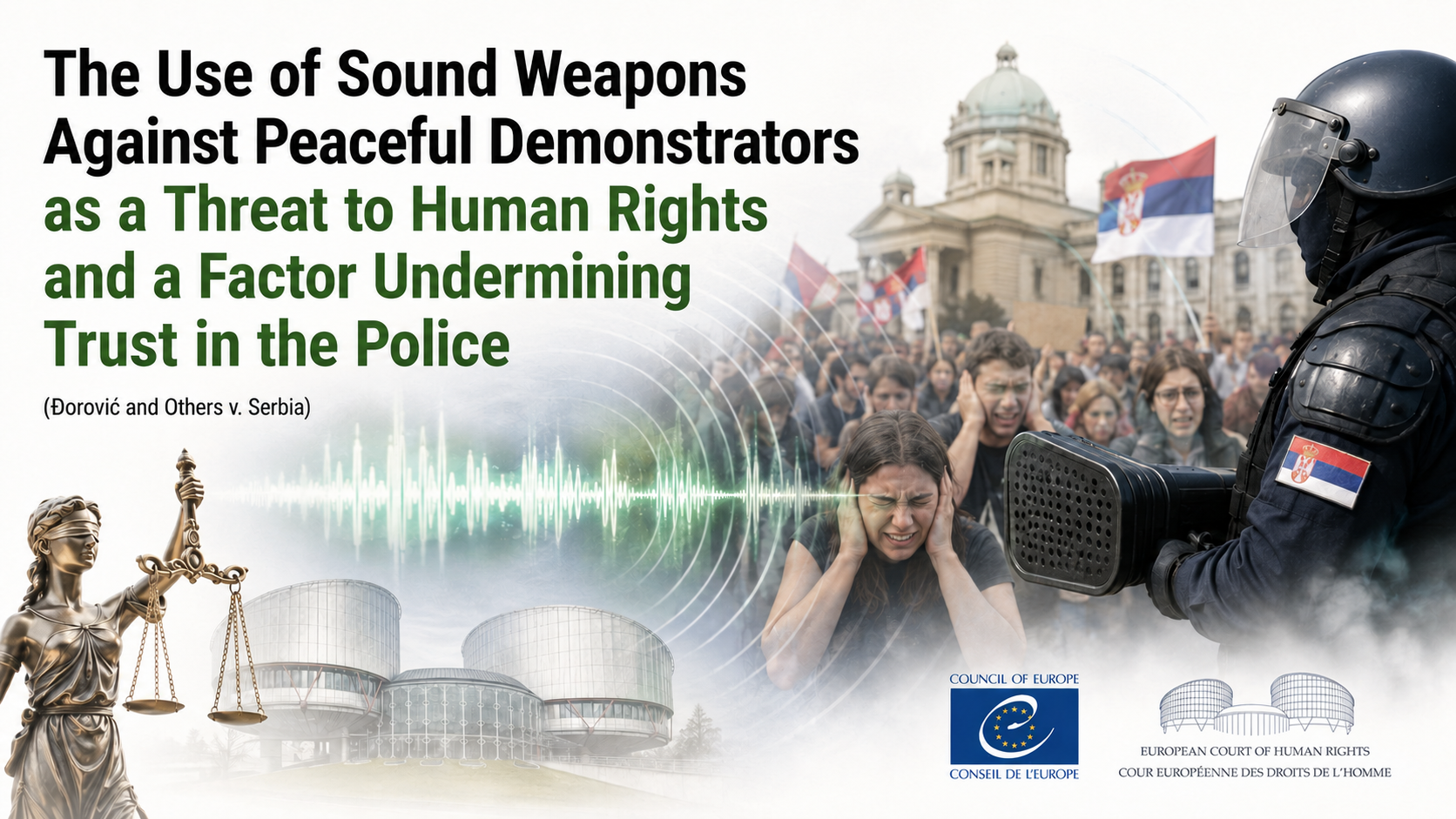
The applicants in the case – 47 Serbian citizens – took part in this peaceful gathering. At around 7 p.m., at the moment when the participants were observing a fifteen-minute silence in memory of the victims, the crowd was suddenly struck by a powerful sound wave. According to the applicants’ own accounts, they experienced sudden instinctive fear, panic, shock, accelerated heartbeat, trembling, hearing problems, nausea, vomiting, tachycardia and similar symptoms. Some sustained bodily injuries as a result of the panic-induced crush. Witnesses described how it all began like a human “avalanche”: people ran, fell and screamed without understanding what was happening; the sound resembled the roar of an approaching aircraft or train. Up to four thousand people reported a similar experience, and many of them sought medical assistance in the following days because of persisting symptoms.
The authorities’ response was markedly one of denial. The Minister of Internal Affairs initially stated that the ministry possessed no sonic cannon or similar weapon, but later confirmed that the police owned acoustic systems (in particular the LRAD 100X and LRAD 450XL), acquired in 2021, while maintaining that they had never been used because they are regarded as unlawful weapons under Serbian law. The Serbian Law on the Police does not provide for the use of any kind of sonic or acoustic weapon – that is, there is a legal vacuum in which any use of such a weapon would be ultra vires. Activists submitted to the United Nations office in Belgrade a petition signed by more than half a million people, demanding an international investigation. The authorities, by contrast, turned for assistance to the United States Federal Bureau of Investigation and to the Federal Security Service of the Russian Federation. The published FSB report concluded that acoustic devices had not been used and advanced the theory of a “staged provocation” with movements synchronised via smartphones; independent experts criticised this report as failing to meet the formal requirements for documents of this kind, lacking methodology and an evidentiary basis, and more closely resembling propaganda.
In April 2025, the Council of Europe Commissioner for Human Rights carried out a mission to Serbia, focused on policing during the demonstrations and on the working conditions of civil society and human rights defenders. He stressed the critical importance of preserving the principles of democratic policing for the safety of all citizens and warned the authorities against stigmatising protesters through discourse that falsely portrays the protests as a “colour revolution”. The Commissioner also expressed concern about the unfavourable environment for non-governmental organisations and human rights defenders, aggravated by reports of the use of spyware against human rights defenders and journalists, stigmatisation campaigns and leaks of personal data.
THE NATURE OF SONIC WEAPONS AND THE PARALLEL WITH “HAVANA SYNDROME”
Acoustic (sonic) weapons operate through the propagation of sound – pressure oscillations travelling through an elastic medium (in particular air) – directed at striking a target. Most such devices are based on ultrasound, low frequencies or infrasound emitted at high intensity levels. So-called “long-range acoustic devices” (LRADs, or “sound cannons”) emit, instead of bullets, sound waves of extreme loudness. Ordinary sound weakens with distance, yet the acoustic signal of such a device can be heard loudly at distances of up to a kilometre, because the waves are emitted under high pressure. The impact of such a wave on the eardrum is capable of causing significant physical injury, but no less important is the psychological harm of an “invisible attack”. Despite the labelling of such means as “non-lethal” or “less lethal”, they are open to the same objections as other technologies bearing this label, and their use together with kinetic means in fact increases the risk of death. In international law, acoustic weapons have no authoritative definition and are not regulated, nor are they the subject of dedicated multilateral policy discussions.
This phenomenon is usefully considered in connection with the so-called “Havana syndrome” – a set of unexplained health disorders (headache, nausea, balance disturbances, auditory and cognitive symptoms) attributed to the possible effect of acoustic or directed-energy sources. Common to both phenomena is a mechanism that is invisible, easily denied and difficult to document, yet capable of causing entirely real physiological and psychological harm. It is precisely this combination – the reality of injury in the absence of obvious traces – that makes such means especially dangerous from the standpoint of human rights protection: the harm occurs, but proving it is made difficult, which creates room for denial with impunity.
WHY SUCH POLICING PRACTICES THREATEN HUMAN RIGHTS
The use of a sonic weapon against a peaceful assembly engages several Convention rights at once. First of all, Article 3 is concerned (prohibition of torture and of inhuman or degrading treatment), and in certain circumstances Article 2 as well (the right to life): a means that causes mass panic, bodily injuries and potentially serious health consequences for a large number of people is fully capable of reaching the threshold of severity envisaged by Article 3. The State’s positive obligations under this Article, as formulated in the Court’s case-law, comprise three elements: the obligation to put in place a legislative and regulatory framework of protection; in clearly defined circumstances, the obligation to take operational measures to protect specific individuals from a risk of prohibited treatment; and the obligation to carry out an effective investigation of arguable allegations of such treatment. Alongside this, Article 8 is engaged (respect for private life, which encompasses a person’s physical and psychological integrity), as are Article 11 (freedom of peaceful assembly) and Article 10 (freedom of expression).
The fundamental flaw of a sonic weapon lies in its indiscriminate character. A sound wave cannot be directed solely at those particular individuals who are allegedly behaving aggressively – it strikes the entire crowd without distinction: peaceful protesters, passers-by, journalists, medics, the elderly, children. This makes it practically impossible to comply with the requirement of proportionality, which is an indispensable condition for any lawful use of force by law-enforcement officers. Interference with Convention rights is lawful only where it is prescribed by law, pursues a legitimate aim and is necessary and proportionate in a democratic society. In the present case, even the first condition is not met: since the Serbian Law on the Police does not provide for the use of a sonic weapon, any use of it is not “prescribed by law” and is therefore unlawful under domestic law itself.
A particular threat is posed by the “invisible” and easily deniable character of such an impact. Where the harm is real but difficult to prove, the burden of proof in effect shifts onto the victims, and the State is tempted to deny the very fact that the weapon was used. This generates a structural risk of impunity, which is itself a threat to human rights, as it renders impossible the effective protection and restoration of the violated right. Finally, the use of such means has a pronounced chilling effect: the awareness that participation in the next protest may turn into a sudden attack on one’s health deters people from exercising freedom of peaceful assembly and freedom of expression. The matter therefore concerns not only harm to specific applicants at a specific moment, but also a preventive, future-oriented risk to an indeterminate and very wide circle of persons.
THE EROSION OF TRUST IN THE POLICE
Democratic policing rests on legitimacy and the consent of society. According to the classic principles of policing, the effectiveness of the police depends not on fear but on approval, voluntary cooperation and the trust of the population. The use of a weapon that harms peaceful citizens turns the very protective function of the police inside out, transforming a body intended to safeguard people’s safety into a source of danger to them. Such an inversion destroys the social contract on which policing by consent rests, and has long-term consequences for public safety, for people’s willingness to cooperate with the police, and for the rule of law in general.
Trust is destroyed not only by the very fact of the possible use of a weapon, but also by the pattern of the authorities’ subsequent conduct – denial and concealment. The Minister’s contradictory statements (first a denial of the very existence of sonic cannons, then an admission of their acquisition in 2021 coupled with a denial of their use), and especially the handing over of the “investigation” to a foreign special service – the Federal Security Service of the Russian Federation – strip the process of any signs of independence and impartiality. A report prepared by such a service and assessed by experts as propagandistic and methodologically untenable is not only incapable of establishing the truth but also finally undermines public trust. An investigation that is not independent, impartial, prompt and capable of leading to the identification and punishment of those responsible does not satisfy the procedural limb of Article 3 of the Convention and at the same time destroys the legitimacy of the law-enforcement system.
The erosion of trust is deepened by accompanying practices: the stigmatisation of protesters as participants in a “colour revolution”, discrediting campaigns, reports of the use of spyware against journalists and human rights defenders, and leaks of personal data. All of this narrows civic space and entrenches the perception of the police as an instrument of political pressure rather than as a service to society. The only path to restoring trust in such circumstances is an effective, independent and impartial investigation, full transparency as to the means available and the circumstances of their possible use, and genuine accountability of those responsible. In the absence of this, the State loses not only trust in the police but also the capacity to maintain public order by methods compatible with democracy.
A DETAILED ANALYSIS OF THE APPLICATION OF RULE 39 OF THE RULES OF THE EUROPEAN COURT OF HUMAN RIGHTS
Rule 39 of the Rules of Court governs interim (provisional) measures. Formally, it is contained not in the text of the Convention itself but in the Rules of Court, and it allows the Court, in exceptional circumstances – at the request of a party or of any other person concerned, or of its own motion – to indicate to the parties any interim measure which it considers should be adopted. Although formally this is an “indication”, the binding force of such measures derives from Article 34 of the Convention (the right of individual application): a State’s failure to comply with a Rule 39 measure may constitute a violation of Article 34. This approach was established in the Grand Chamber judgment Mamatkulov and Askarov v. Turkey [GC] and confirmed, in particular, in Paladi v. Moldova [GC], Savriddin Dzhurayev v. Russia and Olaechea Cahuas v. Spain. Interim measures are thus de facto binding for compliance.
The conditions for the application of Rule 39 form a settled test. A measure is taken only on an exceptional basis where there is, first, an imminent risk; secondly, irreparable harm; and thirdly, a Convention right of such a character that the harm caused would not subsequently be amenable to reparation, restoration or adequate compensation. The burden of substantiating an imminent risk of irreparable harm rests on the applicant. Measures may be taken where this is necessary in the interests of the parties or of the proper conduct of the proceedings. The classic field of application of Rule 39 is cases concerning expulsion, extradition or forced return, in which the return of a person would expose them to a real risk of death (Article 2) or of torture or inhuman treatment (Article 3) – along the logic expressed as early as Soering v. the United Kingdom as regards non-return. Outside this field, interim measures are granted extremely rarely.
It is for this very reason that the decision in the present case is a notable and atypical example of the application of Rule 39, distinguished by several features at once. First, the measure has a preventive and future-oriented character: it is intended not to stop a specific imminent act against a named person at a known moment (such as a planned deportation), but to prevent an entire category of future conduct – any use of sonic devices for crowd control – at indeterminate future protests. Secondly, the measure has a general and collective character: it protects an indeterminate and exceptionally wide circle of persons, potentially the entire protesting community, rather than specific applicants who suffer individualised harm. Thirdly, it is open-ended in time – it operates “until further order”. Fourthly, it is addressed to the conduct of the State in the sphere of public-order maintenance and policing, rather than in the classic migration domain.
The Court’s reasoning was concise but telling. In granting the measure, the Court noted that the use of such a weapon for crowd control is unlawful under Serbian law, and also drew attention to the potentially serious health consequences for a large number of persons. It was precisely the combination of unlawfulness under domestic law with a grave and irreversible risk to the health of many people that, in the Court’s view, satisfied the threshold of imminence and irreparability of harm. At the same time, the Court strictly adhered to the principle of not prejudging the outcome: granting the measure does not mean that the Court has taken any position as to whether a sonic weapon was in fact used on 15 March 2025, and it does not affect any subsequent findings as to the admissibility or the merits of the case. Yet the very fact of granting the measure under such strict conditions signals at least the existence of an arguable (prima facie) complaint and of a real, rather than illusory, risk – otherwise the exceptional threshold of Rule 39 could not have been reached.
No less important for understanding the limits of Rule 39 is what the Court refused to grant. The applicants’ two other requests – not to allow the criminal prosecution of persons taking part in the public discussion of the events of 15 March, and to order the conduct of an effective investigation – the Court found to fall outside the Rule 39 procedure. This delineates the doctrinal limits of interim measures: Rule 39 is a shield against imminent irreparable physical harm, not an instrument for the preventive protection of the interests of freedom of expression or of the criminal process, nor a mechanism for compelling the conduct of an investigation. The latter is a matter of the State’s positive obligations, falling within the examination of the merits, rather than a subject for an interim measure. Such a position is consistent with the Court’s settled restrictive approach to Rule 39 and prevents it from being turned into a general means of influencing national policy.
Finally, an interim measure cannot exist in a vacuum: it is tied to existing or imminent proceedings. The Court therefore gave the applicants one month to submit a substantive application under Article 34 of the Convention. The State to which the measure is addressed is obliged to comply with it, and non-compliance risks a finding of a violation of Article 34; compliance is supervised by the Court and the Committee of Ministers. The significance of this case extends far beyond it: it is the first instance in the Court’s practice in which the question of acoustic (sonic) weapons has become the subject of an interim measure, and it will most likely shape European standards on “less lethal” crowd-control technologies and on the positive obligations of States. The case demonstrates the adaptability of Rule 39 beyond the migration paradigm – its suitability for responding to systemic risks in the sphere of public order – even though the Court formulated its measure cautiously and narrowly.
CONCLUSIONS
The case of Đorović and Others v. Serbia crystallises three interrelated propositions. First, the use of an indiscriminate, easily deniable weapon against peaceful assemblies is incompatible with the Convention: it engages Articles 3, 8, 10 and 11 and breaches the State’s positive obligations to protect people’s physical and psychological integrity and to carry out an effective investigation. Secondly, such practices, compounded by denial and by the imitation of an investigation by forces lacking independence, destroy the legitimacy and public trust on which democratic policing rests, transforming the police from a service of protection into a source of threat. Thirdly, Rule 39, traditionally a migration instrument, became in this case a rare preventive shield that protected an entire civic community from irreversible harm.
For Ukraine and other Council of Europe member States, this precedent is at once a warning and a standard. Crowd-control technologies require a clear legislative basis, strict observance of necessity and proportionality, independent oversight and an effective investigation of any allegations of their use. These requirements are entirely in keeping with the standards of the European Committee for the Prevention of Torture (CPT) on the use of force by law-enforcement officers and on the treatment of persons deprived of their liberty or under the control of the police. In the absence of these guarantees, the State risks losing both human rights and its own legitimacy: when the police use a weapon against citizens and then conceal it, what is lost is not only trust in the police but the very foundational condition of public order in a democratic society.