 0
0
 0
0
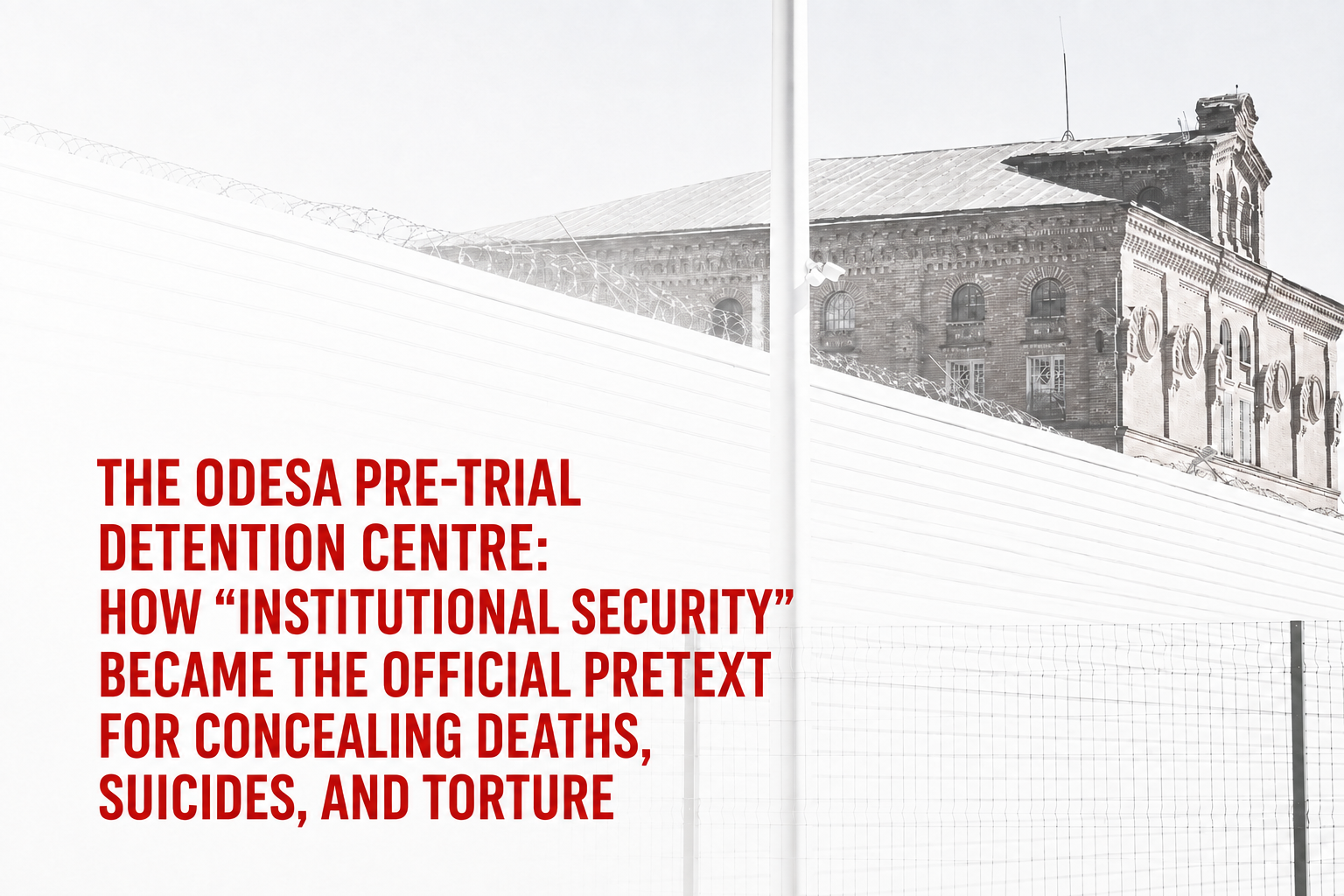
On 4 August 2026 I submitted a request for public information to the South-Central Interregional Directorate for the Execution of Criminal Punishments of the Ministry of Justice, asking that certified copies be provided of documents relating to cases of death, suicide, self-harm, extraordinary incidents, escapes or attempted escapes, and the death or injury of persons at the state institution “Odesa Pre-Trial Detention Centre” (SIZO) for the period 2010–2026.
On 8 September 2026 I received a reply signed by the Head of the Directorate, Colonel of the Internal Service Serhii Pryimak. Formally, this is an ordinary refusal couched in the language of “restricted-access information.” In substance, however, it is a document that, in its own words, line by line, describes the mechanism by which the penitentiary system has for decades shielded itself from any external scrutiny of what happens behind its walls.
FIVE POINTS OF THE REQUEST – FIVE REFUSALS ON THE SAME TEMPLATE
The Directorate responded to every point of the request with an almost identical formula: the requested documents allegedly contain personal data and/or information about the organisation of security and staff response procedures, disclosure of which could “create a threat to the security of the institution,” and that the harm from disclosure therefore outweighs the public interest in obtaining the information.
This formula was applied literally to everything: to internal-inquiry reports on deaths, to logs of extraordinary incidents, to registers of escapes and attempted escapes, to inquiry reports on cases of injury or death. There is no individual assessment of whether a specific document from 2010, 2015, or 2022 is genuinely still capable, today, of “creating a threat to security.” There is only a stock reference to paragraph 2 of part one of Article 22 of the Law of Ukraine “On Access to Public Information” and to the Law “On the Protection of Personal Data.”
It is telling that this is happening against the backdrop of an ongoing war, in which the greatest real threat to the security of state institutions is not the publication of decade-old mortality statistics, but the plain unwillingness to acknowledge systemic problems.
THE KEY ADMISSION – BURIED IN THE SECOND PARAGRAPH
But the true substance of the letter lies not in the legal rhetoric about personal data. It lies in the answer to point 2 of the request, which is phrased almost casually: the maintenance of a separate register recording completed acts of suicide is not provided for by the current orders of the State Criminal-Executive Service of Ukraine, and for that reason no such register is kept at the institution.
Let us read that again, slowly. The Odesa pre-trial detention centre – an institution through which thousands of people pass every year in a state of maximum psychological vulnerability, an institution with a longstanding reputation, documented in various sources, regarding conditions of detention – officially confirms that it simply keeps no centralised record of suicides. Not “classified,” not “restricted access” – it does not exist at all as a category of record-keeping.
This is not a technical gap. It is a systemic decision, taken at the level of departmental orders: where there is no obligation to keep a register, there is also no document that could ever be requested, disclosed, or produced in court or before the Committee for the Prevention of Torture. The absence of record-keeping is not the inaction of an individual head of institution; it is a safeguard against accountability built directly into the system.
AN INQUIRY INTO THE DESTRUCTION OF ITS OWN EVIDENCE
Another element of the letter deserves separate attention. The Directorate states that, for the purpose of a “full, comprehensive and objective establishment of the circumstances,” including verification of the existence, storage, and possible destruction of the requested documents, it sent a letter to the institution requesting that an internal inquiry be conducted pursuant to Order of the Ministry of Justice No. 356/5 of 12 March 2015.
In other words: the state itself is currently unable to state whether documents concerning deaths, injuries, and extraordinary incidents at the Odesa SIZO over sixteen years physically exist, or whether they have already been destroyed. The response to a request for access to information turns into an admission that access cannot even be assessed on a procedural level – because it is unknown whether there is anything to provide.
For an institution whose reputation is already burdened by a history of complaints about conditions and treatment of detainees, this is an ideal configuration of unaccountability: it is possible neither to confirm concealment of facts nor to refute it, since the primary documents themselves may, by now, have been destroyed “in accordance with the established procedure.”
WHY THIS MATTERS SPECIFICALLY FOR THE QUESTION OF TORTURE
The logic of this letter operates as a closed loop. Internal-inquiry reports on deaths or injuries are closed off as “personal data.” Logs of extraordinary incidents are closed off as “information about the security system.” A dedicated register of suicides does not exist in principle. And where verification mechanisms formally do exist (internal inquiries), their outcome may also be lost together with the destroyed documents.
It is precisely in this gap – between the absence of a mandatory register, a regime of restricted access, and uncertainty over the preservation of documents – that space opens up for concealing the most serious cases: deaths under unclear circumstances, suicides that may have resulted from being driven to despair, and bodily injuries inflicted by staff or by other detainees with the connivance of the administration. Where there is no mandatory register, there is no systemic trace. Where a document exists, it is protected as personal information. Where that protection proves insufficient, the document may already have been destroyed.
The Directorate further stresses that it is prepared to provide only aggregated quantitative statistics (as it claims was already done in the institution’s letter of 13 August 2026) – that is, bare figures without any context, without any possibility of verifying the circumstances of each case, and without any possibility of establishing systemic patterns – for example, whether cases of death or self-harm are concentrated in particular periods, under particular staff, or in particular cells.
CONCLUSION
The letter from the South-Central Interregional Directorate is not an isolated instance of bureaucratic delay. It is a telling example of how Ukraine’s penitentiary system, invoking both the protection of personal data and its own “security,” constructs a double barrier against external oversight: a legal one (restricting access to information) and a practical one (the absence of any obligation to keep records of the most sensitive events at all).
When an institution responsible for the life and health of persons held in custody officially admits that it keeps no register of suicides, while at the same time being unable to guarantee the preservation of other documents concerning deaths and injuries, the question ceases to be purely procedural. It becomes a question of whether the state is capable of seeing the scale of the problem of torture and ill-treatment in places of detention at all, when the primary data about it is structurally never created, or disappears before anyone manages to examine it.


