 0
0
 0
0
Michel Foucault’s analysis in Discipline and Punish remains one of the most productive theoretical instruments for understanding how power organises the bodies, space and behaviour of individuals. At the same time, the direct transfer of the Foucauldian model of discipline, developed on the material of the eighteenth and nineteenth centuries, onto the realities of the twentieth and twenty-first centuries requires substantial rethinking. Discipline has neither disappeared nor weakened – it has been transformed, has acquired new, more penetrating and less visible forms, and its principal purpose has become not so much the punishment of the body as the management of the risks that the unpredictable behaviour of the individual poses to political elites. On the basis of the key theses – social control, political elites, the expansion of social control, imprisonment as a form of social control, ill-treatment as a by-product of contemporary social control, and the figure of the disciplined person, Homo disciplinatus – we offer an integrated account of how the disciplinary matrix of the nineteenth century has evolved into a system of total, albeit covertly exercised, social control in the twenty-first century.
DISCIPLINE AS THE SPATIAL DISTRIBUTION OF INDIVIDUALS
Foucault emphasised that discipline is connected above all with the distribution of individuals in space. To this end it employs several methods, the first of which is enclosure – the specification of a place that is different from all others and closed in upon itself. What is at issue is the enclosed place of disciplinary monotony: the prison, the barracks, the psychiatric hospital and the hospital appear as spaces in which each individual is assigned a separate place, and each place corresponds to a separate individual. Discipline fundamentally does not permit the taking root of collective formations; it breaks up indistinct masses and those forms of community that attempt to escape from control into multiplicity, to dissolve into the crowd, to become elusive to power.
The history of the great confinement of beggars and vagrants, about which Foucault wrote, is merely the most visible, the most demonstrative episode of a far broader process. Alongside it there existed other, less noticeable but no less insidious and effective mechanisms of spatial control. It is precisely this capacity of discipline to organise complex spaces – at once architectural, functional and hierarchical – spaces that secure fixed positions and movements, delineate individual segments and establish operational links, that allows discipline to guarantee the docility of individuals and at the same time to ensure the best economy of time and gestures.
IMPRISONMENT AS A FORM OF SOCIAL CONTROL: THE PARADOX OF DECARCERATION
Today’s permanent problem of prison overcrowding fits perfectly precisely into the concept of discipline. Against the background of public calls to reduce imprisonment as a form of punishment and as a preventive measure, against the background of the rhetoric of decarceration in contemporary societies, a twofold process is taking place that is contradictory at first glance: the simultaneous expansion of imprisonment as an institution and the expansion of alternative, non-custodial means of social control. This is not a contradiction but the logical continuation of the very same concept of discipline about which Foucault wrote, carried to its practical absolute.
Imprisonment thus ceases to be exclusively a penal sanction in the narrow sense and turns into one of many instruments of social control, which coexists with and is complemented by probation, electronic monitoring, risk-assessment systems, administrative supervision and other forms of regulating behaviour outside places of deprivation of liberty. The expansion of non-custodial means of social control does not abolish imprisonment but embeds it in a broader network of disciplinary practices that covers a far larger share of the population than was possible under the exclusively carceral model of the nineteenth century.
ILL-TREATMENT AS A BY-PRODUCT OF CONTEMPORARY SOCIAL CONTROL
Discipline, introduced into the modern society of the nineteenth century through the emergence of the corresponding disciplinary institutions – the prison, the army, the psychiatric hospital, the hospital and so forth – creates a situation in which each individual is assigned a separate place, and each place its own individual. It is precisely in this logic of localising individuals in the cells of the disciplinary matrix that the explanation lies for why that which until recently was openly branded with disgust as torture has, as a result of very flexible operations, been converted into ill-treatment, which in turn has become an inherent attribute of contemporary imprisonment by definition.
It is fundamentally important that ill-treatment, and in some cases torture, is precisely a by-product of discipline and not its aim. This by-product is not important in itself – it is derivative of processes that are far more important for the system and that ensure the precise localisation of individuals in the cells of the contemporary disciplinary matrix. In the twenty-first century discipline has acquired particular, far more penetrating and flexible forms, less known and less visible than classical corporal punishments. This has created a situation in which ill-treatment in total institutions has undergone even greater normalisation – even against the background of a constant wave of calls to reduce imprisonment, for decarceration, for the restriction of the corresponding forms of conduct by the staff of total institutions.
This confrontation increasingly resembles a contest between shell and armour, in which rights-oriented appeals and the corresponding human rights strategies, unfortunately, for the most part lose out to the interest of political elites in preserving the broadest possible spatial social control – not only over individual behaviour but also over the habits and even the thoughts of individuals, applying for this purpose the ideas of risk management ever more actively. An echo of this transformation is the transition from classical torture to more penetrating, disguised, flexible and less flagrant forms of ill-treatment. The excesses of individual perpetrators that fall within the definition of torture are undoubtedly condemned and subjected to ostracism, yet this by no means excludes the systemic diligence of deviant states in spreading precisely the disguised forms of ill-treatment that are an inherent attribute of contemporary imprisonment.
POLITICAL ELITES AND THE INTEREST IN THE EXPANSION OF SOCIAL CONTROL
The key actor interested in preserving and expanding social control is the political elites. It is precisely their interests, and not the abstract logic of institutional development, that determine the vector of transformation of disciplinary mechanisms. For political elites, the preservation of the broadest possible spatial social control over individuals, their habits and even their thoughts is too important a task to be sacrificed to the elimination of the by-product of discipline – ill-treatment, even where the excesses of individual perpetrators are concerned.
All total institutions, despite the slogans about their reform, despite the discourse about their non-functionality or even dysfunctionality, continue to be transformed into instruments for the expansion of social control. Having become a citizen, the individual must be predictable and open to political elites in order to be as safe as possible for them and not to resist the ever more widespread social control. The corporeal rhetoric of honour, characteristic of the image of the soldier of the seventeenth century, has been transformed into the behavioural rhetoric of consumer docility inherent in the citizen of the twentieth and twenty-first centuries.
FROM THE IDEAL SOLDIER TO HOMO DISCIPLINATUS
Foucault, in the part entitled “Discipline”, whose chapter bears the eloquent title “Docile Bodies”, described the ideal image of the soldier as he appeared at the beginning of the seventeenth century: the soldier had to march evenly and rhythmically in order to attain the greatest grace and dignity. Out of a formless mass, of wholly unsuitable flesh, a machine had to be created. As a result, calculated constraint slowly penetrated every part of the body, took possession of it, made the body docile and always ready to continue the action in the automatism of habit. In other words, as Foucault wrote, it was necessary to drive the peasant out of the peasant while at the same time giving him the face of a soldier.
In the twentieth and twenty-first centuries this ideal image of the soldier, once seen in every person who was docile to the needs of the new capitalist order, has turned into the ideal image of the citizen – useful to governments, or at least one who creates no problems. It is precisely this that is analysed today in the context of risk management. The corporeal rhetoric of honour has been transformed into the behavioural rhetoric of consumer docility. The rhetoric of the soldier, out of whom the peasant was once “driven”, has undergone change once more: now it was necessary to drive out the already disciplined, docile soldier and to turn him entirely into a disciplined recruit – but no longer a recruit with bearing, rather a recruit with docility, predictability and the absence of any risks, and above all the absence of any initiative of his own.
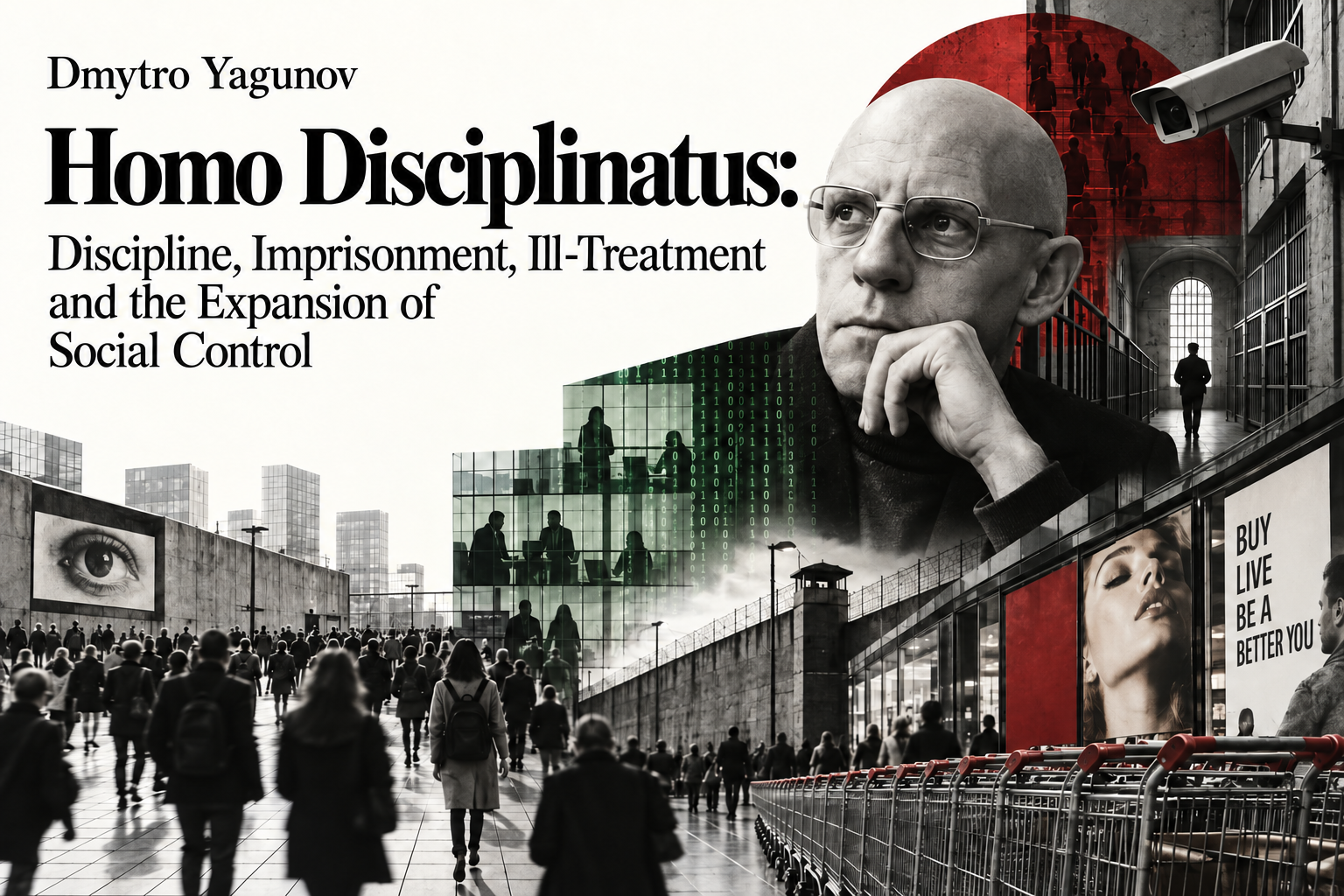
Thus arises the figure that it is appropriate to designate by the term Homo disciplinatus – the disciplined person. It was necessary to drive the free person out of the citizen in order to create the docile person, Homo disciplinatus, that is, the predictable, safe consumer. The classical age discovered the body as an object and target of power; the Foucauldian concept of the “man-machine” was constructed simultaneously in two registers – the anatomico-metaphysical and the technico-political. It is precisely the technico-political register, somewhat forgotten at first glance, that has been rewritten anew to meet the needs of the twentieth century, and it is precisely this register that underlies the formation of Homo disciplinatus as a social type.
HOMO DISCIPLINATUS AND RISK MANAGEMENT
The need to understand the human being in the way that was characteristic of the nineteenth and twentieth centuries has fallen away. Fundamentally new registers have appeared that no longer have any particular need to understand the human being – instead, the usefulness of the consumer becomes the absolute priority. The total institutions of the twentieth and twenty-first centuries are tailored precisely to these needs of political elites. Unlike what Foucault wrote about the nineteenth and twentieth centuries, when the docile body could be subjected, used, transformed and improved, in the case of Homo disciplinatus there is no need to subject, use, transform or improve it. The main thing is that Homo disciplinatus should not break free of the ultra-strong networks of social control and should not create those risks that would be unpredictable, or those risks whose overcoming would be too costly for political elites.
If, for the first modulation of social control described by Foucault, the human body had to be worked over in detail, subjected to subtle coercion and captured at the level of the very mechanics of movements, gestures, postures and speed, then under the conditions of contemporary social control this is no longer sufficient at all. It is necessary to take control of habits and, where possible, of thoughts as well – not as abstract categories of an incorporeal nature, but as thoughts produced as a result of total social control over risks and the application of contemporary concepts of risk assessment. In the twenty-first century the relations of docility and utility characteristic of classical discipline are no longer relevant; instead they must be analysed through the prism of predictability and of safeguarding against any departure of Homo disciplinatus from the predictability that would constitute a challenge to the system. To the predictability and foreseeability of gestures and actions is added control over thoughts, which becomes a foundational element of social control in the twenty-first century.
If the political anatomy about which Foucault wrote was characteristic of the mechanics of power in the nineteenth and twentieth centuries, then today it is more appropriate to speak of the cybernetics of power, since the bodies of Homo disciplinatus are already subjected and act with maximum speed and efficiency. Yet this entire system has a fundamental vulnerability: power must function not simply like a clock but like a Swiss one, or more precisely like an electronic watch with a battery designed not for years but for decades of uninterrupted operation. The suitability of the human being in the twenty-first century is increasingly replaced by the absence of risks on the part of Homo disciplinatus – it is precisely this, and not productivity or usefulness in the classical sense, that becomes the principal criterion for evaluating the individual.
HUMAN RIGHTS AS THE LIMIT OF THE EXPANSION OF SOCIAL CONTROL
In any society the body is caught in the grip of a power that imposes on it constraints, prohibitions and obligations, and this, as Foucault noted, is not an invention specifically of the twentieth and twenty-first centuries. However, it is precisely the twenty-first century that has created a rather interesting construction – an obstacle in the path of the expansion of social control, which leaves space for the human being so that this control does not acquire an absolutely total character. This barrier is human rights. Human rights have become that very barrier in the path of disciplinary totality, the overcoming of which constitutes the principal aim of contemporary disciplinary mechanisms together with the corresponding carceral institutions and places of deprivation of liberty with their by-product in the form of ill-treatment.
It is precisely for this reason that ill-treatment, despite the human rights rhetoric, despite the existence of conventional and institutional mechanisms for the prevention of torture, continues to be reproduced – not as an accidental failure of the system, but as a systemic, albeit formally condemned, element of the functioning of total institutions. The excesses of individual perpetrators are condemned demonstratively and publicly, whereas disguised, routinised forms of ill-treatment, embedded in the everyday practices of places of deprivation of liberty, remain far less vulnerable to human rights scrutiny precisely because they are functional for political elites in their striving to maximise the predictability and safety of Homo disciplinatus.
THE EMPIRICAL DIMENSION: PENITENTIARY STATISTICS AND THE RHETORIC OF REFORM
It is telling that the official statistics on the functioning of total institutions, in particular the penitentiary system, usually do not become an obstacle to the described process of the expansion of social control but, on the contrary, serve as an additional instrument of risk management. Data on the overcrowding of penal institutions, on the number of persons under alternative, non-custodial forms of control, and on the dynamics of reoffending are used by political elites selectively: where this is advantageous for the rhetoric of humanisation and decarceration, and where, conversely, this justifies the need to strengthen supervision and to expand the instruments of risk management.
Thus the public discourse on the reform of total institutions and the official statistics on their functioning perform a dual function. On the one hand, they shape the image of a progressive, human rights-oriented system that is supposedly gradually abandoning carceral logic in favour of less repressive forms of social control. On the other hand, this same rhetoric legitimises the expansion of non-custodial forms of supervision which, despite the absence of physical imprisonment, ensure no less dense, though less visible, control over the behaviour, habits and, to an ever greater extent, the thoughts of Homo disciplinatus.
THE DISCIPLINARY MATRIX IN THE DIGITAL AGE
The processes described acquire particular significance under the conditions of the digitalisation of social control. If in the nineteenth and twentieth centuries the disciplinary matrix relied above all on architectural and institutional mechanisms – the wall, the cell, the timetable, the hierarchy of supervision – then in the twenty-first century these mechanisms are supplemented and increasingly replaced by digital instruments: electronic monitoring, algorithmic risk assessment and systems for predicting behaviour. This makes it possible to extend the logic of Homo disciplinatus far beyond the physical walls of the total institution – to every citizen, regardless of whether he or she has ever had any contact with the criminal justice system.
In this sense every contemporary citizen increasingly appears as a potential Homo disciplinatus, whose suitability for the system is measured not so much by productivity or usefulness in the classical sense as by the absence of risks and the predictability of behaviour. Digital instruments of risk management allow political elites to exercise control without the need for the physical enclosure of a place about which Foucault wrote, applying instead far more flexible, dispersed and less noticeable forms of supervision over Homo disciplinatus.
CONCLUSIONS
The synthesis of the theses set out above makes it possible to formulate an integrated picture of the transformation of discipline and social control from the nineteenth to the twenty-first century. Discipline, which arose as the spatial distribution of individuals in enclosed institutions, did not disappear with the emergence of the critique of total institutions and the rhetoric of decarceration, but was transformed into a far broader and more flexible network of social control. Within this network imprisonment is not opposed to non-custodial means of control but is complemented by them, which explains the paradoxical simultaneous expansion of both tendencies against the background of calls to reduce the prison population.
Ill-treatment appears not as an anomaly or an exception but as a systemic, albeit formally condemned, by-product of the functioning of contemporary social control, necessary to ensure the precise localisation of individuals in the cells of the disciplinary matrix. The principal beneficiary and driving force of this process are the political elites, interested in maximising spatial, behavioural and, to an ever greater extent, cognitive control over the population through the application of concepts of risk management.
At the centre of this transformation stands the figure of Homo disciplinatus – the disciplined person, the docile, predictable and safe consumer who has replaced the image of the disciplined soldier of the seventeenth to nineteenth centuries. If classical discipline sought to subject, use, transform and improve the body, then with regard to Homo disciplinatus it is sufficient merely to safeguard the system against his exit from the network of social control and against the unpredictable risks that he generates. Human rights remain the sole barrier whose overcoming constitutes the strategic aim of contemporary disciplinary mechanisms and, consequently, the principal resource of resistance to the totality of social control over Homo disciplinatus in the twenty-first century.


