 1
1
 0
0
For almost 30 years I have been researching Ukraine’s penitentiary system and reforming this field. During this time much has changed – my own views, the legislation, and officials’ rhetoric have all changed. One thing has remained unchanged: Ukraine still has no nationwide, open, and reliable statistics on the functioning of the penitentiary system. And without such statistics it is impossible either to prevent torture, abuse, and killings in places of deprivation of liberty, or to assess whether the state is fulfilling its obligations to its own citizens and to European institutions.
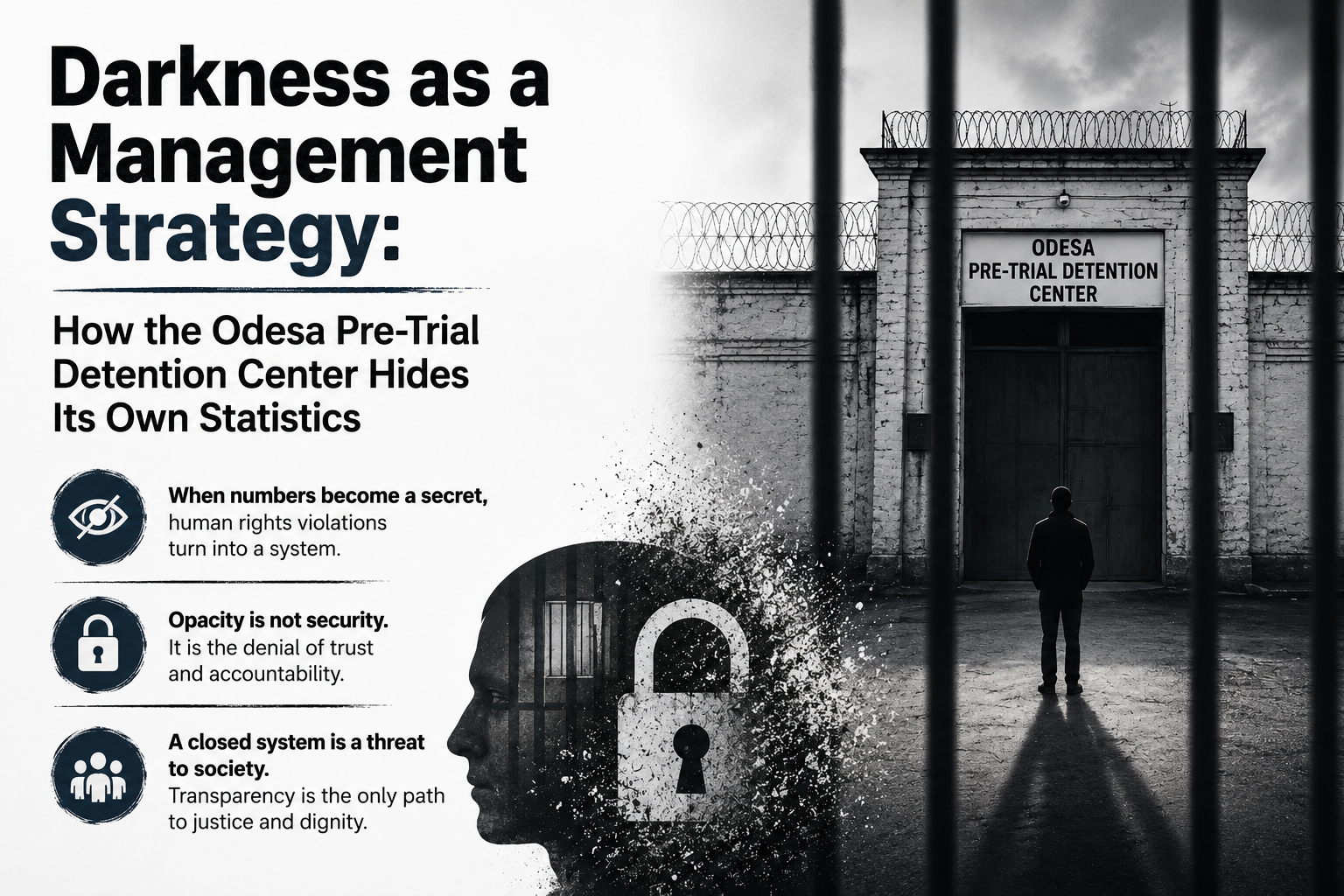
An interesting episode in this thirty-year history is my correspondence with the South-Central Interregional Department for the Execution of Punishments and the State Institution «Odesa Pre-Trial Detention Center» concerning what would seem to be trivial questions about the institution’s basic performance indicators. The details of the administrative dispute itself are the subject of a separate publication. Here the point is something else: the specific way in which an institution accountable to the state and to society evades elementary transparency.
A LETTER THAT SAYS TWO OPPOSITE THINGS AT ONCE
On August 13, 2026, I received a reply from the State Institution «Odesa Pre-Trial Detention Center» No. 5/20-32-26/9/11 to a request concerning statistics on mortality, suicides, and self-harm among detainees and convicted persons.
The institution reports that data on the number of deaths for 2023–2026 is available (13, 12, 13, and 8 persons respectively), but that it is «not possible» to provide analogous information for the period from 2010 to 2022 – because, according to the institution’s version, the retention period for monthly reporting is three years, and all the relevant logs, paper statistical records, and – mark this – even the computers and electronic spreadsheets on which this statistical data was kept have allegedly been destroyed.
Not only the documents have been destroyed. Allegedly, the very electronic storage media themselves have been destroyed – in the 21st century.
And in that very same letter, the institution provides a table with data on suicides and self-harm among detainees and convicted persons – not for the last three years, but for six years, from 2021 to 2026:
| Year | 2021 | 2022 | 2023 | 2024 | 2025 | 2026 |
| Number of suicides | 2 | 0 | 1 | 1 | 2 | 0 |
| Number of self-harm incidents | 34 | 13 | 22 | 20 | 24 | 36 |
To this is added information on emergency incidents for 2021–2026 (fires, escapes from custody, escape attempts, an assault on a staff member) and on persons injured as a result of these incidents – again for a six-year period, which goes far beyond that very «three-year retention period» that the institution had just used to explain its inability to provide the mortality data.
In other words: in one and the same letter, signed by one and the same official, the same three-year retention period simultaneously applies and does not apply – depending on which information turns out to be convenient to disclose, and which does not.
WHY THIS IS NOT A TRIFLE
At first glance, this looks like a purely technical matter of archival record-keeping. In fact, the consequences of this approach are far more serious.
If an institution is allowed to invoke the «destruction» of documents and even of electronic media selectively – whenever it wants and with respect to whatever it wants – this opens the door to a universal excuse. Any institution will always be able to say: the relevant forms either were never created, or have also been destroyed. This is impossible to verify in principle, since verification relies precisely on the very documents whose existence is being denied.
This is not a hypothetical threat. It is already concrete practice: when it comes to mortality – «destroyed»; when it comes to suicides and self-harm – suddenly «available», and not for three years, but for six.
It would be interesting to take a look at the official who, within the scope of their own authority, decides exactly which files on office computers are to be deleted and which are not.
SCIENCE, LAW, AND A MORAL SLAP IN THE FACE
I find it particularly regrettable that Ukrainian criminological and penitentiary scholarship repeatedly receives responses of this kind instead of elementary access to anonymized statistical data. Researchers are not seeking access to detainees’ personal data; what they need are aggregated figures, without which it is impossible either to assess the scale of the problem or to build evidence-based policy in the field of the execution of punishments.
This is happening against the backdrop of Ukraine’s public commitments to the Council of Europe and other European institutions regarding the reform of the penitentiary system and the enhancement of its transparency and accountability. Transparency of statistics is not a bureaucratic whim of researchers, but one of the basic indicators of whether an institution actually has a functioning system for preventing torture, ill-treatment, suicides, and emergency incidents – or only an imitation of one.
WHAT’S NEXT
Ahead lie further court hearings on this matter; I will set out the details of the proceedings themselves in a separate piece. For now, I want to address my colleagues.
To fellow researchers studying Ukraine’s penitentiary system, I recommend keeping this response for yourselves – it may prove useful as an illustration of the method by which institutions evade providing statistics even when they in fact have them.
To fellow lawyers handling cases connected with the operation of the Odesa Pre-Trial Detention Center – including cases on detention conditions, inadequate medical care, and investigations into deaths or suicides in places of deprivation of liberty – this response may also prove useful as evidence of the institution’s selective and contradictory approach to disclosing its own statistics.
The darkness in which the institution is trying to submerge its own activities is dispelled not by declarations, but by documents. And this document is one of them.


