 0
0
 0
0
Dear friends, colleagues, everyone who is in one way or another involved in the study, analysis, and reform of Ukraine’s penitentiary system.
Everyone who has ever encountered this system from the inside — as a practicing lawyer, as a scholar, as a representative of an international monitoring institution, or simply as a citizen — knows the real state of affairs well. And everyone who has tried to change something within it knows just how closed an organization it is. This closedness is not an accidental trait or a consequence of a lack of resources. It is a deliberate institutional strategy, and right now, within the framework of one seemingly local court case, this strategy has a chance either to be finally legitimized or to be broken at the level of judicial precedent.
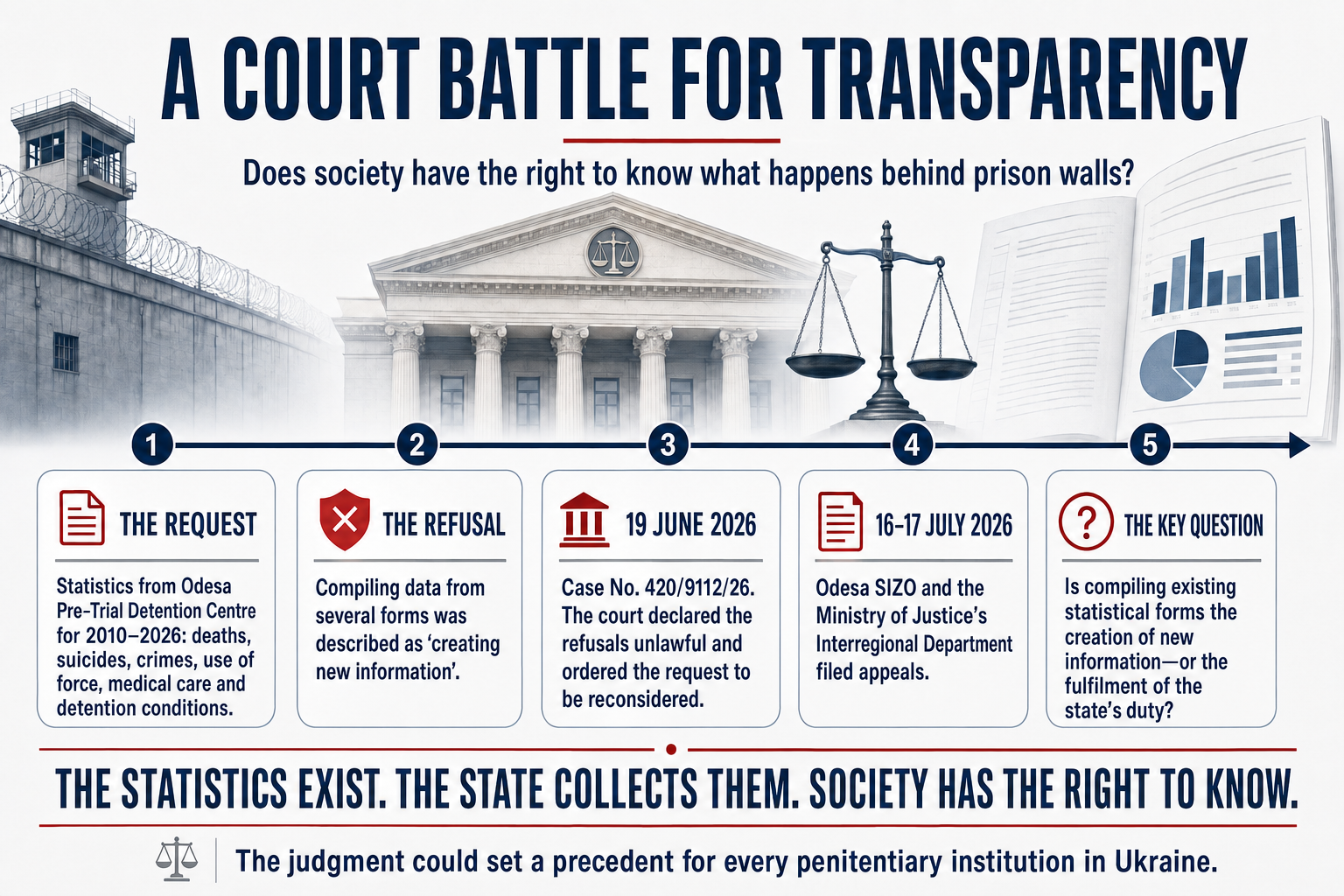
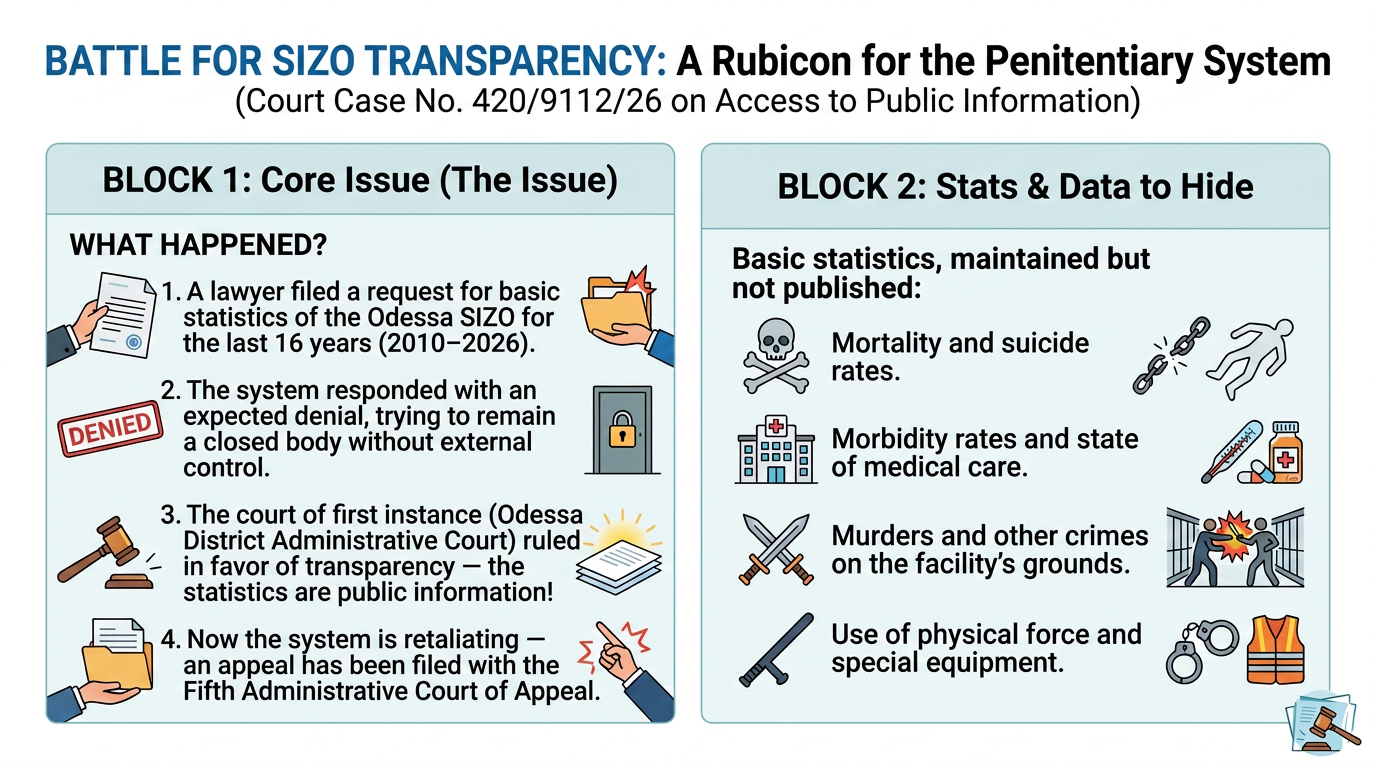
Not long ago I filed a perfectly ordinary, routine-in-form request for access to public information with the State Institution “Odesa Pre-Trial Detention Center” and with the South-Central Interregional Directorate for the Execution of Criminal Punishments of the Ministry of Justice of Ukraine. The request concerned the provision of basic statistics on the Odesa pre-trial detention center for the last sixteen years — from 2010 to 2026.
Yes, this is indeed a fairly large time period, but it is not about some exclusive analytics — it is about the most basic indicators that any modern penitentiary institution is legally obliged to keep: mortality rates, suicides, morbidity, homicides, other crimes committed on the premises of the institution, use of physical force and special means, disciplinary practice, the state of medical provision, and conditions of detention. In other words, things that in principle must exist, must be maintained and recorded — and I know that this statistics is kept. It simply is not published.
Accordingly, from the very outset both the Odesa pre-trial detention center and the Interregional Directorate chose an entirely predictable strategy of delay. First they extended consideration of the request by twenty days — supposedly due to the large volume of information — and then, quite predictably, refused to provide this information at all, claiming that it allegedly does not constitute “public information” within the meaning of the law, that it is defined through “generalized criteria” rather than specific documents, and that providing it would supposedly require “the creation of new information.” I could not leave this refusal without a response — not merely as an interested private individual, but as a lawyer, a researcher of the penitentiary system, and a member of the European Committee for the Prevention of Torture, for whom the transparency of statistics on places of deprivation of liberty is a matter of professional, not merely personal, importance.
I filed a lawsuit, and the court of first instance — the Odesa District Administrative Court — ruled in my favor.
By a decision of 19 June 2026 in case No. 420/9112/26, the court found the refusals of both defendants unlawful and obliged them to reconsider my request taking into account the court’s findings. The court expressly stated that the obligations imposed by law on the administration of places of pre-trial detention — to keep records of persons taken into custody, to register deaths and emergencies, to ensure living conditions, food, and medical care — mean that the relevant information is subject to recording, and therefore constitutes public information within the meaning of the law. The court also found that the defendants had selectively and erroneously applied the criteria from the well-known ECtHR judgment in Magyar Helsinki Bizottsag v. Hungary, and that the large volume of information requested does not in itself constitute a lawful ground for refusal.
And today — and I am addressing you precisely in these days, on 16 and 17 July 2026 — both the Odesa pre-trial detention center and the Interregional Directorate for the Execution of Punishments have filed appeals against this first-instance court decision with the Fifth Administrative Court of Appeal. Both institutions insist on quashing the decision in full and issuing a new decision dismissing my claim entirely.
There is one detail in these appeals that is truly telling and, frankly, strange for reasons entirely unclear to me. The Directorate and the pre-trial detention center, as before, rely in their argumentation on a very well-known case against Hungary — the judgment of the Grand Chamber of the European Court of Human Rights in Magyar Helsinki Bizottsag v. Hungary. The essence of that case was precisely that Hungary lost the dispute at the ECtHR because it had refused to provide information, in response to a request for public information, to a human rights organization studying the effectiveness of the state-funded legal aid appointment system. By fifteen votes to two, the Grand Chamber found a violation of Article 10 of the Convention — the state that refused access to information lost the case. This logic seemed at the very least strange to me from the outset: using a judgment that is a classic precedent for protecting the right of access to information as an argument in favor of refusing such access. But, well, why not — the Odesa pre-trial detention center, as they say, shot itself in the foot. I find this very strange, and I do not hide my surprise.
In any case, that is precisely why the Magyar Helsinki judgment — which is a very useful tool and, indeed, a classic tool from the standpoint of ECtHR practice, and which supported my position at first instance — is now, on appeal, once again being given an opposite, distorted meaning. The appeals have been filed, and I am currently preparing the corresponding responses to them.
But the question I want to put before you today is far broader than the technical legal dispute over a single case.
The agenda is not simply a banal dispute over some statistics of some pre-trial detention center. The agenda holds a much more fundamental question: will Ukraine’s penitentiary system be transparent at all? Will it keep statistics accessible to the community, to researchers, to human rights defenders, to international institutions?
Let me stress once again — and this is the key point of this entire case — this statistics is being kept, all of it. It is not a fiction, it is not something hypothetical. It is simply being concealed from society. And the consequence of precisely this concealment is the corresponding acts of criminal torture in the Odesa pre-trial detention center, with all their international consequences — ECtHR judgments, CPT reports, which for years have recorded one and the same picture of institutional dysfunction, while having no real internal statistical confirmation or refutation whatsoever, because the state refuses to disclose this statistics.
The agenda holds the question: will a state body — and here it does not matter which one exactly — provide statistics if it exists? I stress: if it exists, but is simply scattered and needs to be gathered from various statistical forms, without any additional analysis, without research, without the formulation of new conclusions, and so on. The agenda raises the key question: will the state be obliged to provide you with statistics if, literally, in concrete terms, this statistics is not consolidated by the state into a single statistical form, but is instead scattered across two, three, or four statistical forms that the state bodies themselves keep under their own internal orders.
From the standpoint of the Odesa pre-trial detention center and the Interregional Directorate for the Execution of Punishments, this literally means the following: if you want to obtain information contained in statistical forms established by the state itself — but not in one, but in several such forms — then, in the opinion of the administration of these institutions, this already constitutes enormous, excessive analytical work: compiling two, three, or four already-existing statistical forms together and providing consolidated statistics. This is precisely the legal construct that the defendants are trying to push through the court of appeal: they equate the obligation to consolidate existing, already-documented reporting forms — Form No. 1-VK, Form No. 1-MED, Form No. 1-DP, Form No. 1-FIN, and others, which penal institutions are already obliged to compile monthly, quarterly, and annually — with the obligation to “create new information” that allegedly does not exist. The equating of the technical work of consolidating existing data with the creation of new, previously non-existent information is the central legal distortion of this entire case.
It is quite clear and obvious that the system is trying to be as closed as possible, that the system wants to shield itself from external oversight as much as possible, and, indeed, this is precisely the Rubicon in question. This issue is especially acute precisely for the penitentiary system, where the price of closedness is measured not by abstract indicators but by the lives, health, and dignity of thousands of persons deprived of liberty. Will statistics exist for society at all, or will it be de facto prohibited — prohibited for society, for researchers, for experts, for international organizations, for the European Committee for the Prevention of Torture, for the European Court of Human Rights, which for years has been issuing judgments against Ukraine precisely because of the state’s inability to prove the adequacy of conditions of detention?
Accordingly, I appeal to you with a request to demonstrate civic position and principle. Of course, it is not procedurally possible to join the case itself as a third party or participant in the proceedings. But any expert support and expert letters, written opinions, scholarly or practical expert assessments of this issue — all of this will be very useful in helping the court of appeal shape a future rule: a rule stating that if the state scatters any statistics needed by society across several different statistical forms that it itself established, this does not constitute analytical work, does not constitute scholarly work, does not constitute research work in the sense that would relieve the holder of information from the obligation to provide it. This is simply the gathering of statistics from two, three, or more forms. And the state is not relieved of the obligation to provide such statistics even when this statistics is inconvenient for it, even when it does not speak in its favor.
The main point, of course, is that we all understand what this case is really about. It is about the impossibility of keeping behind closed doors the number of murders, rapes, drug trafficking incidents, suicides and deaths, and other critically important data about what actually happens in places of deprivation of liberty in Ukraine. It is about whether society has the right to know how many people die in Ukrainian pre-trial detention centers and precisely from what, how many cases of staff violence against detainees are recorded and how the administration responds to them, whether informal criminal hierarchies among detainees are indeed used by staff as a tool of control — something the European Committee for the Prevention of Torture has written about directly and repeatedly in its reports since as far back as 2016 — and whether anything is systemically changing in this area despite decades of recommendations and dozens of cases lost by Ukraine in Strasbourg.
That is why I ask you to demonstrate principle and expertise — indeed, to put a full stop that will ensure a real beginning to the reform of the penitentiary system, starting literally from zero, precisely in the aspect of providing civil society with statistical information about the activity of the penitentiary system.
This decision, if it stands on appeal, will become not merely a victory of bureaucracy over human rights in one administrative case. It will become a precedent applicable to every subsequent request for access to information filed with any penal institution or any state body in Ukraine — and thus to the fundamental question of whether Ukraine’s penitentiary system is capable of being accountable to its own society, or whether it will remain a closed institution capable of hiding systemic pathologies behind formal references to “large volume” and “the need for analytical work.”
That is why I ask everyone with professional capacity — legal, scholarly, human-rights — to consider preparing a brief expert opinion or letter of support on the fundamental question of this case: whether consolidating several existing statistical forms constitutes “the creation of new information,” or whether it is simply the ordinary fulfillment of the duty of a holder of public information.