 0
0
 0
0
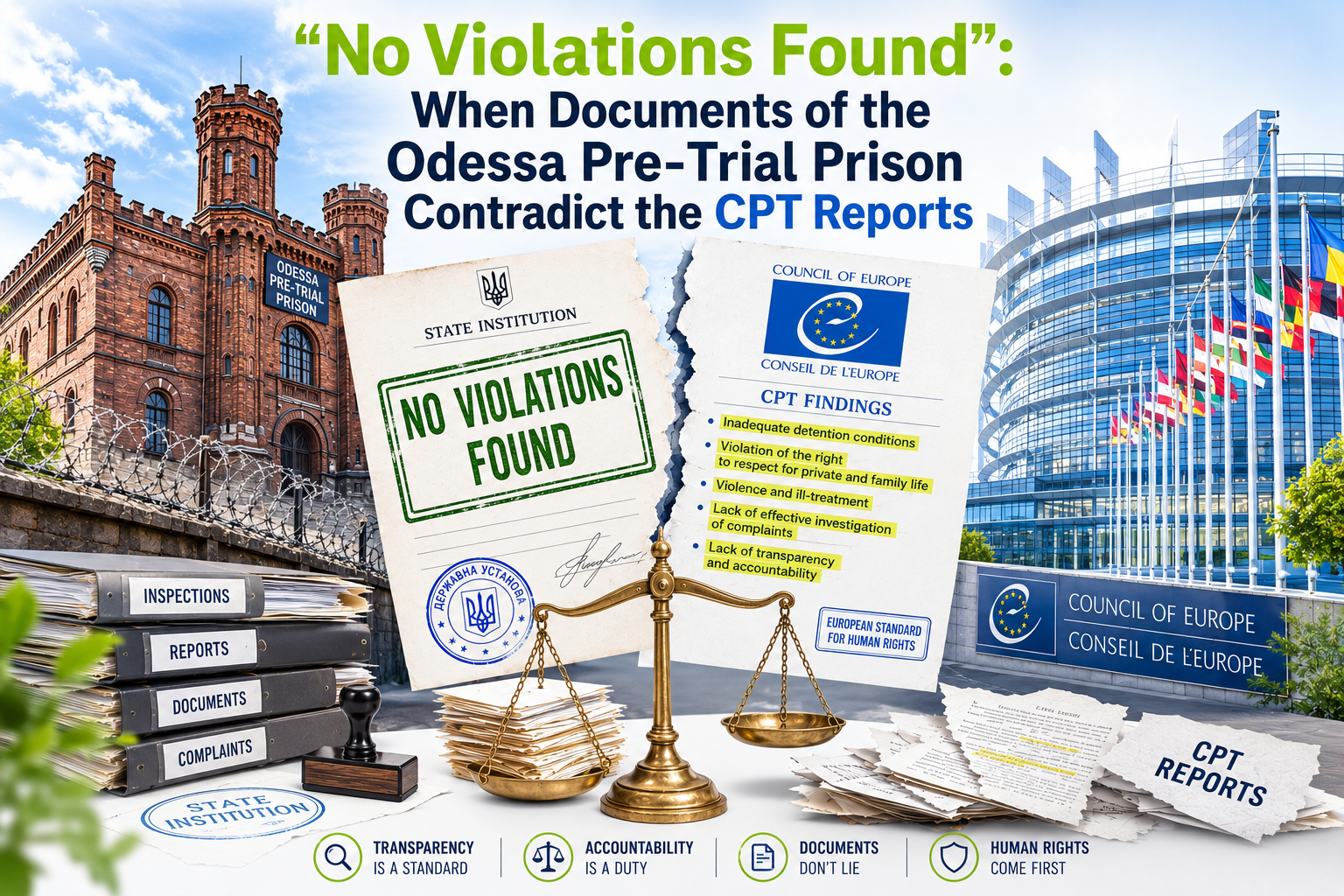
I recently received responses from the Odesa Pre-Trial Detention Centre to a lawyer’s request concerning conditions of detention — and these responses prompt reflection that goes far deeper than the circumstances of any single case.
The request contained sixteen specific, substantive questions: about the floor area of cells, the regularity of access to showers, the provision of mattresses and bed linen, the presence of insects, medical care, and the existence of an informal prison hierarchy. Each of these questions could have been answered with a fact — a figure, a document, a formal record. Instead, the institution answered nearly every one of them with the same legal formula: “within the available documents, no information has been found regarding the establishment by the competent authorities, in the manner prescribed by law, of any violations.” And where a substantive answer would have been plainly unfavourable, a convenient assumption was added — that the documents for the relevant period “may have been destroyed.”
The problem is not that this answer is evasive. The problem is that it is objectively untrue.
The conditions of detention in this institution have already been inspected, described, and characterised — and not by the claimant, not by his lawyer, and not even by a human rights organisation. They were examined by the European Committee for the Prevention of Torture (CPT) — the official monitoring body of the Council of Europe, whose delegations work with forensic medical experts and inspect institutions directly. CPT delegations visited this very Odesa Pre-Trial Detention Centre on several occasions, notably in 2013, 2016, and 2023.
And what the Committee found contradicts, word for word, every “no violations found.”
Where the institution “found no” problems with floor area, the CPT recorded that capacity was calculated according to the national standard of 2.5 sq. m per person — already below the minimum of 4 sq. m insisted upon by the Committee — while in 2023 many cells offered less than 3 sq. m per person.
Where “no” problems with sanitation were found, the Committee described cells “literally infested with cockroaches,” bedding ridden with insects, mould-covered walls, and showers covered in mildew.
Where “no” problems with medical care were found, the CPT wrote of a medical unit that was “literally falling apart.”
Where the institution denied the very existence of an informal prison hierarchy, the Committee recorded that reliance on such a hierarchy was implicitly acknowledged by the management and staff of this very detention centre.
The Committee’s overall conclusion regarding the institution — in both 2016 and 2023 — was formulated without euphemism: the conditions “could easily be considered inhuman and degrading.”
And here lies the central point for which I am writing this text.
CPT reports are not “external criticism” that an institution is entitled to ignore. Ukraine is a Party to the relevant European convention. One of the reports mentioned was published at the request of the Ukrainian Government itself; another, under the automatic-publication procedure agreed to by the State. This means that the findings of inhuman conditions in this institution are not a secret document that someone “dug up,” but an officially acknowledged and published position of the State itself concerning its own institution.
Accordingly, in answering “no violations found,” a particular State institution is not contradicting some outside observer. It is contradicting the officially acknowledged position of the State of which it is itself a part. And it is denying before a court precisely what its own management acknowledged before the monitoring body of the Council of Europe.
Tellingly, the “no violations found” formula falls apart even without the CPT reports — on the strength of the institution’s own responses. In one document it asserts that no ill-treatment whatsoever was “found.” In another, it admits that the use of physical force against detainees and the actions of its own officials were the subject of separate criminal proceedings. The “possible destruction” of documents argument works just as selectively: where the information is unfavourable, the documents appear not to exist; where there is a need to demonstrate “routine practice of technical infrastructure improvement,” both contracts and specific sums and dates are readily found.
This is more than an episode in a single case. When a State body permits itself to provide a court with information that directly contradicts the officially acknowledged position of its own State, the reliability of official responses from State bodies in general is called into question — and with it, trust in the system. And this has a wholly concrete dimension in the context of Ukraine’s fulfilment of its obligations under Chapter 23 (justice and fundamental rights) on its path towards the European Union.
“No violations found” was a phrase meant to close the question. Instead, it opened it. Because once an institution sets out to refute not only the CPT but the published position of its own Government, the central question is no longer the state of the cells. The central question becomes how far an official “none found” can be trusted at all.


