 1
1
 0
0
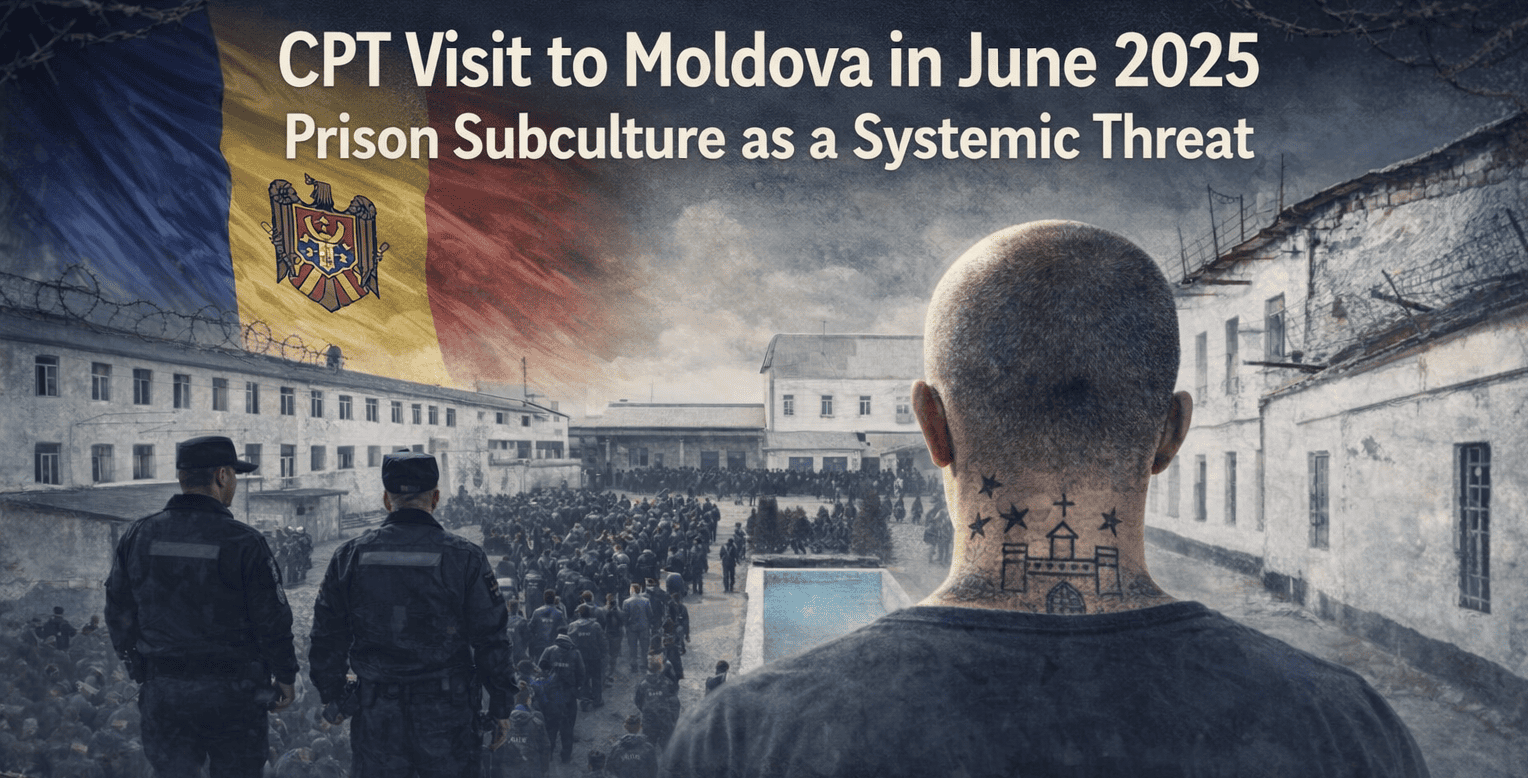
In early June 2025, the European Committee for the Prevention of Torture (CPT) carried out an ad hoc visit to Moldova, following its previous visit in December 2022. The central theme of this visit was informal prison hierarchies and prison subculture.
MAIN CONCLUSIONS
On the one hand, the Committee confirmed the previously identified systemic problems of the Moldovan prison system related to the dominance of prison subculture. On the other hand, this visit revealed that the problem is much more acute than previously recorded. The published report clearly demonstrates the extent to which the Soviet-style prison subculture continues to dominate in a modern European country, effectively displacing the formal state authority from penitentiary institutions.
UNPRECEDENTED PRESSURE ON THE DELEGATION
The visit recorded an incident unprecedented in the history of the Committee: leaders of informal prison hierarchies directly pressured members of the delegation, effectively threatening them. At the same time, they intimidated other prisoners, forcing them to stop or not to give interviews to CPT representatives at all.
CONTRASTS IN DETENTION CONDITIONS
As during previous visits, a striking difference in detention conditions was noted: representatives of the prison ‘elite’ lived in comfortable one- and two-room premises with spacious halls and offices, while the rest of the prisoners were held in overcrowded dormitories infested with cockroaches, bedbugs and other parasites — in conditions bordering on slavery.
During a visit to one of the institutions, a large quantity of a tobacco-like mixture was found in the sports hall — it was lying openly, apparently in full view of the institution’s staff.
CONCLUSIONS
This report deserves careful study by Ukrainian prison administrators and academics. The Moldovan experience clearly illustrates the extent to which prison subculture can reach and the threats to prisoners’ rights posed by the existence of informal prison rules supported by parallel hierarchies. The systematic violations of rights caused by these practices may, in essence, amount to ill-treatment within the meaning of Article 3 of the Convention for the Protection of Human Rights.
In the context of the ongoing war, this issue is particularly acute for Ukraine. New prisoners with combat experience will inevitably form their own hierarchies and rules based on military brotherhood, combat experience and frontline connections.
This creates the conditions for a criminologically extremely interesting — and at the same time potentially dangerous — conflict between subcultures: the traditional Soviet prison subculture and the new subculture forming around the experience of veterans. This phenomenon requires separate comprehensive research.
Report of the CPT to the Government of Moldova (ad hoc visit 13-12 June 2025, published on 4 December 2025).
Ever since its first visit to Moldova in 1998, inter-prisoner violence and intimidation in prisons, largely linked to the well-established and long-standing informal hierarchy amongst prisoners, have been matters of grave concern to the CPT.
Ever since its first visit to Moldova carried out in 1998, inter-prisoner violence and intimidation in prisons, largely linked to the well-established informal hierarchies amongst prisoners, have been matters of grave concern to the CPT. In several visit reports, the Committee called upon the Moldovan authorities to take resolute action, without further delay, to tackle the phenomenon of informal prisoner hierarchy and to prevent inter-prisoner violence and intimidation throughout the prison system.
Above all, the Committee considered that this would require putting in place a system of appropriate risks and needs assessment, depriving informal prison leaders of their privileges, providing prisoner accommodation based on smaller living units, having sufficient numbers of appropriately trained staff and ensuring the management’s full support for prisoners who are at risk of abuse by other inmates and for those who do not wish to be involved in the informal prisoner hierarchy.
In most cases, due to the atmosphere of fear created by the informal prisoner leaders and their close circles, the omnipresent intimidation, and the lack of trust in the staff and their ability to guarantee safety, persons who had been victims of inter-prisoner violence did not complain. If found by staff with injuries, they refused to provide an explanation as to the origin of the injuries or indicated causes which were at best vague (“there was some sort of an incident”) or, more often, clearly inconsistent with the injuries observed (such as “fell from a bed”, “slipped in the shower”, “fell on the stairs” or “hit himself”).
In all three establishments visited, many prisoners whom the delegation attempted to interview were reluctant and often visibly scared to speak, asked to interrupt the interview, or even refused to be interviewed at all. Some of these prisoners stated explicitly that this was due to fear of reprisals they may face from the representatives of the informal prisoner hierarchy for having spoken with the delegation.
When delegation members entered detention areas, prisoners from higher castes of the informal prisoner hierarchy systematically attempted to follow them, and/or to remain present during interviews with other prisoners, and/or control what was being said.
Most strikingly, at Prison no. 15 in Cricova, prisoners from higher castes actively interfered in the interviews being carried out by the delegation, tried to prevent other prisoners from speaking to the delegation, or even put pressure directly on the delegation members to stop their interviews. They refused to leave the room where interviews were supposed to take place in private, claiming that this was not in line with “their prison rules”. Staff members who were present remained astonishingly passive in these situations.
Such aggressive interference with the work of a CPT delegation is unprecedented, seriously impeded the work of the delegation and combined with the passive approach of staff, is a clear indicator that the establishment is entirely controlled by the informal prison leaders, with staff appearing afraid to exercise their authority.
Despite these attempts to prevent interviews, many prisoners in all three establishments visited agreed to speak with the delegation. They again described the overall atmosphere of intimidation and violence used by the informal prisoner hierarchy to impose their rules on other persons held in prison, including the obligation to regularly pay a “fee” (“nalog”) to an illegal collective fund (“obshchak”) managed by the informal prison leaders.
The intimidation and violence included systematic extortion, threats of beatings and physical violence, including slaps, punches to the face, head and back, and severe beatings with a wooden shovel or a wooden mop stick to the buttocks, backs and thighs, that is, to parts of the body hidden by clothing. These violent acts, which were inflicted as a punishment for having failed to follow the informal rules, including the obligation to pay the aforementioned “fee” or debts incurred because of forced gambling, took place in the presence of other prisoners, in order to spread fear, ensure obedience and demean the victim.
In several cases, injury reports examined by the delegation contained descriptions of injuries which were consistent with the allegations of inter-prisoner violence made to the delegation by the prisoners concerned, although these persons officially indicated other causes of injuries.
In all three establishments visited, several prisoners interviewed during the visit stated that persons who had been subjected to inter-prisoner violence and who had visible injuries had been obliged by informal prison leaders to remain in the accommodation areas and avoid any contact with staff, and had not been allowed to participate in roll calls — under the pretext that they felt unwell — until their injuries had healed.
Moreover, the delegation received several allegations in Sector 2 of Prison no. 2 in Lipcani and at Prison no. 15 in Cricova that persons who had been subjected to inter-prisoner violence had even been prevented by prisoners from higher castes from seeing healthcare staff. Furthermore, at Prison no. 15 in Cricova, prisoners from higher castes allegedly remained present during medical examinations of other prisoners; indeed, in their presence, prisoners did not indicate plausible explanations for the injuries they displayed. This makes the procedure of recording and reporting of injuries inefficient.
The findings of the 2025 visit and the data provided by the authorities once again indicated that a number of instances of inter-prisoner violence remained undetected as the victims were systematically intimidated by the perpetrators, under the threat of further violence, to neither complain to staff nor request medical examination.
The situation of persons considered to be “humiliated” or “untouchable“, that is, those on the lowest caste of the informal prisoner hierarchy, was the same as described in detail in previous visit reports” and remains a matter of serious concern to the CPT.
As during previous visits, the delegation received many complaints of frequent verbal abuse, systematic demeaning and dehumanising behaviour by other persons held in prison, threats of physical violence if they failed to follow the informal “code of conduct“, and physical violence.
The informal rules obliged them to avoid contact with other persons held in prison and their belongings, to walk on the side or along the walls, to not look into other persons’ faces, to not use expletives when interacting with other persons, and to not access communal sports and recreational facilities used by other prisoners. They were also prevented from using the same laundry facilities that the general prison population had at their disposal and, at Prison no. 2 in Lipcani, had to use dilapidated outside toilets and were only allowed to take water from an outside tap.
Further, these persons were used as manpower for “dirty” work: they were compelled to clean accommodation and communal areas (including toilets) for free and to collect rubbish and were not permitted to work with other persons held in prison. In addition, they continued to be systematically accommodated in the poorest conditions to be found in the prisons visited, usually in separate rooms or dormitories.
As repeatedly stressed in previous visit reports, the CPT considers that the situation of persons regarded as “humiliated” could be considered to constitute a continuing violation of Article 3 of the European Convention on Human Rights, which prohibits, inter alia all forms of degrading treatment and obliges state authorities to take appropriate measures to prevent such treatment, including by other persons held in prison.
Similar to those considered to be “humiliated”, prisoners belonging to the so-called “neputiovie” caste’ were subjected to frequent instances of inter-prisoner violence and were accommodated in comparably poor material conditions. Allegedly, they were in some cases obliged to work as servants for prisoners from higher castes, making their beds and laundry, cleaning and cooking for them.
At Prison no. 15 in Cricova, the delegation heard a few isolated allegations that following their “initial classification interview” with informal prison leaders, newly arrived prisoners were not “accepted” to the living zones and were “placed in segregation” by the informal leaders, purportedly under Article 206.
The findings of the visit suggest that there continues to be tacit acceptance of the informal hierarchy and their “rules” by prison staff and even, to a certain extent, tacit “agreement” between staff and informal prison leaders when it comes to ensuring “order” among prisoners and the “smooth operation” of the establishments.
First of all, the delegation once again observed striking differences in material conditions, in terms of state of repair and equipment, as well as the available living space, between informal prison leaders and their close circles on the one hand, and the general prison population, most notably those considered to be “humiliated” and “neputiovie”, on the other. The former continued to live a very comfortable life inside prison, with all possible amenities. Moreover, the delegation again received allegations that the refurbishment and equipment of the cells of leaders was paid for by the illegal collective fund.
In all three establishments, visiting facilities for long-term visits available to prisoners from higher castes offered significantly better material conditions than those reserved for other prisoners. Moreover, at Prison no. 15 in Cricova, the delegation heard allegations that children who came to visit prisoners considered to be “humiliated” were not allowed to use the playroom available to other children visitors.
Further, in some cases, the informal prison leaders still gained access to persons newly admitted to the prisons and “interviewed” them to make their own initial “classification” and decide on their placement in rooms/dormitories. For example, at Prison no. 1S in Cricova, these initial interviews took place through a window in the room accommodating kitchen workers, which lead to the unit containing quarantine cells for persons newly admitted to the prison.
Moreover, in some cases, informal prisoner leaders and their close circles still learned about requests lodged by other prisoners for protection under Article 206 and tried to persuade them to withdraw the requests.
At Prison no. 2 in Lipcani, lists of prisoners maintained by the administration were incomplete, and the most up-to-date and complete lists, indicating the allocation of persons to rooms/dormitories were actually in the possession of prisoners “appointed” by informal prison leaders.
Most strikingly, at Prison no. 15 in Cricova, prisoners from the higher castes were using an outdoor swimming pool and had a large pile of fresh tobacco stored in one of the gyms. The explanation provided by some staff that the tiled pool in perfect state of repair with turquoise water, featuring a constantly running water filter, was in fact a water tank for firefighting, and that the tobacco was merely leftovers from cigarette butts which were collected so that the tobacco could be re-used, was clearly misleading; this raises a serious issue of cooperation.
Further, staff members who witnessed interference by prisoners from higher castes in interviews carried out by the delegation and their attempts to prevent other prisoners from speaking, remained astonishingly passive in these situations and appeared afraid to exercise their authority; this is a clear indicator that staff are not controlling the situation in this establishment.
Finally, allegations were received in this establishment that prisoners from higher castes remained present during medical examinations of other prisoners who had been victims of inter-prisoner violence.
In addition, the Committee acknowledges that a few prisoners interviewed during the visit, in particular at Prison no. 6 in Soroca, stated that the collaboration between the official prison management and the informal prison leaders is weaker than in the past, that the management is less inclined to rely on the latter and is steadily tightening the formal rules, that the situation is incomparable with that of the early 2000s and that the system of informal prisoner hierarchy is “decomposing year after year”. As one prisoner put it, “now it is the administration who is in charge, not the bandits”.
In light of the findings described in the preceding sections of this report, the CPT considers that, despite the efforts made by the authorities, Moldovan prisons still fail to provide a safe and secure environment for prisoners. As in the past, this is directly linked to a number of factors, most notably the chronic shortage of custodial staff, the de facto relinquishment of authority and control over the prison population to informal prison leaders, and the existence of large-capacity dormitories and/or freely accessible unlocked rooms in interconnected sectors.