 0
0
 0
0
The Russian authorities have officially announced plans to build an entire complex of new prisons. By 2035, the Federal Penitentiary Service of the Russian Federation intends to create seven “innovative institutions of a combined type”, each of which brings together a correctional colony, a prison and a pre-trial detention centre; these measures are laid down in the new version of the federal target programme “Development of the Penal System (2018–2035)”, approved on 20 August 2026.
The locations are already known: Kaluga, Astrakhan, Tyumen and Kherson regions, Tatarstan, as well as Buryatia and Zabaykalsky Krai. The first institutions are to become operational in Tatarstan (by 2030) and in Kaluga Region (by 2031), and the remaining five by 2035.
The preliminary cost of one “multi-regime” institution is between 13 and 20 billion roubles, that is, between 91 and 140 billion roubles for all seven facilities. At stake are 5,380 places in the pre-trial detention (SIZO) regime and 15,120 places in the colony sections – more than 20,000 new prison places, and this is only within these seven facilities, without counting the separately planned six new SIZOs with 8,366 places.
And here lies the main question. What for?
The official explanation is “savings”. The Russian Ministry of Justice promises a 25–30% reduction in the costs of holding the “special contingent” through consolidated procurement, changes in staffing levels and fewer prisoner transfers, and the building itself is supposedly to “pay for itself” within ten years. But let us look at the figures that the Russian authorities prefer not to mention.
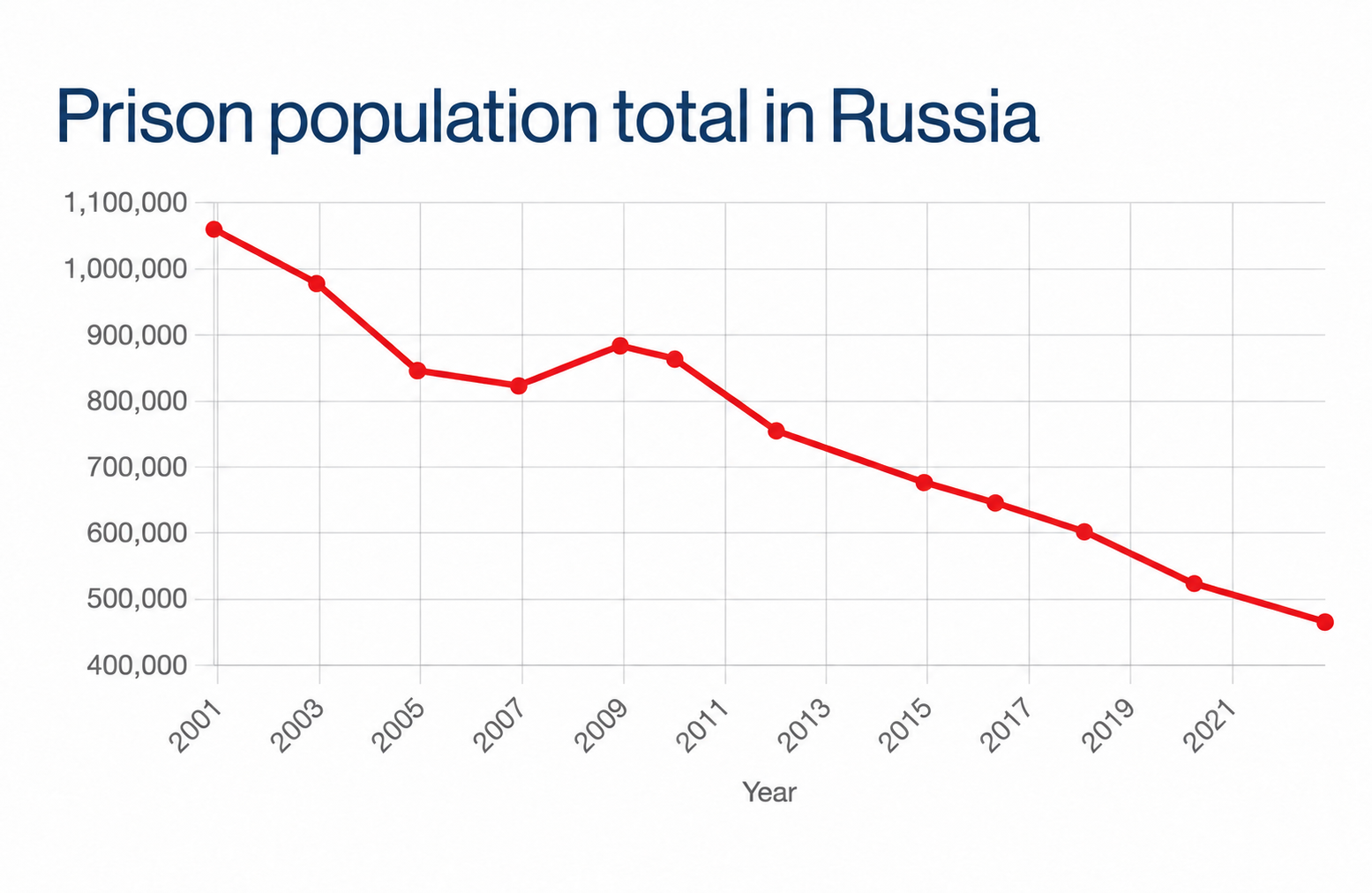
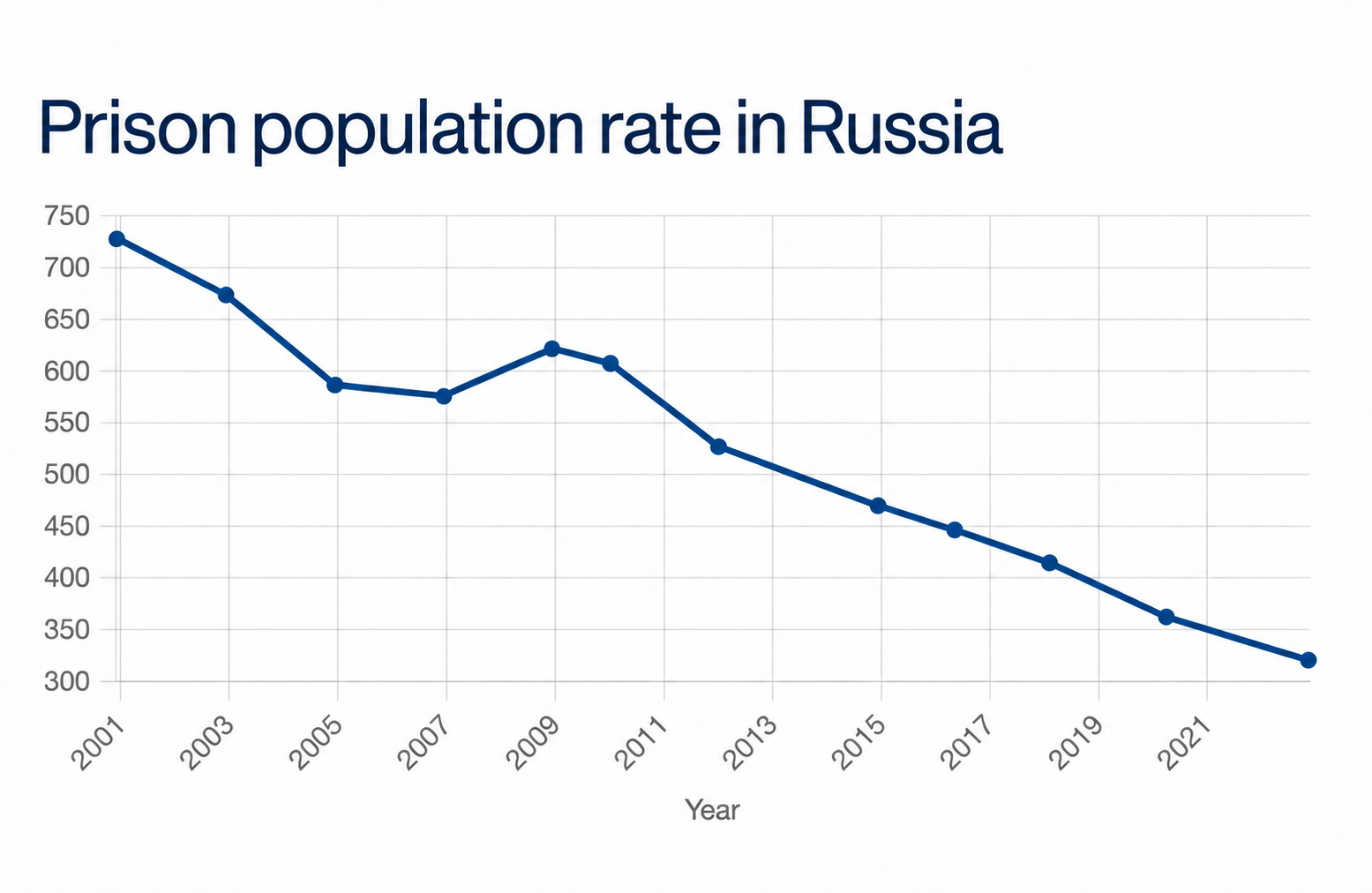
According to World Prison Brief (Institute for Crime & Justice Policy Research, University of London), the dynamics of Russia’s prison population look as follows. In 1990 there were 698,900 prisoners; in 1995, 920,685; in 2000 came the peak, 1,060,404 persons, or 729 prisoners per 100,000 of the population. This was one of the highest rates in the world. Then came a steady decline: 2004, 847,004; 2008, 883,436; 2010, 864,197; 2012, 755,651; 2014, 677,287; 2016, 646,085; 2018, 602,176; 2020, 523,928; 2022, 465,896. And, finally, as of May 2026, 282,000 persons, or 197 prisoners per 100,000 of the population.
What does this mean in comparative terms? Over a quarter of a century, Russia’s prison population has shrunk almost fourfold (from 1,060,404 to 282,000). Compared with 2012, it has fallen 2.7 times. In the last six years alone, since 2020, it has almost halved. And, most tellingly, over four years of full-scale war, from 2022 to 2026, Russia “lost” 184,000 prisoners – almost 40% of its entire prison population. The imprisonment rate fell from 729 to 197 per 100,000, that is, 3.7 times.
The dynamics of pre-trial detention are also revealing. In 2000, Russian SIZOs held 232,864 persons (160 per 100,000 of the population); in 2010, 119,010; in 2020, 104,220; in 2026, 85,000 persons (59 per 100,000). The absolute numbers are falling, but the share of remand prisoners in the overall prison population has grown from 14.5% in 2010 to 30.1% in 2026 – the highest figure of the entire twenty-first century. In other words, when the number of convicted prisoners decreased while the number of remand prisoners grew in relative terms, the repressive machine did not stop: it simply operates at a different stage, in pre-trial detention centres rather than in colonies.
And now about the infrastructure. As of March 2022, the Russian prison system comprised 872 institutions: 204 SIZOs, 642 correctional colonies, 8 prisons and 18 juvenile colonies. The official capacity of the system as of the beginning of 2021 was 714,253 places, with an occupancy rate of 67%. Today, with 282,000 prisoners, the same system is filled to approximately 40%. Put differently, more than 430,000 prison places in Russia stand empty. That is more than the entire prison population of Russia today. And it is precisely this state, in which three out of every five bunks are empty, that announces the construction of seven super-prisons for more than 20,000 places at a cost of more than one hundred billion roubles.
This is not about savings. This is a plan.
One needs to understand clearly the nature of this sharp decline. The reduction of Russia’s prison population is not the result of any policy of humanisation. On the contrary, it is an indicator of a decarceration policy of a very particular kind: the old prisons were emptied of prisoners not because the state became more merciful, but because the prisoners were sent, as part of assault battalions, to the Ukrainian front, where they were physically destroyed. The Russian prison literally “cleared itself out” for the war. The World Prison Brief figures are not statistics of humanisation; they are statistics of disposal.
And here arises a paradox that is in fact no paradox at all. Russia is a prison state. The carceral complex is not an appendage of the Russian state; it is its foundation, without which this state cannot be conceived and cannot exist. Accordingly, for the Russian authorities the construction of new prisons is a matter of self-preservation, self-development and the very existence of the Russian state. A state that has “spent” its prison population at the front cannot remain without a prison population. It must reproduce it.
But prisons need to be filled with someone. Super-prisons for twenty thousand places, with more than one hundred billion roubles earmarked for them, are not built “just like that” and will not stand empty. This means that the future of the Russian population – and it is very much to its own detriment that it refuses to understand this – is directly linked to the question of who exactly will go into these prisons. Prisons for its own citizens. Prisons for intimidation. Prisons for the prevention of dissent. Prisons for political opponents, if any remain at all. This is an openly proclaimed plan for the incarceration of the population, which the authorities do not even attempt to conceal. In the near future these institutions are to be filled – for the sake of strengthening Russian power itself.
Now about Kherson Region. One of the seven institutions is planned on temporarily occupied Ukrainian territory. This is neither a detail nor a coincidence. It is a message sent simultaneously to many addressees and in many directions. First: “we are here for a long time, if not forever”. Second: “we are strengthening our control even over those territories that some consider temporarily occupied, but which we consider ours once and for all”. A prison on occupied territory is the most explicit form of a declaration of sovereignty that a state of this type can make: not a school, not a hospital, not a road, but a prison. Prisons for citizens of Ukraine in the occupied territories are already a reality, and the new super-prison in Kherson Region merely institutionalises this practice for decades to come.
And, finally, there is one more addressee of this message – Europe. There can be no doubt whatsoever that among the future “clients” of the Russian prison system are also citizens of other countries with which Russia intends to wage war. Moreover, all of this is being done so openly, against the backdrop of calls for “gangland diplomacy” and promises to settle international matters “according to the code”, by the rules of a thieves’ gathering, that one should have no illusions whatsoever as to how this state intends to resolve its problems both with its own citizens and with those of others – using everything that the Russian prison and the Russian katorga stand on and breathe by.
Therefore, the construction of these prisons is not even about the prisons themselves, nor about the people who will fill them. It is about an open declaration to the whole world of what the Russian state is and what it will be in the foreseeable future. This message must be taken into account. I very much hope that the Western world, and Europe in particular, will see it.